
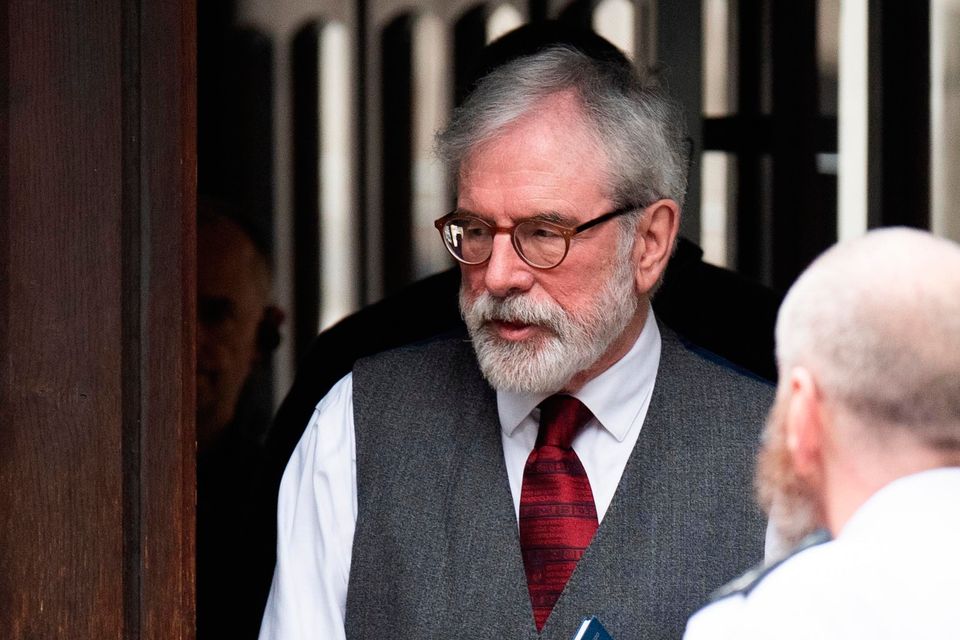
Gerry Adams took the witness stand in London’s High Court on Tuesday — St Patrick’s Day — and told the judge he had never been a member of the Provisional IRA, would never be able to say he had, and yet would not distance himself from the paramilitary organization whose members were, as he put it, his neighbors, in testimony that captured the paradox that has defined his public life for five decades and now hangs in the balance of a civil court ruling that could settle it, at least in legal terms, by week’s end.
Adams, 77, arrived at the Royal Courts of Justice wearing what appeared to be a bulletproof vest, driven directly into the court precinct under close security protection, before entering Courtroom 16 before Justice Jonathan Swift. He opened by wishing the judge “a very happy St Patrick’s Day,” a pleasantry that drew a swift correction from the bench. “This isn’t a public forum in any other sense other than for you to answer questions,” Swift told him.
In a 20-page witness statement submitted to the court, Adams set out his denial categorically: “These allegations are untrue. I was never a member of the IRA or its Army Council. I was never the commanding officer or OC of the 2nd Battalion of the IRA’s Belfast Brigade. Indeed, I have never held any rank or role within the IRA, including on the IRA’s Army Council. I have never held a command-and-control role in the IRA and have never been a senior, let alone most senior, figure in the IRA.”
Under cross-examination by Max Hill KC — a former director of public prosecutions for England and Wales acting for the claimants — Adams was asked whether he would discuss his involvement in the IRA if a truth and reconciliation process were established for the Troubles. “I can’t talk about my involvement in the IRA because I was never involved,” he said. Hill pressed him on whether he would stand by the IRA. “I don’t stand by everything they did, but yes — these were my neighbours,” Adams replied. “I’m glad that the IRA have left the stage and I’m glad that nobody else has been killed. I’m glad that there’s a peace process, but I don’t distance myself from the IRA.”
The three men who brought the civil case — John Clark, injured in the IRA’s 1973 bombing of the Old Bailey, the paramilitary’s first attack on the British mainland; Jonathan Ganesh, injured in the 1996 London Docklands attack that ended the IRA ceasefire; and Barry Laycock, injured in the 1996 Arndale Shopping Centre bombing in Manchester — are seeking a finding on the balance of probabilities that Adams was personally liable for their injuries as a senior member of the Provisional IRA and of its seven-person Army Council, which prosecutors have told the court had to authorize all attacks outside Northern Ireland. They are each seeking symbolic vindicatory damages of £1. Adams was moved to turn and face Barry Laycock in court, telling him he was “extremely moved” by the claimant’s testimony during the week-long hearing.
The evidentiary case the claimants have assembled over five days of witness testimony before Adams took the stand was substantial, though Adams’s defense lawyers dispute its legal weight. A senior former officer of the Police Service of Northern Ireland’s Special Branch, testifying from behind a screen under court-ordered anonymity as Witness B, told the court that Garda intelligence placed Adams at IRA Army Council meetings in the Republic of Ireland on multiple occasions and that it was “unthinkable” that bombs could have been set off outside Northern Ireland without the sanction or explicit instruction of the Army Council. “The IRA was a very disciplined organisation and was utterly ruthless in its enforcement,” he said.
Read Also: Ireland Starts Vote In Three Horse Race To Form Next Govt
A former RUC Special Branch officer told the court that intelligence reports he had seen stated Adams “was a senior member of the IRA Army Council and the de facto leader of the IRA.” Journalist John Ware, who spent decades reporting on the Troubles for the BBC and ITV and whose evidence was given for what he described as public interest reasons, told the court he believed Adams had been a member of the IRA Army Council for more than 30 years from the late 1970s. He said IRA members he interviewed over the years were angered by Adams’s repeated public denials of membership. He suggested Adams may have “spectacularly deluded” himself about his own status. The court was also told that former US President Bill Clinton believed there was “credible evidence” that Adams was involved in the IRA at “the highest level” in the 1990s.
Adams’s legal team challenged the evidentiary foundation of the prosecution’s case, noting that none of the individuals alleged to have authorized, planned, or carried out the 1973 and 1996 bombings appeared as a witness; that no contemporaneous documents, forensic evidence, or scientific material implicating Adams had been produced; that not a single page of the intelligence reports referred to by multiple witnesses had been disclosed to the court in its classified form; and that the burden of proof remained with the claimants, not with Adams.
Read Also: Sinn Fein Becomes Ireland’s Second Largest Party
“The defendant does not bear the onus of proving anything. In particular, he is not required to prove a negative,” his skeleton argument stated.
Adams’s defenders on the peace process question have long argued that whatever his relationship was with the IRA — a question many in Ireland, Britain, and the United States treat as settled fact regardless of his denials — his role in producing the 1998 Good Friday Agreement was indispensable. The agreement, signed after years of negotiations involving Adams, Sinn Fein, the unionist parties, the Irish and British governments, and the Clinton administration, brought three decades of sectarian violence to a close. It remains the foundational political architecture for governance in Northern Ireland. Adams told the court he had engaged with SDLP leader John Hume on outreach to the unionist community and that all of this work had “led to the cessation in 1994 because we were able to impress there was an alternative.”
The trial commenced on March 9 and is estimated to run until March 17 — meaning a judgment could follow within weeks of the close of evidence. It is a civil proceeding rather than a criminal one, meaning the verdict will be decided by Justice Swift on the balance of probabilities. No jury is involved. If Adams loses, he will be required to pay £1 to each of the three claimants. If he wins, the legal finding will stand as the sole formal judicial determination ever made on the most consequential allegation in Irish political history.