
The Philippines on Monday flatly rejected China’s claim to sovereignty over the South China Sea, dismissing a Chinese embassy assertion that a Filipino diplomat had once acknowledged that the disputed Scarborough Shoal did not belong to Manila — and warning Beijing that territorial claims are settled through international law, not social media posts.
Foreign ministry spokesperson Rogelio Villanueva told reporters the Philippines held “indivisible, incontrovertible and longstanding sovereignty” over Scarborough Shoal and the islands Manila controls in the Spratly archipelago. The statement was a direct response to a weekend post by the Chinese embassy in Manila citing a former Philippine ambassador’s remarks to a German radio station as evidence that even Filipino officials had privately conceded the shoal was not Philippine territory.
“China must be reminded that maritime and territorial claims are subject to established international legal procedures and dispute settlement mechanisms, not through unilateral proclamations or social media posts,” Villanueva said.
Read also: Trump To Ease Oil Penalties As Iran Conflict Shakes Markets
The Chinese embassy pushed back the same day. Spokesperson Ji Lingpeng denied that Beijing had ever claimed the entirety of the South China Sea as its sovereign territory and accused Manila of deliberate distortion. “The Philippine side’s deliberate distortion of China’s position is unconstructive and has no merit,” Ji said in a statement.
The exchange is the latest round in an increasingly pointed public argument between Philippine officials and the Chinese embassy, one that has moved from formal diplomatic channels onto social media platforms where both sides now regularly trade accusations before a regional and global audience. The shift in arena has not softened the substance — if anything, the public nature of the dispute has hardened positions on both sides, giving each government’s domestic audience a ringside seat to confrontations that might once have been managed quietly.
Read also: China Drone Found Faking Aircraft IDs Over South China Sea
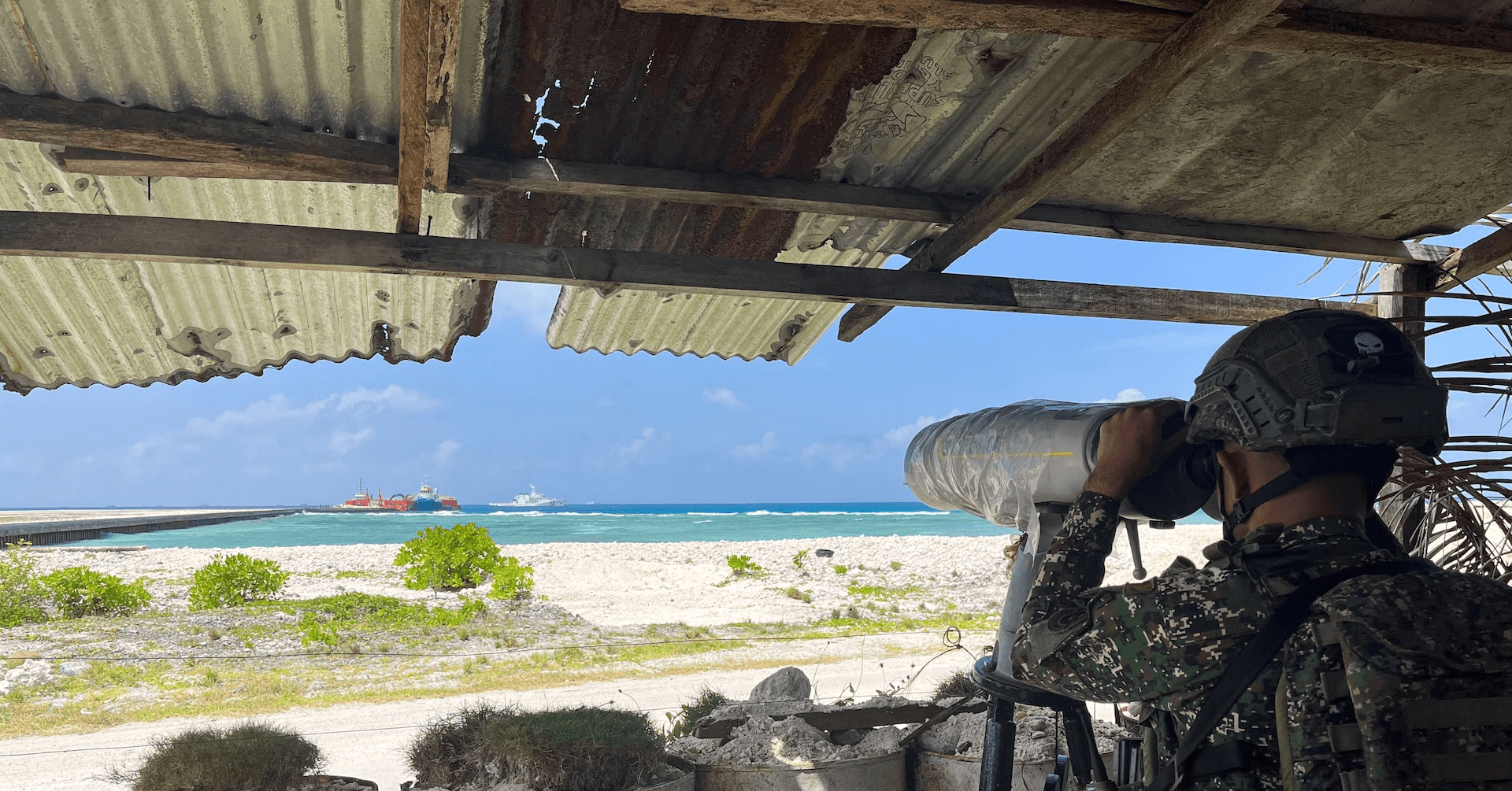
At the physical centre of the dispute sits Scarborough Shoal, a small but strategically significant atoll located 200 kilometres off the Philippine coast and firmly within Manila’s exclusive economic zone. China’s coast guard has maintained a continuous presence there since 2012, exercising de facto control without formal sovereignty ever having been legally established. The shoal’s value is not sentimental: it sits astride major shipping lanes, offers rich fishing grounds, and provides a natural harbour where vessels can shelter during storms. Its location inside the Philippine EEZ makes China’s effective occupation a daily affront to Manila under the terms of international maritime law.
“Sovereignty is not merely claimed, it is exercised,” Villanueva said — a pointed formulation that cuts both ways, acknowledging China’s physical presence on the shoal while asserting that presence confers no legal standing.
The legal architecture underpinning Manila’s position was established nine years ago. In 2016, the Permanent Court of Arbitration ruled that China’s sweeping historical claim to most of the South China Sea — demarcated by the so-called nine-dash line — had no basis under international law.
The ruling was a complete victory for the Philippines on the central question of Chinese maritime entitlement. Beijing rejected it immediately and has continued to reject it, treating the decision as illegitimate and proceeding as though it does not exist.
That gap between the legal record and the physical reality on the water defines the daily texture of the dispute. Philippine vessels attempting to resupply troops stationed on features Manila controls in the Spratlys have repeatedly been met by Chinese coast guard ships deploying water cannons, blocking manoeuvres and, in some incidents, seizure of supplies and equipment. Manila has characterised these actions as dangerous and illegal. Beijing has described its coast guard as acting professionally within what it considers its own territorial waters.
The incidents have accumulated steadily over the past several years, each one individually managed but collectively building a picture of a relationship under sustained stress. The Philippines under President Ferdinand Marcos Jr. has taken a markedly more assertive public posture toward China than his predecessor Rodrigo Duterte, who cultivated warmer ties with Beijing and largely downplayed maritime confrontations. Marcos has moved to deepen security ties with the United States and has been more willing to publicise Chinese actions that previous administrations might have handled through quiet protest.
China’s approach has been to contest every Philippine statement publicly and at length, using its embassy’s social media accounts to challenge Manila’s historical and legal claims in real time. The invocation of the former ambassador’s radio interview — apparently surfaced from years-old material — suggests Beijing is actively mining the historical record for ammunition to use in the information dimension of a dispute it cannot win in court.
The 2016 arbitration ruling remains the definitive international legal statement on Chinese claims in the South China Sea. Its findings bind the Philippines and China under the UN Convention on the Law of the Sea, to which both are signatories.
China’s refusal to accept the ruling has created a situation in which the legal outcome and the strategic reality point in opposite directions — with Philippine fishermen still unable to freely access waters an international tribunal confirmed are theirs, and Chinese coast guard vessels still stationed at a shoal the same tribunal found China has no right to control.