
The modern world does not lack belief. It lacks ballast. We are surrounded by declarations, identities, moral performances, ideological uniforms, and public ceremonies of conviction, yet what is missing almost everywhere is interior weight. Our age is fluent in the rhetoric of seriousness but deeply uncomfortable with its demands. We say much, display more, and endure very little. The result is a civilization crowded with professions of faith and starved of fidelity.
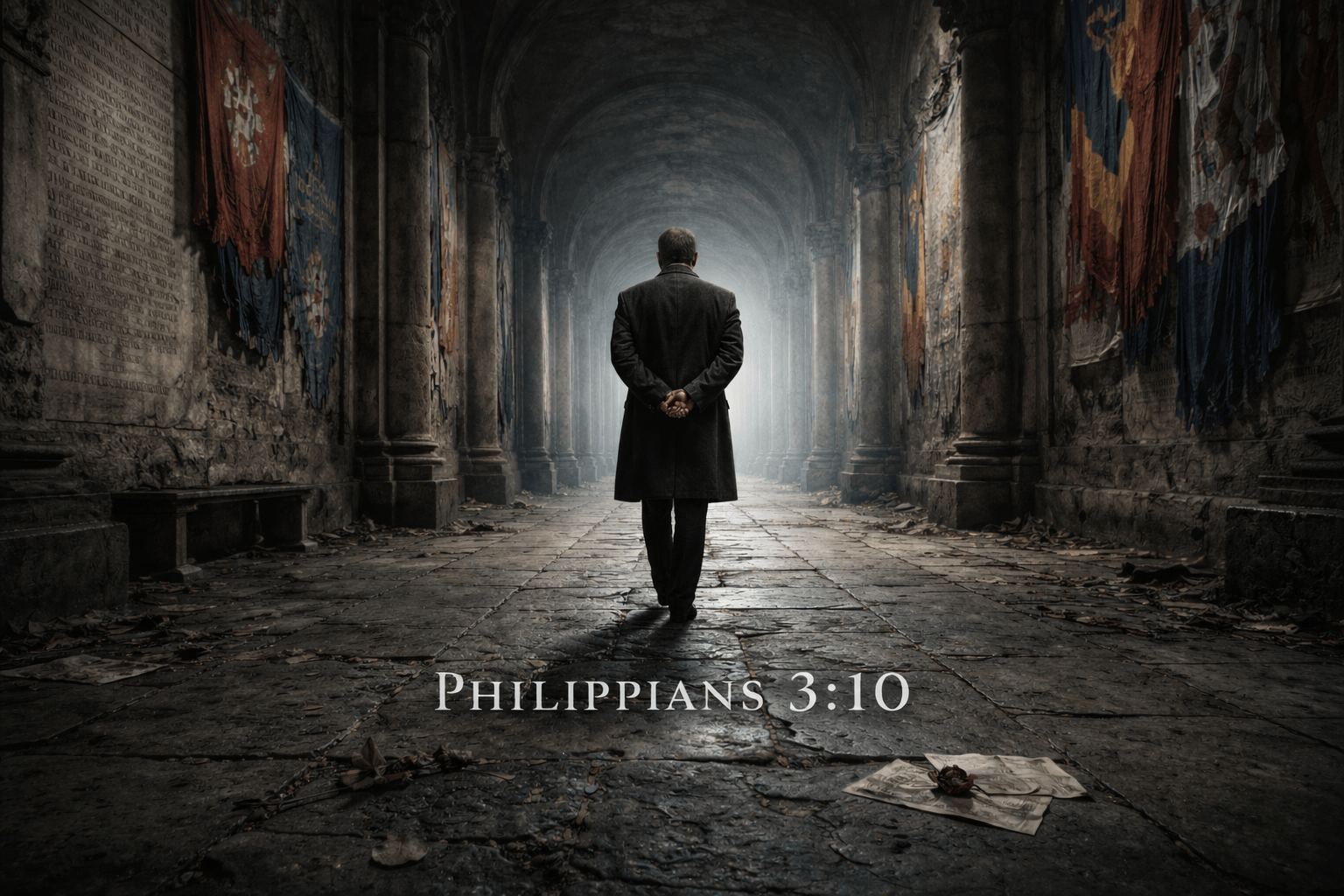
That is what provides Philippians 3:10 its enduring force: “That I may know him.” It is one of those rare lines that sounds almost scandalous in a culture addicted to easy certainty. It does not announce possession. It expresses pursuit. It does not perform on arrival. It confesses longing. In a single phrase, it cuts through the vanity of inherited religion, public piety, and moral exhibitionism. It speaks from a posture now increasingly rare: the humility to admit that truth must be sought, suffered, and lived before it can be claimed.
Whatever one believes theologically, that verse survives the collapse of shallow belief because it names something larger than religion. It names the discipline of serious seeking. It refers to the refusal to confuse affiliation with understanding. It names the difference between merely belonging to a tradition and being transformed by what one claims to believe.
Years ago, after my first doctorate in Strategic Management and Leadership, I renounced Christianity. That decision did not come from cynicism, emotional injury, or fashionable disbelief. It came from inquiry. It came from comparisons, research, and a growing conviction that organized religions often operate less as literal maps of the cosmos than as layered allegories through which human societies encode meaning, fear, hierarchy, morality, hope, and control. That argument has its own place. What matters here is a simpler point: one can abandon institutional religion and still find that certain texts remain alive because they speak not merely to dogma but to the aboriginal framework of human seriousness.
Read also: Iran’s Path To Washington—Intro
Philippians 3:10 is such a text.
Its power lies partly in what it does not do. It does not congratulate the believer. It does not flatter the faithful. It does not offer the comforting illusion that truth is something one inherits automatically through membership, ritual, or identity. Paul writes instead in the grammar of incompletion. He is still reaching. Still seeking. He continues to submit himself to a reality that surpasses self-affirmation. And that is precisely what makes the verse an indictment of our age.
We inhabit a culture that prizes the appearance of certainty over the labor of understanding. We prefer conclusion to inquiry, posture to formation, and affiliation to character. People want to be seen as principled without undergoing the disciplines that principle requires. Institutions want moral prestige without moral cost. Leaders invoke service while pursuing appetite. Communities celebrate honesty abstractly and punish it concretely. In nearly every sphere of life, the distance between profession and practice has become one of the fundamental facts of public existence.
This is not only a religious failure. It is political, intellectual, and civilizational. The politician praises sacrifice while insulating himself from consequence. The academic speaks of truth while bending to tribe and fashion. The citizen condemns corruption while making private peace with small dishonors. The activist demands justice while excusing falsehood on behalf of the right cause. The preacher proclaims righteousness while living for status. Everywhere, language has grown larger than character.
That is why the crisis of our time is not merely ignorance. Ignorance can sometimes be corrected. The more profound problem is disloyalty to what we already know. We know that truth matters, yet we manipulate it. We know that discipline matters, yet we evade it. We know that integrity matters, yet we treat it as ornamental rather than binding. We know that depth requires sacrifice, yet we still seek the rewards of seriousness without paying its price.
In that sense, “that I may know” is not a pious phrase. It is a rebuke. It confronts the superficiality of modern identity and asks whether we actually want truth enough to be changed by it. Not admired for it. Not associated with it. Changed by it. That is a far harder proposition. To know, in the deepest human sense, is never merely to collect information. It is necessary to submit oneself to discipline, contradiction, correction, and sometimes loss. It is to permit truth to wound illusion.
Read more: Why The Wealth Of New York & Europe Still Echoes Africa’s Poverty
And this is why so many today, especially within the Abrahamic traditions they loudly invoke, appear unfaithful, not because they lack religious vocabulary, but because they have mistaken profession for fidelity. They defend doctrine yet abandon honesty. They invoke God yet worship power, convenience, tribe, or status. They inherit moral language but evade moral transformation. Their crisis is not unbelief. It is incoherence.
The real question, then, is not whether people still pray, preach, attend, or identify. Those are easier things. The real question is whether we can still live faithfully in an age that rewards display and punishes inward seriousness. Whether we can still resist the seduction of performance. Whether we can still pursue what is true with enough rigor to let it reorder our desires, restrain our vanity, and expose our fraud.
That is why Philippians 3:10 still matters. Not because it props up religion, but because it tests the human capacity for fidelity. It asks whether we remain capable of living beyond spectacle. We must consider whether we can still seek, still submit, and still be inwardly governed by something other than appetite and applause.
It is, finally, not a question about religion alone. It is a question about whether any civilization can remain morally serious after it has turned conviction into theater.
That may be one of the defining questions of this generation.