
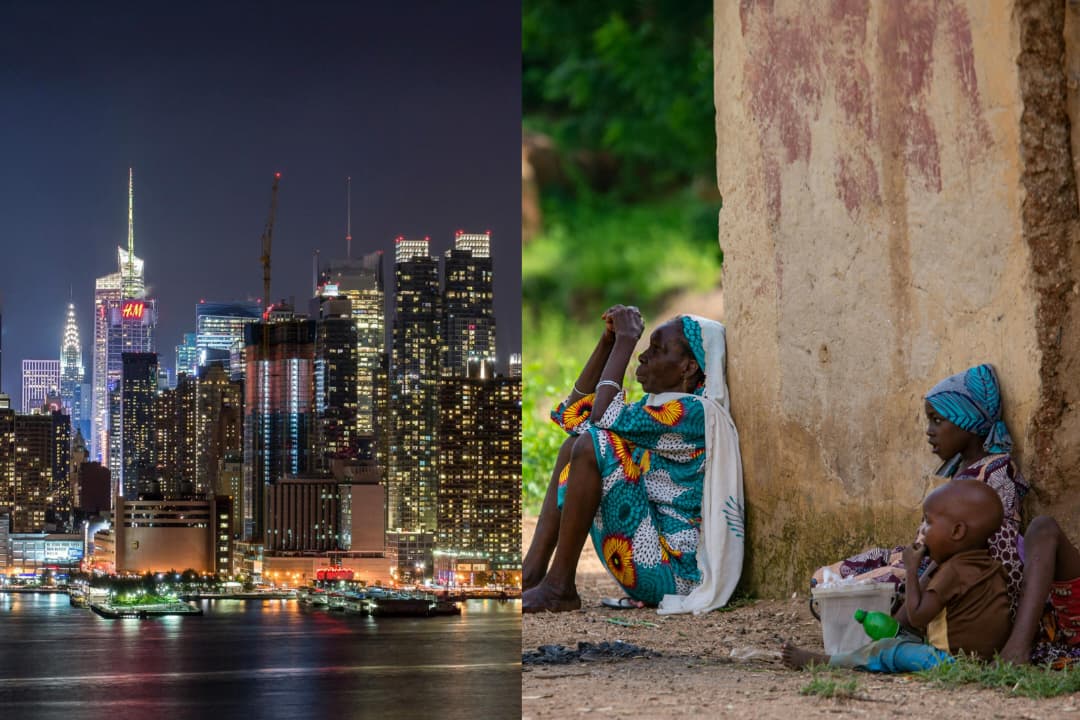
New York glitters. So do London, Paris, Brussels—cities that wear certainty like a tailored coat. Their skylines are disciplined, their subways obedient, their museums heavy with artifacts and confidence. To the casual eye, they look like civilization perfected: polished stone, calibrated clocks, money moving like blood through clean veins.
But the world has grown too comfortable admiring the shine without asking the oldest question in economics:
Who paid for it?
Modern Western prosperity is often narrated as self-generated—innovation, industriousness, institutions, the myth of a closed loop where wealth is born, raised, and kept at home. Those forces matter. Yet the story is incomplete to the point of dishonesty. Much of what became “capital” in Europe—and later the industrial fuel for American dominance—was not conjured from genius alone. It was accumulated through a global system that treated Africa as quarry, plantation, and warehouse: a place where labor could be coerced, land could be seized, and value could be priced as cheaply as human dignity.
This is not sentimentalism. It is accounting.
Africa is not poor because it lacks worth. Africa is poor, in too many places, because worth has been systematically removed, discounted, captured, or controlled—first through direct violence, then through more elegant mechanisms. Gold, diamonds, cocoa, rubber, timber, oil, cobalt, coltan—these were never merely commodities. They were structural inputs: the raw materials that built factories, financed banks, stabilized currencies, and expanded empires. The framework of Western wealth did not rise in spite of Africa’s extraction. In many cases, it rose through it.
And when the flags came down, the pattern did not vanish. It changed uniforms.
Colonial governors left; contractual governors arrived. Occupation became “investment climate.” Plunder became “terms of trade.” Coercion became debt, conditionalities, and the quiet power of asymmetric negotiation. The language softened. The outcome often stayed familiar: Africa exports raw value, then imports finished dependence—at a premium.
Consider the cruelty embedded in the supply chain. Countries export crude oil and import refined fuel, paying for the privilege of using their own resource. They export cocoa and import chocolate brands, watching value multiply elsewhere. They export lithium and cobalt and then buy batteries, watching technology—and the profits that follow it—consolidate offshore. In this arrangement, Africa is permitted to lay the foundation, but rarely allowed to own the skyscraper.
That is why the contrast is not merely ugly; it is revealing. A traveler can move from the geometric efficiency of Manhattan to a mineral-rich African community where the roads fracture, schools lean, clinics ration, and children memorize ambition under roofs that leak. The problem is not that New York or Europe should not prosper. The problem is that global prosperity has been narrated in a way that treats African deprivation as a natural condition—like weather—rather than a designed outcome of incentives and power.
It is not natural.
It is engineered.
Read also: Beyond Benin Bronzes: Britain’s Looting Of Nigeria Today—Epilogue
But a serious conversation cannot stop at external extraction. If we are honest about the global system, we must also be honest about local stewardship. Africa’s poverty in the present cannot be explained solely by the crimes and contracts of the past. It is also sustained by internal failures that have become their own machinery: elite capture, corruption, policy inconsistency, weak institutions, insecurity, and the betrayal of public trust by leaders who behave as if the state were a private inheritance.
So yes—gold streets elsewhere carry fingerprints from Africa’s extraction. But broken roads at home can also carry fingerprints from Africa’s complicity.
This double truth is uncomfortable, which is precisely why it matters. It prevents the laziness of single-cause blame. It also clears the path to the only question that matters:
What would power look like—practically—if Africa decided to stop being a source and start being a system?
The answer is not poetry. It is strategy.
First, Africa must renegotiate value, not merely volume. Shipping more raw material is not development; it is faster dependency. The continent must prioritize processing, refining, manufacturing, and regional industrial ecosystems—because value is not in what you extract, but in what you transform.
Second, governance must become developmental, not ceremonial. States cannot remain rent managers—collecting from extraction while citizens survive on improvisation. Public institutions must be designed to convert national wealth into public goods: power, roads, schools, healthcare, research capacity, and productive jobs. Nations are not built by speeches. They are built by boring competence repeated for decades.
Read more: Jesus And Muhammad Are Sacred—So Why Not Fela?
Third, Africa must build negotiation intelligence as a national asset. Many countries lose not because they lack resources, but because they sign weak contracts, lack technical expertise, or negotiate under geopolitical pressure with inadequate leverage. In the modern world, legal capacity and data capacity are as valuable as minerals. A poor contract can drain a nation more efficiently than a thief.
Fourth, Africa must invest in its people as strategic infrastructure, not political audiences. Youth is not an advantage by itself; it is a liability without education, health, skills, and opportunity. With those investments, Africa’s demographic rise becomes the engine of the century. Without them, it becomes a reservoir of frustration waiting for a match.
Finally, the global system must be challenged—but not with slogans. With coalitions, policy leverage, and disciplined demands: beneficial ownership transparency, anti–tax haven enforcement, debt justice, fairer trade rules, ethical supply chains that are audited rather than advertised. Justice in the global economy is not a moral decoration; it is a practical condition for stability.
The shine of New York and Europe is real. So is the shadow beneath it.
If some streets gleam as if painted in gold while the places that supplied the pigment remain stripped, then what we are witnessing is not civilization at its finest. It is a sophisticated façade built over an unfinished moral account.
The task of this generation is not to hate the gold. It is to ask, without flinching: who paid for the paint, who is still paying, and what would it take—economically, politically, institutionally—for the bill to finally be settled?
Until then, the glitter will remain impressive.
And incomplete.