
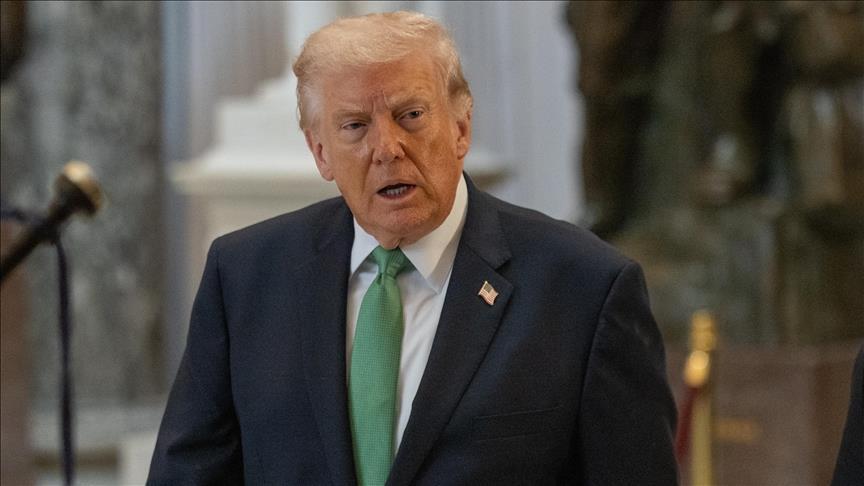
The United States and Israel struck Iran’s Natanz nuclear enrichment facility for the second time in three weeks on Saturday, even as President Donald Trump posted on social media that the United States was “considering winding down” its military campaign — a message delivered the same morning that Israel’s defense minister announced strikes would intensify significantly in the week ahead and as 2,500 additional Marines steamed toward the region with no publicly disclosed mission.
Iran’s Atomic Energy Organization confirmed that the Shahid Ahmadi Roshan enrichment complex at Natanz was “targeted this morning,” stating that “no leakage of radioactive materials” had been reported at the site in central Iran, approximately 220 kilometers southeast of Tehran.
The facility had already been struck in the first week of the war, and satellite images from that earlier attack showed several buildings damaged. The IAEA said it had been informed by Iran about the strike, confirmed “no increase in off-site radiation levels,” and said it was looking into the incident.
Director-General Rafael Grossi repeated his call “for military restraint to avoid any risk of a nuclear accident.” Israel’s military said it was unaware of Israeli strikes in the Natanz area. Russia, which has positioned itself as a diplomatic mediator, condemned the attack as “a blatant violation of international law.”
The strike on Natanz came as Trump offered his most explicit language yet about ending American involvement, even while conditions on the ground pointed in the opposite direction.
“We are getting very close to meeting our objectives as we consider winding down our great Military efforts in the Middle East with respect to the Terrorist Regime of Iran,” he posted on Truth Social. He listed as achievements the degradation of Iran’s missile capabilities, the destruction of its navy and air force, the dismantling of its anti-aircraft systems, and the destruction of its nuclear capability. He then added that the Strait of Hormuz would henceforth have to be “guarded and policed, as necessary, by other Nations who use it — The United States does not!” He offered to help if asked, but said it “shouldn’t be necessary once Iran’s threat is eradicated.”
Within hours of that statement, Israel’s Defense Minister Israel Katz directly contradicted its tone.
“This week, the intensity of the strikes to be carried out by the IDF and the US military against the Iranian terror regime and the infrastructure on which it relies will rise significantly,” Katz said in a video statement on Saturday. He added that Israel was “determined to continue leading the attack against the Iranian terrorist regime, to behead its commanders and to thwart its strategic capabilities.”
The divergence between Trump’s wind-down language and Katz’s escalation statement — issued within the same morning — reflected the contradictory signals that have characterized the war’s management from Washington and Jerusalem since it began on February 28.
U.S. Central Command chief Admiral Brad Cooper released a video assessment on Saturday, stating that American forces had struck 8,000 military targets including 130 Iranian naval vessels since the war began.
“Their Navy is not sailing, their tactical fighters are not flying and they have lost the ability to launch missiles and drones at the high rates seen at the beginning of the conflict,” Cooper said, adding that his operational assessment was that “Iran’s combat capability is on the steady decline as our offensive strikes ramp up.” Cooper separately disclosed that the United States had dropped “multiple 5,000-pound bombs” on an underground weapons storage facility on Iran’s coastline to degrade its military presence near the Strait of Hormuz.
Read Also: War-Hit Gulf Nations Secure $16bn In US Military Hardware
The IAEA’s assessment of Iran’s nuclear status provides a complicating counterpoint to the administration’s declared success. IAEA Director-General Grossi told NPR this week that Iran’s physical nuclear facilities have suffered “enormous degradation” but that “most probably, at the end of this military conflict, the material will still be there and the enrichment capacities will be there, perhaps some infrastructure will still be there.”
Iranian sources indicated that Tehran currently holds approximately 400 kilograms of highly enriched uranium — material that, if further processed, could in principle be configured toward weapons use.
The war reached a new geographic boundary on Saturday. Iran fired two intermediate-range ballistic missiles at Diego Garcia, the joint U.S.-British military base in the Indian Ocean — the first time Tehran has used such missiles to strike at a target beyond the Middle East. Neither missile hit the base. A UK official confirmed the “unsuccessful targeting” to AFP. The attack demonstrated both the range of Iran’s remaining missile inventory and the limits of its accuracy at extended distances — a data point carrying implications for both the military balance and for the insurance value of the CENTCOM asset that has been a central logistics node throughout the war.
Iran also resumed natural gas supplies to Iraq at a rate of five million cubic meters per day, according to the Iraqi electricity ministry — flows that had been suspended after Israel struck South Pars earlier in the week. Iran’s IRGC spokesperson separately stated that Tehran was still actively building missiles despite the ongoing bombardment, dismissing Israeli claims that its production capacity had been eliminated.
Read Also: UN Chief Claims Cooperation With Trump’s Gaza Peace Board
Congressional unease about the war’s direction and objectives continued to crystallize. Senator Thom Tillis, a North Carolina Republican, told the Associated Press: “The real question is: What ultimately are we trying to accomplish? There has to be a kind of strategic articulation of the strategy, what our objectives are.”
The toll on the U.S. military stands at 13 personnel killed and more than 230 wounded. A $200 billion Pentagon supplemental funding request for the war is pending at the White House, and thousands of additional troops are deploying with no stated endgame.
The European Commission separately urged EU member states to lower their natural gas storage targets for the coming months to alleviate price pressures caused by the war, as European gas benchmark prices remained more than double their pre-war levels. Iran’s Foreign Minister Abbas Araghchi told Japanese media outlet Kyodo that Tehran was “ready to listen and to consider” proposals aimed at bringing the conflict to “a complete end,” while adding that “it does not appear that the United States is prepared to halt its aggression” — the clearest signal yet from Tehran’s foreign ministry that diplomatic channels, if opened, would find a receptive audience on the Iranian side.
No ceasefire framework is under active consideration by any party. No mediating country has announced a formal diplomatic initiative. The war enters its fourth week.