
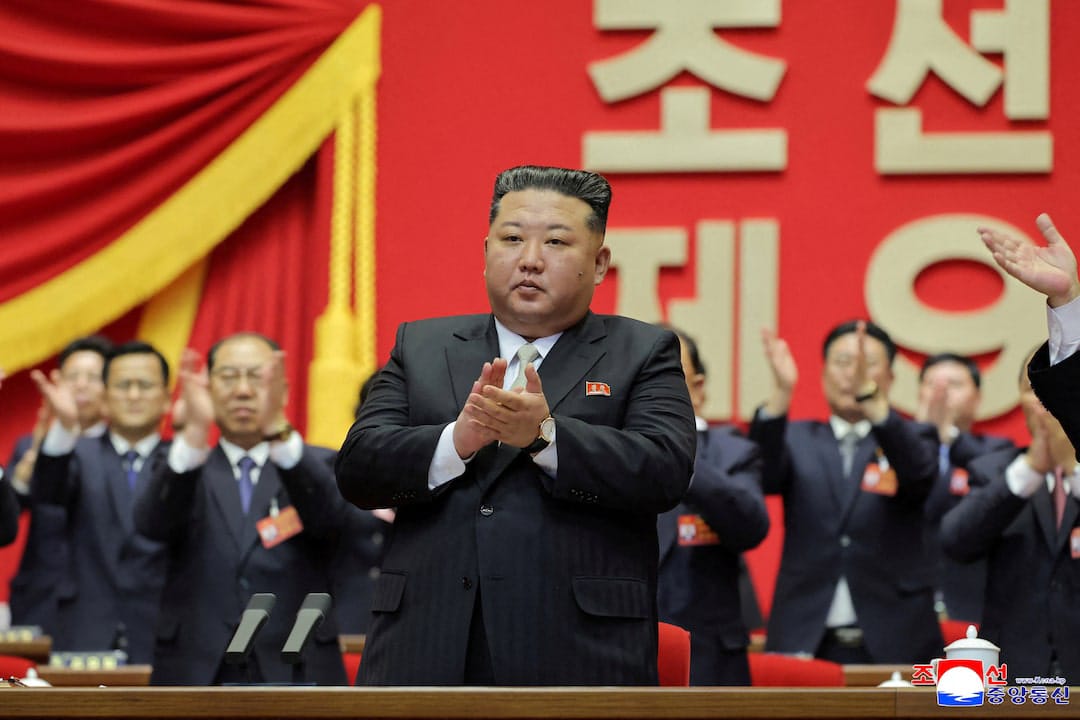
Kim Jong-un was formally reappointed president of North Korea’s state affairs commission Sunday, extending his grip on the country’s highest state post into a third consecutive term while his parliament enacted a series of measures flowing from last month’s ruling party congress — including constitutional revisions whose content the government declined to disclose.
The Supreme People’s Assembly, North Korea’s rubber-stamp legislature, convened its first session of a new parliamentary term to ratify appointments and legislation that in practice had already been determined by the Korean Workers’ Party congress. The sequence is standard Pyongyang procedure: the party decides, the parliament legislates. State media reported the reappointment Monday through the Korean Central News Agency, which quoted party secretary Ri Il-hwan describing Kim’s leadership as “per se the strongest national power” of the state.
Kim has held the state affairs commission presidency since the body was created in 2016 to serve as the country’s top policy guidance organ, replacing the earlier National Defence Commission as the apex of formal state authority.
The commission’s role is to translate party directives into government action across military, economic and foreign policy — making its presidency, held by the same man who leads the party and commands the military, a largely symbolic but constitutionally significant consolidation of authority in a single person.
The more consequential personnel movement may be the elevation of Jo Yong-won to chairman of the SPA standing committee, the parliament’s top administrative post. Jo, regarded by analysts as one of Kim’s closest and most trusted aides, replaces Choe Ryong-hae — a figure who had held the position and represented a slightly older generation of the leadership. The change continues a pattern of Kim installing loyalists from his inner circle into positions that control the flow of legislation and parliamentary business.
Ri Son-gwon, a former point man on inter-Korean relations known for his hardline positions during negotiations with Seoul, and party director Kim Hyong-sik were named vice chairmen of the standing committee. Premier Pak Thae-song retained his position, while former Premier Kim Tok-hun was appointed to a newly created post of first vice premier — a structural addition that analysts will examine for clues about how economic governance responsibilities are being redistributed.
Read also: Beijing-Pyongyang Train Resumes After Six-Year Halt
The session also produced a notable absence. Kim Yo-jong, the leader’s sister and one of the most powerful figures in North Korea’s political system, was removed from her membership of the state affairs commission. The removal almost certainly does not reflect a diminution of her actual influence — she has operated as a major policy voice, particularly on inter-Korean and foreign affairs, regardless of her formal titles. North Korean leadership positions frequently understate the real power of figures close to Kim, and her removal from a formal body may simply reflect a reorganisation of how that power is channelled rather than any change in its magnitude.
The session discussed constitutional revisions, the state budget for 2026 and measures to implement a five-year national development plan unveiled at the party congress.
None of the substantive content of the constitutional changes was disclosed through state media, a silence that has drawn significant attention from analysts focused on how North Korea is legally encoding its dramatically hardened posture toward South Korea.
Kim declared last year that the two Koreas constitute “two countries hostile to each other” — a formulation that represented a fundamental break from decades of official North Korean policy that had at least nominally maintained peaceful reunification as a national goal. Experts widely anticipate that Sunday’s constitutional revisions may have removed the unification principle from the foundational law entirely, legally cementing what Kim’s declaration established politically. Whether that change will eventually be confirmed through state media, or whether Pyongyang will leave it deliberately ambiguous, remains unclear.
The significance of such a revision, if made, extends beyond symbolism. North Korea’s constitution has historically functioned as a signal of ideological direction — changes to it indicate not merely current policy but the framework within which future decisions will be made. Removing reunification as a constitutional principle would close off, at least formally, an entire category of diplomatic engagement that had periodically served as the basis for inter-Korean talks, confidence-building measures and international negotiations over the peninsula’s security architecture.
Read also: U.S. Charges 30 More In Minnesota Anti-ICE Church Protest
The timing places the constitutional question against the backdrop of a region under acute stress. The Iran war has consumed the attention of the United States and its key allies, tightened the focus of American military assets on the Middle East, and produced exactly the kind of great-power distraction that analysts have long identified as creating space for North Korean provocations or policy shifts. Whether Pyongyang is timing its domestic consolidation to exploit that window, or simply proceeding on its own internal schedule, the international community’s capacity to scrutinise and respond is currently limited.
Kim emerges from Sunday’s session with his formal authority reconfirmed, his legislature aligned, and his constitutional framework — whatever it now contains — updated to reflect a worldview that has moved steadily away from engagement and toward the institutionalisation of permanent hostility as the defining condition of Korean peninsula politics.