
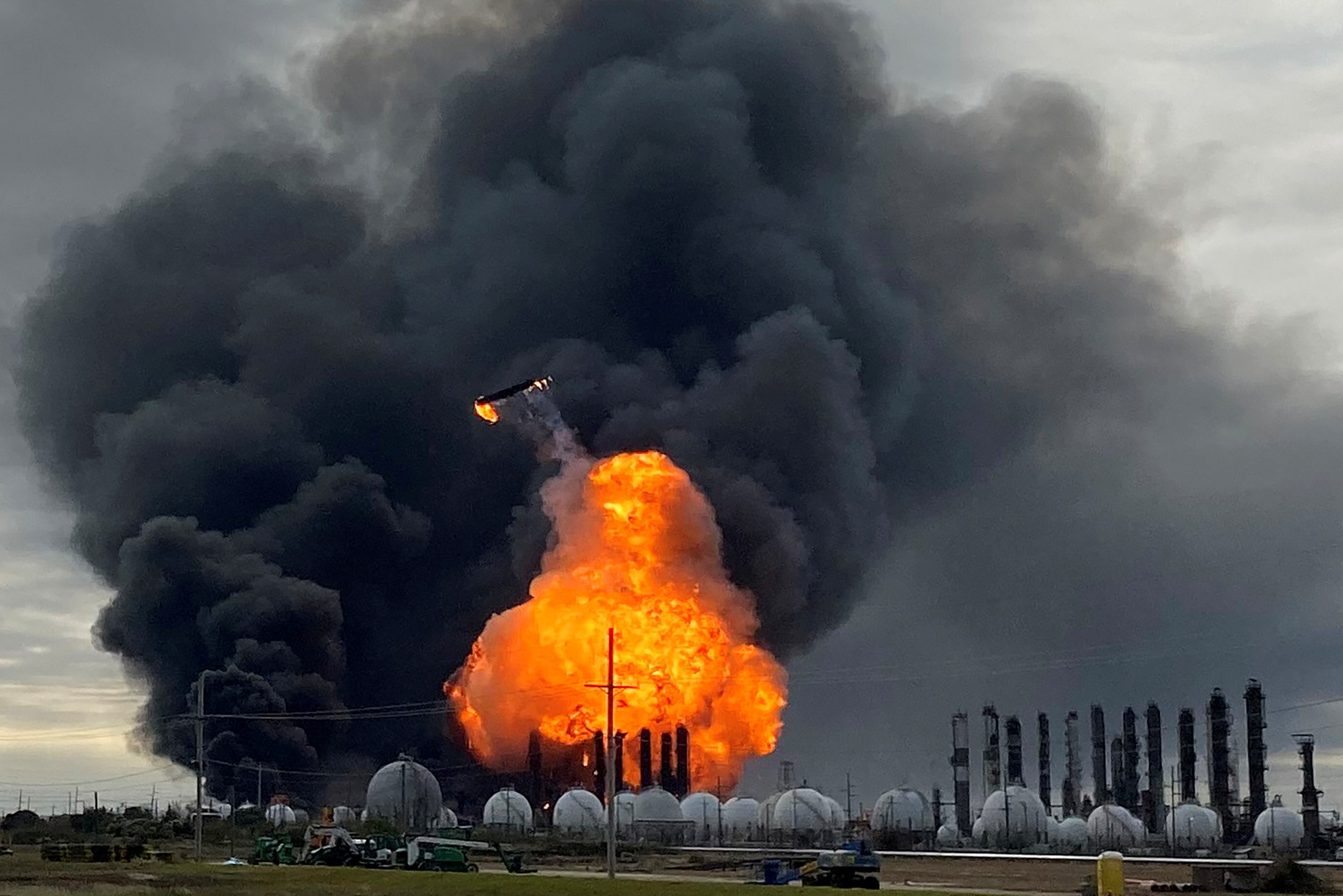
An explosion tore through the Valero oil refinery in Port Arthur, Texas on Monday, sending towering columns of black smoke into the Gulf Coast sky and triggering shelter-in-place orders for nearby residents — an industrial emergency that arrived at one of the worst possible moments for American energy markets already destabilised by war in the Middle East.
No injuries were reported. Port Arthur Mayor Charlotte M. Moses confirmed the explosion and said firefighters were on scene working to contain the fire. “There’s been an explosion, yes, but we’re OK; everybody’s OK,” she said, urging residents on the city’s west side to remain indoors until emergency personnel issued an all-clear. Images and videos circulating online showed massive flames and dense smoke billowing from the complex, with some residents reporting hearing a loud boom and feeling their windows shake from the force of the blast.
The refinery is one of the largest and most consequential in the United States. Understanding what it does — and what its disruption means — requires a brief look at how oil refining works and why this particular facility matters.
Crude oil extracted from the ground is not directly usable as fuel. It is a complex mixture of hydrocarbons that must be separated, broken down and chemically transformed into the products that power vehicles, aircraft and industrial operations. The Port Arthur Valero refinery is specifically designed to process heavy sour crude — a lower-grade, high-sulphur variety of oil that is cheaper to acquire but technically demanding to refine. The plant uses a combination of heat-driven distillation and catalytic cracking to break the crude’s large hydrocarbon molecules into smaller, more valuable ones, ultimately producing gasoline, diesel and jet fuel at a rate of approximately 435,000 barrels per day.
That daily output figure is not abstract. It represents a significant share of the refined fuel supply feeding the American South and Southeast. The facility employs around 770 workers and operates continuously — refineries of this scale do not simply pause and resume. Any unplanned shutdown triggers a cascade of supply adjustments across the distribution network that connects refineries to terminals, pipelines to fuel stations, and fuel stations to the vehicles of millions of Americans.
Read also: Dangote Slashes Fuel Price ₦100, Now ₦1,075 Per Litre
Monday’s explosion occurs against an energy market already under acute stress. The US-Israeli war on Iran has disrupted Persian Gulf oil flows and pushed crude prices above $110 a barrel. Iran’s near-closure of the Strait of Hormuz — through which approximately one-fifth of the world’s oil and liquefied natural gas normally passes — has already sent gasoline prices climbing at pumps across the country. A significant production disruption at a major Gulf Coast refinery compounds that pressure through a different mechanism: even if crude oil remains available, it must still be processed into usable fuel. Refining capacity is its own bottleneck, distinct from crude supply, and the Port Arthur facility is a substantial piece of it.
Texas Commission on Environmental Quality personnel arrived at the refinery with air monitoring equipment, state Representative Christian Manuel confirmed on social media. The TCEQ’s presence reflects a standard protocol in industrial explosions of this type: refinery fires release combustion products — including particulate matter, sulphur dioxide and volatile organic compounds — that can pose respiratory risks to surrounding populations.
The shelter-in-place order is designed around this risk. Keeping windows and doors closed and limiting outdoor activity reduces residents’ exposure to airborne pollutants while monitoring equipment establishes whether concentrations are reaching levels that require further protective action or evacuation.
Port Arthur sits approximately 90 miles east of Houston, in the heart of a region sometimes called the refining capital of the United States. The concentration of petrochemical infrastructure along this stretch of the Texas Gulf Coast means that industrial incidents here carry economic and supply chain implications far beyond the immediate geography. The city itself has a long and complicated relationship with the refining industry — a major employer and economic anchor that has also been the subject of sustained environmental health research documenting elevated rates of respiratory illness in communities living near its facilities.
Read more: Oil Price Surges As Iran War Disrupts Global Energy Markets
Valero did not respond to requests for comment from the Associated Press. The cause of the explosion had not been officially determined at the time of reporting. Industrial explosions in refineries can originate from a range of sources — equipment failure, pressure buildup in processing units, leaks in piping systems that allow flammable vapours to accumulate and ignite. Investigations of this kind typically take weeks to months to reach definitive conclusions.
What is immediately clear is the context into which Monday’s explosion landed: an energy market on edge, a country watching gas prices at the pump with a combination of anxiety and anger, and a refinery capable of processing nearly half a million barrels of oil per day sitting idle while firefighters worked to bring the blaze under control.
The all-clear had not been issued as of Monday evening. Residents remained indoors. The smoke kept rising.