
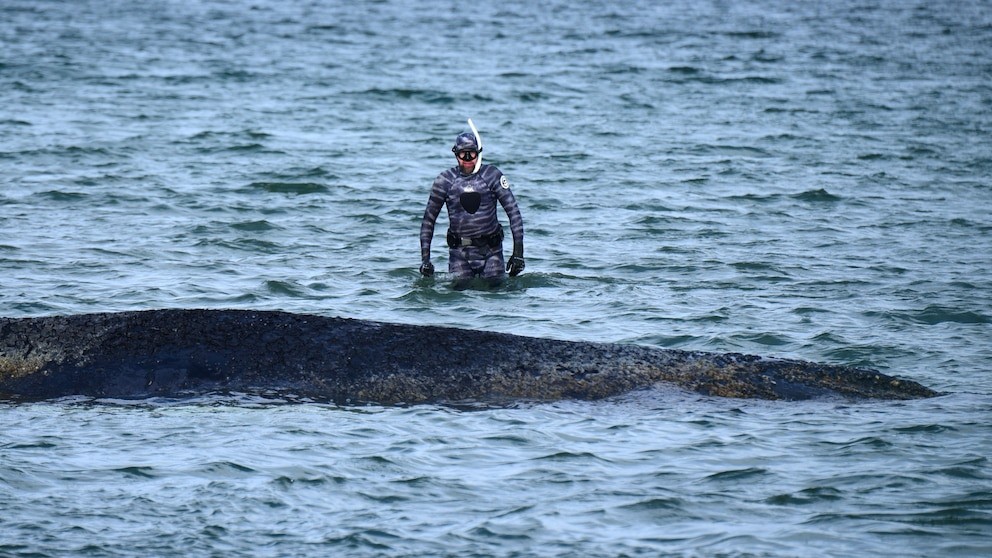
A rare and delicate rescue operation along Germany’s Baltic coastline has taken an encouraging turn, after a stranded humpback whale managed to free itself from a sandbank and return to deeper waters, offering cautious optimism among marine experts monitoring its survival.
The whale, estimated to measure between 12 and 15 metres in length, had been trapped for several days near the coastal resort of Timmendorfer Strand, drawing the attention of conservationists, local authorities and international observers. Its presence in the Baltic Sea—a region far removed from its natural migratory routes—had already raised concerns about disorientation and environmental stress.
By early Friday, officials confirmed that the animal had successfully moved off the sandbank and was now swimming approximately 300 metres offshore in Lubeck Bay. The development followed a sustained, multi-day intervention involving biologists, rescue teams and heavy equipment.
According to marine biologist Robert Marc Lehmann, the whale appeared to have regained enough strength overnight to break free without direct physical assistance at the critical moment. “It built up energy and managed to release itself,” he indicated, though he cautioned that the animal’s condition remained fragile.
Efforts to assist the whale had intensified in the preceding days. Rescue teams attempted to guide it toward deeper water, while also working to modify the immediate environment to improve its chances of escape. On Thursday, two excavators were deployed to dredge a temporary channel through the sandbank, creating a potential route for the whale to navigate out of the shallow zone.
Operations extended into the evening under floodlights, reflecting both the urgency of the situation and the difficulty of intervening in a dynamic marine environment. Observers reported increased movement from the whale later that day, an early sign that conditions were improving.
Confirmation of the animal’s release came through coordinated observation. Stephanie Gross of the Institute for Terrestrial and Aquatic Wildlife Research stated that a colleague, positioned in an inflatable boat, was able to verify the whale’s movement into deeper water shortly after first light.
Despite the breakthrough, experts remain cautious. The whale is not yet considered safe. Its continued survival depends on its ability to remain in open water and gradually navigate out of the Baltic Sea—a region that poses ecological challenges for large marine mammals accustomed to oceanic conditions.
The Baltic’s relatively shallow depth, lower salinity and complex coastal geography make it an inhospitable environment for species such as humpback whales, which typically inhabit the open Atlantic. As a result, rescue teams are now focused less on direct intervention and more on monitoring and guiding the animal’s trajectory.
Several vessels, including coast guard boats, have been deployed to accompany the whale at a distance, helping ensure it does not return to shallow areas. This form of soft escort reflects standard practice in marine rescue operations, where minimising stress and interference is critical.
Complicating the situation is the whale’s physical condition. Rescuers have been unable to attach a tracking device, limiting their ability to monitor its movements over longer distances. Additionally, reports indicate that a piece of netting is lodged in its mouth, raising concerns about feeding ability and overall health.
Read Also: India Slashes Fuel Taxes To Absorb Iran War Oil Shock
Local officials have nonetheless expressed relief at the immediate outcome. Sven Partheil-Bohnke described the whale’s self-release as a positive development, noting that it has revived hopes the animal can continue its journey toward safer waters.
Experts believe the whale is likely to move northward, potentially toward Danish waters. However, reaching the Baltic’s outer limits will not be sufficient. For the animal to return to its natural habitat, it must pass through narrow straits into the North Sea and eventually the Atlantic Ocean—routes that require both navigational success and sustained physical endurance.
Such incidents, while rare, are not unprecedented. Marine scientists point to a combination of factors that can lead large whales into atypical regions, including changes in prey distribution, underwater noise pollution, and navigational errors. Once inside semi-enclosed seas like the Baltic, the risk of stranding increases significantly.
The Lübeck rescue effort illustrates both the possibilities and limitations of human intervention in marine ecosystems. While engineering solutions—such as dredging channels—can provide temporary relief, the ultimate outcome often depends on the animal’s own capacity to respond and adapt.
For now, the whale’s movement into deeper water marks a critical transition point. It has shifted from immediate danger toward a more uncertain phase of recovery, where distance from the shore offers safety but does not guarantee survival.
Read Also: Tinubu, Ajaero, And Nigeria’s Shameful Wage Crisis
Monitoring will continue in the coming days as authorities track its progress and assess whether further intervention is required. The absence of a tracking device means reliance on visual sightings and coordinated maritime reporting, adding complexity to an already delicate operation.
The episode has drawn public attention across Europe, highlighting both the vulnerability of marine wildlife and the collaborative efforts required to respond to such crises. It also underscores the broader environmental pressures affecting oceanic species, many of which are increasingly encountering unfamiliar and hazardous conditions.
As the whale moves further from the coastline, the focus will shift from rescue to endurance. Its path forward—through the Baltic, into the North Sea, and ultimately the Atlantic—will determine whether this intervention becomes a rare success story or a temporary reprieve in a far more uncertain journey.