
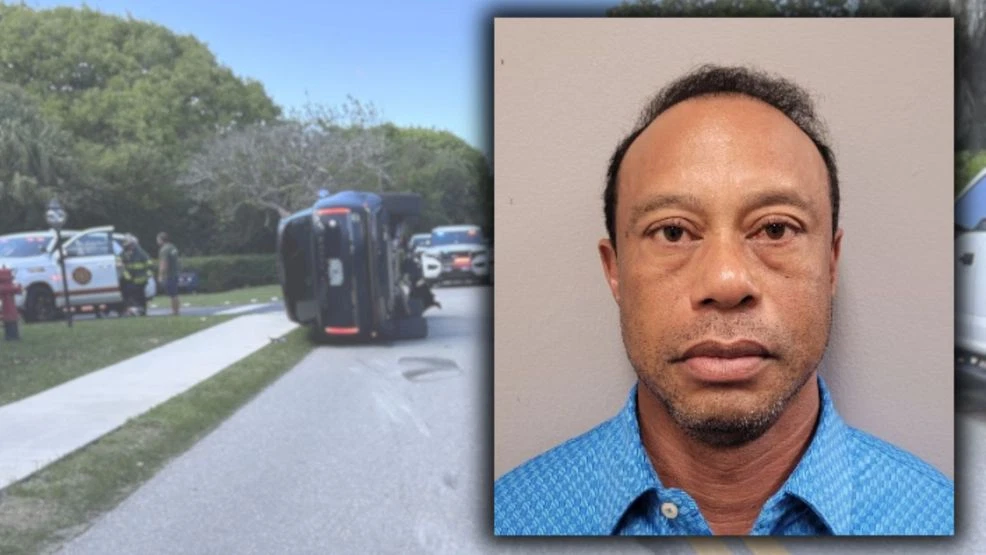
Tiger Woods was arrested on a driving under the influence charge Friday afternoon after his SUV rolled onto its driver’s side door on a two-lane road in Jupiter Island, Florida — the latest in a series of vehicle incidents involving the golf legend that have punctuated a career already shaped by physical catastrophe and public reckoning.
The crash happened shortly before 2 p.m., according to the Martin County Sheriff’s Office. Woods, 50, was driving a dark Land Rover when he clipped the back of a truck pulling a trailer. The Land Rover rolled. Woods climbed out through the window. Neither he nor the truck’s driver was injured.
The truck driver told officers that he had been beginning to turn into a driveway off the road when he checked his mirror and saw the Land Rover approaching at high speed. He attempted to move out of the way. The Land Rover overtook him at the last moment, swerved, and caught the trailer’s rear end — enough contact to send the SUV rolling.
Officers at the scene suspected impairment. Woods submitted to a breathalyser test and told officers he had taken medication for prior injuries. He refused a urine test, a decision that produced a second charge alongside the DUI count. He was arrested at the scene and transported to a local jail.
The arrest arrives four days after Woods played in the Tomorrow’s Golf League finals on Tuesday, where his team, Jupiter Links Golf Club, lost to Los Angeles Golf Club. It was one of his most recent competitive appearances — a man who had spent years managing a body rebuilt from catastrophic injury, competing in an indoor format designed partly around the physical limits the surgeries had imposed.
Read also: Golf Legend Woods Tees Up For Masters Preparation Run
Those limits have been earned in the hardest possible way. In February 2021, Woods was driving through Rolling Hills Estates in Southern California when his Genesis SUV struck a tree at more than twice the posted speed limit. The vehicle became airborne and landed on its side. He suffered severe leg injuries that required multiple surgeries and raised genuine questions about whether he would ever walk a golf course again, let alone compete on one. Authorities found no signs of impairment in that crash, a conclusion that drew scrutiny after investigators acknowledged they had not obtained a warrant for blood samples that might have told a more complete story. No charges were filed.
Friday’s arrest carries explicit echoes of an earlier episode. In 2017, Woods was found asleep at the wheel of a car parked on a Florida roadside and arrested on a DUI charge. He subsequently told authorities he had an unexpected reaction to prescription medications. He was not charged with alcohol-related impairment — a breathalyser registered zero. He pleaded guilty to reckless driving and entered a diversion programme. Later that year, he checked himself into a clinic for help with prescription medication dependency, a public disclosure that reframed how much of what had been visible in his life during those years was understood.
He has spoken since, with varying degrees of directness, about the physical reality of managing chronic pain across decades of elite competition and surgical intervention. Seven back surgeries. A shattered leg. An Achilles rupture. A lumbar disc replacement as recently as last October, his own description of which — “disc replacement is not a lot of fun” — was delivered with the understatement of a man who has recalibrated his baseline for suffering so many times that ordinary language no longer quite fits.
The medications that manage that pain, and the consequences of managing it imperfectly, have appeared at multiple points in his public record. Friday’s incident will be read through that lens by some, and through a simpler one by others — a man who has been warned before, in different courtrooms and different contexts, and who was nevertheless driving at high speed on a two-lane road in the early afternoon.
Read also: Tiger Woods, Nike Part Ways After 27-Year Collaboration
Woods has not made a public statement. His management team had not responded to media requests by Friday evening.
The legal exposure from Friday’s charges is real but not severe by itself — a first-time DUI conviction in Florida typically carries fines, licence suspension, community service and mandatory education programmes rather than custodial sentences. The refusal charge adds a separate dimension; Florida’s implied consent law treats the refusal to submit to a chemical test as a separate offence with its own penalties, including automatic licence suspension. His 2017 diversion completion means this arrest would be treated as a first DUI offence for most sentencing purposes, though prosecutors retain discretion.
What is not primarily a legal question is the wider one that Friday’s events reopen: how a man of Woods’ intelligence and experience, who has lived through 2017 and 2021 and all the years between them, finds himself again at the intersection of a vehicle, a road and a law enforcement response to suspected impairment.