
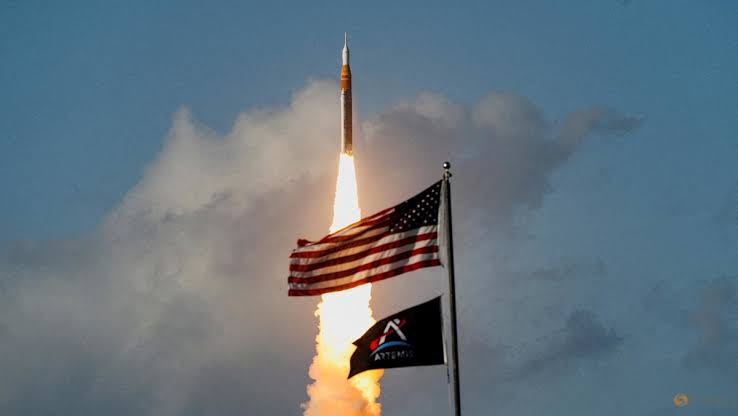
Four astronauts broke humanity’s deepest boundary in space on Wednesday, lifting off from Florida aboard a 32-storey rocket and beginning a journey around the moon that makes them the first humans to travel beyond low-Earth orbit in more than half a century.
The Artemis II mission launched from NASA’s Kennedy Space Center at Cape Canaveral, where tens of thousands of spectators gathered to watch a moment that NASA has been building toward for years and that the world has not experienced since the final Apollo missions of the early 1970s. The crew — NASA astronauts Reid Wiseman, Victor Glover and Christina Koch, and Canadian Space Agency astronaut Jeremy Hansen — are set for a nearly 10-day journey that will take them around the moon and back, reaching distances from Earth that no human being has covered since Apollo 17 departed in December 1972.
Five minutes after liftoff, Wiseman radioed from the capsule with the simplicity that tends to emerge when language meets the genuinely extraordinary. “We have a beautiful moonrise, we’re headed right at it,” the commander said.
Read more: Rocket Trouble Forces NASA To Postpone Moon Mission
Launch Director Charlie Blackwell-Thompson sent them off with words that reached for the occasion’s scale. “On this historic mission, you take with you the heart of this Artemis team, the daring spirit of the American people and our partners across the globe, and the hopes and dreams of a new generation. Good luck, Godspeed Artemis II. Let’s go.”
The hours before liftoff carried the particular tension of a mission where everything has to work and almost everything has failed at least once in testing. Hydrogen fuel — more than 700,000 gallons of it — had to be loaded into the Space Launch System rocket, a phase that had caused a dangerous leak during a countdown test earlier this year and forced a lengthy delay. Wednesday’s fuelling proceeded without significant leaks, to NASA’s visible relief. Engineers also resolved a problem with commands not reaching the rocket’s flight-termination system — the mechanism designed to trigger self-destruction if the rocket veers toward populated areas — and troubleshot a battery temperature anomaly in the Orion capsule’s launch-abort system. Both were fixed without delaying the launch.
The mission’s immediate agenda is systematic. For the first day or two, the crew will remain in high Earth orbit conducting exhaustive checks of Orion’s life-support, propulsion, navigation and communications systems — confirming the spacecraft is fit for deep space before committing to it. Once those checks are cleared, a critical engine burn called translunar injection will push Orion out of Earth’s gravitational embrace and onto a trajectory toward the moon, a journey of several days during which the crew will monitor systems as the distance from home accumulates in ways that have no precedent in living memory for most of them.
Orion will then swing behind the moon on what is called a free-return trajectory — a path that uses the gravitational fields of both the moon and Earth to arc the spacecraft back without requiring significant additional fuel. The physics are elegant: the moon’s gravity bends the trajectory, Earth’s gravity pulls it home, and the engine does relatively little of the work. During this phase the crew will reach their maximum distance from Earth, surpassing any human being’s distance from the planet since the Apollo era.
Read more: Moon City Project Takes Priority Over Mars, Musk Announces
The return journey will include additional deep-space testing of power systems, thermal controls and crew operations before Orion re-enters Earth’s atmosphere at approximately 40,000 kilometres per hour and splashes down in the Pacific Ocean, where recovery teams will be waiting.
Artemis II is not the landing. That comes later — Artemis III is designed to return humans to the lunar surface for the first time since 1972, with subsequent missions intended to establish a sustained human presence near the moon as a staging point for eventual missions to Mars. Wednesday’s flight is the proof of concept: demonstrating that the spacecraft, the rocket, the life support and the crew operations can function in the deep space environment that all subsequent missions will require.
The generational dimension of what launched Wednesday is real and significant. With roughly half the world’s current population born after the last Apollo mission, the experience of humans travelling beyond low-Earth orbit belongs entirely to history books and archived footage for most people alive today. NASA science mission chief Nicky Fox put it plainly earlier this week: “There are a lot of people who don’t remember Apollo. There are generations who weren’t alive when Apollo launched. This is their Apollo.”
The four people inside Orion are carrying that weight alongside the technical checklists and the mission objectives. They are headed somewhere humans have not been in 53 years, in a spacecraft that has never carried a crew this far, on a trajectory that will take them farther from Earth than any living person has ever been.
The moonrise was beautiful. They were headed right at it.