
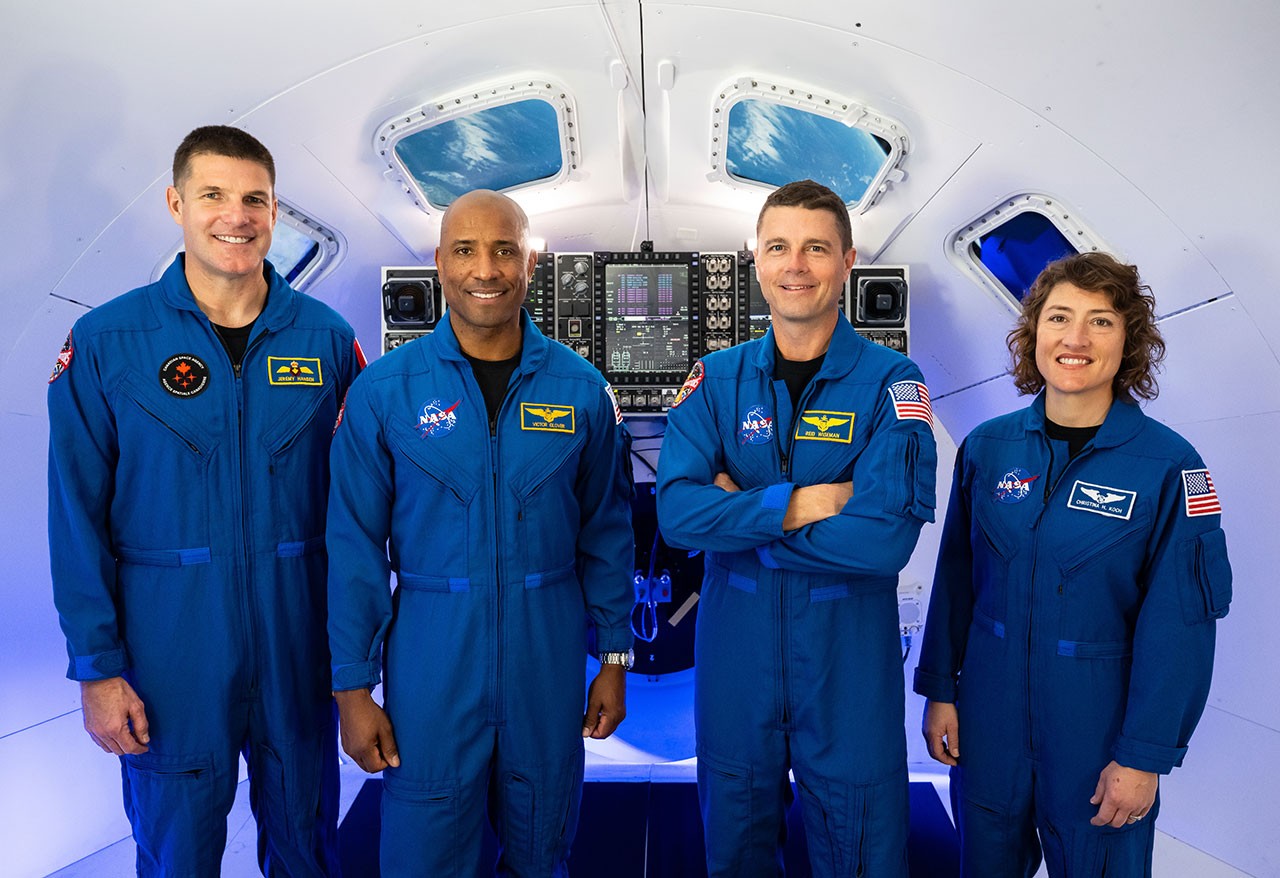
Four astronauts aboard NASA’s Orion spacecraft completed a historic loop around the Moon on Monday, travelling further from Earth than any humans have ventured since the Apollo programme ended in 1972 and returning images that mission control described as “absolutely stunning” before the crew clocked off for the night.
The Artemis II mission reached its most dramatic moment when the spacecraft used the Moon’s gravitational pull to slingshot itself back toward Earth — a manoeuvre that required no engine burn, only the precise positioning that allowed lunar gravity to bend the capsule’s trajectory 180 degrees. Retired NASA astronaut Terry Virts, former commander of the International Space Station, described the physics bluntly: “Sir Isaac Newton is in charge — gravity is what’s manoeuvring the capsule now.”
Virts also put the stakes of the mission in terms that cut through the celebratory atmosphere surrounding the flight. The crew, he noted, were operating in deep space with no possibility of rescue, exposed to radiation levels that do not exist on Earth, separated from instant death by a few millimetres of aluminium. “Basically nothing happened today,” he said. “The only thing that happened today was the moon flew by the capsule.” In the context of spaceflight, that counts as a very good day.
NASA’s head of science, Dr Nicola Fox, told BBC Radio 4 that the crew observed several new small craters on the Moon’s far side during the flyby — bright patches visible to the naked eye, appearing in shades of brown and blue. The astronauts also described the terminator line dividing the Moon’s sunlit and dark hemispheres as a “jagged edge,” shaped by the craters that punctuate the lunar surface. The far side of the Moon, never visible from Earth and rarely photographed at close range by humans, was observed directly by the four crew members in what Fox called a defining moment of the mission.
Read also: NASA Makes Changes In Its Plans For Going To The Moon
The crew also experienced a total solar eclipse during the flyby — one of the more unexpected visual gifts of a mission already generating remarkable imagery.
There was a personal moment among the technical achievements. The crew discussed naming proposals for lunar craters to mark the mission, agreeing that one should be named Integrity after their Orion spacecraft. A second, they decided, should honour astronaut Reid Wiseman’s late wife Carroll, who died in 2020. Both proposals will require formal submission to the International Astronomical Union, the governing body for naming features in space.
Before sleeping, the crew exchanged messages with mission control that captured something of the emotional weight of what they had accomplished. “We got a sneak peek at your imagery. It is absolutely stunning, we are all completely in awe of the work you did today,” mission control told the astronauts. “We hope you have sweet dreams of Moon joy.” The crew replied: “We’re glad they’re appreciated. We certainly appreciate it up here.”
Artemis II is a test flight — no lunar landing is planned for this mission. Its purpose is to validate the systems, procedures and human factors that a landing mission will require, establishing confidence in the Orion spacecraft and the crew’s ability to operate at lunar distances before NASA commits astronauts to a surface descent. Fox described the mission as “doing the work to set up that sustained presence on the Moon,” with Artemis IV expected to land humans on the lunar surface for the first time since December 1972, currently targeted for early 2028.
Read more: Artemis II Moon Rocket Soars After Flawless NASA Launch
The broader ambition reaches further. NASA’s stated goal is not simply to return to the Moon but to establish a continuous human presence there — astronauts living and working on the lunar surface over extended periods — as the foundation for eventual crewed missions to Mars. ESA reserve astronaut Dr Meganne Christian, who began training in January 2025 after being selected from thousands of applicants, told BBC Radio 4 that the mission represents something larger than a single flight. “We are not just going to the Moon,” she said. “We are going there to stay.”
The road to this moment was neither straight nor short. Apollo was cancelled in 1972 as costs mounted and political priorities shifted. A return to the Moon was proposed under NASA’s Constellation programme in 2005 before being cancelled in 2010. The technology developed for Constellation — including the Orion spacecraft — was folded into Artemis, which formally began in 2017 with a landing originally targeted for 2024. Delays pushed that date to 2028.
Monday’s flyby did not land anyone on the Moon. But four humans went further from Earth than any of their species has gone in more than half a century, looked at the far side of the Moon with their own eyes, and came back with pictures that left the people tracking them from Earth completely in awe.