
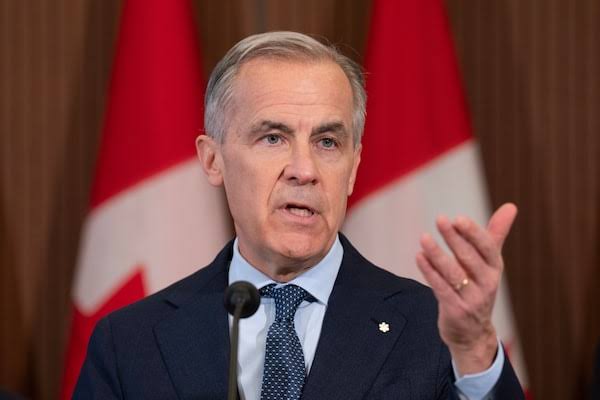
Canadian Prime Minister Mark Carney delivered a striking reassessment of his country’s relationship with the United States on Sunday, telling Canadians that the deep economic integration that defined North American partnership for decades had transformed from an advantage into a liability that the country must now deliberately dismantle.
Speaking in a ten-minute video address, Carney was direct about the scale of the shift he believes is underway. “Many of our former strengths, based on our close ties to America, have become weaknesses,” he said. “Weaknesses that we must correct.”
The framing — that proximity to the United States is now a strategic problem rather than a strategic asset — represents a significant departure from the assumptions that have governed Canadian economic policy across generations. Canada sends roughly three-quarters of its exports to the American market. The two economies are intertwined at the level of supply chains, energy infrastructure, financial systems and labour flows in ways that cannot be quickly unwound without significant domestic disruption. Carney’s argument is that the disruption of staying too close has become greater than the disruption of moving apart.
Read also: France Presses Lebanon Peace Plan As Israel Rejects Demand
He attributed the shift directly to Washington. “The world is more dangerous and divided,” he said. “The US has fundamentally changed its approach to trade, raising its tariffs to levels last seen during the Great Depression.” Trump’s tariff campaign, which has treated allies and adversaries with roughly equal aggression, and his repeated suggestions that Canada should become the 51st American state, have produced in Ottawa a political consensus that would have been unthinkable five years ago — that Canada needs to reduce its exposure to American decisions it cannot influence.
Carney punctuated the address with a piece of deliberate symbolism, holding up a toy soldier depicting General Isaac Brock, the British commander who repelled American forces during the War of 1812. “The situation today feels unique, but we’ve faced down threats like this before,” he said. The reference was unmistakable in its implication: the current pressure from Washington is not the first time Canada has had to defend its existence against American ambition, and it will not be the last.
The prime minister’s position has been reinforced by electoral success. His Liberal Party secured a parliamentary majority in special elections earlier this month, giving him the legislative room to pursue economic repositioning without depending on opposition support. A review of the US-Canada-Mexico free trade agreement is scheduled for July, and that negotiation will unfold with a Canadian government that has publicly declared the existing relationship structurally flawed.
Carney has been cultivating alternatives. His government has pursued closer economic ties with China — a move that would have generated significant controversy in Washington under previous diplomatic conditions, and still might, but which reflects the logic his Sunday address made explicit. “We have to take care of ourselves because we can’t rely on one foreign partner,” he said. “We can’t control the disruption coming from our neighbours. We can’t control our future on the hope it will suddenly stop.”
Read more: Australia Grants Asylum To Iranian Women’s Soccer Players
Some tariffs between the two countries have been rolled back since the worst of the spring confrontations, and the personal relationship between Carney and Trump has been described as less abrasive than the relationship between Trump and Carney’s predecessor Justin Trudeau. But Carney has consistently declined to treat tactical improvements in the bilateral temperature as evidence that the structural problem has been resolved. Sunday’s address made that position explicit at the level of national strategy rather than diplomatic positioning.
The July trade review will be the first significant test of where the relationship actually stands. Canada enters that negotiation with a majority government, a prime minister who has staked his credibility on firmness toward Washington, and a domestic political environment in which concessions to American demands carry genuine electoral risk. The country that Trump has suggested absorbing as a state will be represented at that table by a government that just won an election on a platform of standing up to him.
Carney’s General Brock figurine was a reminder, directed as much at his own population as at any foreign audience, that Canada has a history of knowing when to hold its ground.