
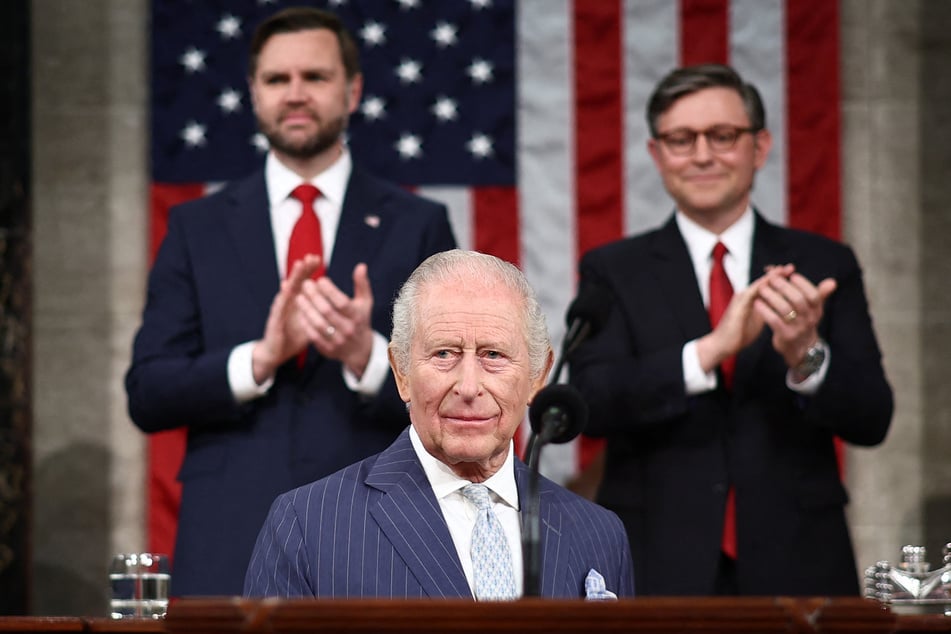
King Charles III stood before the United States Congress on Tuesday and told the most powerful legislature in the world, with the careful precision of a man who cannot afford a single unguarded word, that executive power must be subject to checks and balances — and watched the Democrats rise to their feet while the Republicans sat on their hands.
It was that kind of speech.
The first address by a British monarch to Congress since Queen Elizabeth II appeared before the same chamber in 1991, Charles’s remarks ranged across Ukraine, climate change, NATO, democratic tradition and the importance of allies standing together — a tour of precisely the subjects on which Donald Trump and the British government have been most publicly at odds. He navigated all of it without once mentioning the prime minister’s name, the Iran war by its proper terms, or the American president’s specific positions on anything. He did not need to. The architecture of the speech did the work.
“The challenges we face are too great for any one nation to bear alone,” Charles said, framing the entire address around the premise that unilateralism is insufficient — a position his hosts have not always shared.
He described Congress as a “citadel of democracy” and noted that Magna Carta, the 13th-century English document that established the principle of limited sovereign power, had been cited in more than 160 US Supreme Court cases. The applause from the Democratic side of the aisle when he invoked checks and balances on executive authority was prolonged. The Republican response was noticeably more restrained. Charles appeared to notice neither, which is the monarchical gift — the ability to say something pointed while maintaining an expression of perfect benevolent neutrality.
Read also: Royal-Presidential Summit Aims To Mend US-UK Rift
On Ukraine, he was direct. “Unyielding resolve” was needed to secure “a just and lasting peace,” he told lawmakers, in a chamber where support for Kyiv has become one of the most contested questions in American politics. The address came during celebrations marking 250 years since American independence, and Charles used that historical frame to argue that the partnership between the two countries was “born out of dispute, but no less strong for it” — an elegant acknowledgement of the current strains without conceding that they represent anything unprecedented or terminal.
“Our defense, intelligence and security ties are hardwired together,” he said — language chosen to emphasise that the relationship functions at levels of institutional depth that political disagreements cannot easily reach.
Earlier in the day, Trump had set a markedly different tone from the criticisms of British Prime Minister Keir Starmer that have punctuated recent months. Welcoming Charles and Queen Camilla to the White House on the South Lawn — cannons firing, military band playing, jets roaring overhead in a flypast — the president called Britain America’s closest ally and praised the special relationship with the warmth of a man who had apparently set his previous complaints aside for the duration. He joked that his Scottish-born mother had “a crush on Charles” and described the King as “a fantastic person.” After their closed-door Oval Office meeting, Trump told reporters it had been “a real honor.”
Read more: King Charles’ US Trip Unaffected By Gun Violence
The juxtaposition between Trump’s White House warmth and Charles’s Congressional precision captured the visit’s essential function. The monarch provided the emotional register — pageantry, history, personal connection — that allowed the political relationship to be discussed in terms larger than the current disagreements. The government ministers who accompanied the visit, including Foreign Secretary Yvette Cooper, operated in the space that warmth created.
Security throughout the visit has been heightened following the alleged assassination attempt against Trump at Saturday’s White House Correspondents’ Dinner. Charles addressed the incident with the compression it required. “Such acts of violence will never succeed,” he said, and moved on.
The state dinner Tuesday evening, with toasts from both Charles and Trump, caps a visit that has been simultaneously ceremonial and surgical — a four-day exercise in using the weight of 250 years of shared history to demonstrate that an alliance is larger than any government, any policy disagreement, or any war that one side chose to fight and the other chose to watch.
The Democrats gave him a standing ovation. The Republicans gave him polite applause. Trump called him fantastic. The King said thank you and meant something slightly more complicated than that.