
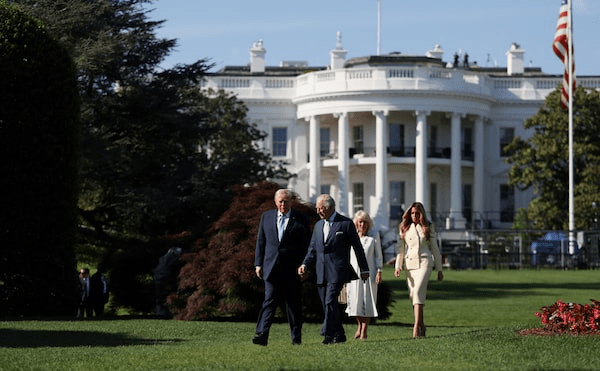
A state visit conceived to mark 250 years since Britain lost its American colonies opened on Monday with King Charles III being welcomed to the White House by a president openly at odds with his prime minister and a transatlantic alliance under more strain than at any point in recent memory.
The pageantry held. Charles and Queen Camilla were received outside the South Portico by Donald and Melania Trump, the First Lady in primrose yellow, the Queen in a Cartier brooch fashioned from platinum, rubies, emeralds and diamonds in the design of the British and American flags. Trump and Charles exchanged words inaudible to the press pool before the president guided the king inside with a brief touch on the arm. Tea was scheduled. So was a tour of the beehives on a South Lawn recently redesigned by the First Lady.
Read also: King Charles’ US Trip Unaffected By Gun Violence
Beneath the choreography, almost nothing about the trip is going to plan.
The visit was supposed to anchor a year of celebrations around American independence — a moment to revisit the long arc from George III to the present. It is instead being read in both capitals as a damage-limitation exercise. Trump has spent recent weeks publicly excoriating Prime Minister Keir Starmer over Britain’s refusal to back the United States in its war with Iran, and over what the president has framed as failures of immigration and energy policy. He has gone so far as to dismiss Starmer as “no Churchill,” reaching for the wartime premier who first gave the Anglo-American partnership its enduring label.
Starmer has criticised the war in public while defending the decision to proceed with the state visit — a position that finds him at odds with much of the British public. A YouGov poll in early April put support for cancelling the trip at 48 per cent.
Security around the four-day programme has been tightened further following a shooting at the White House Correspondents’ Dinner on Saturday. A suspect accused of attempting to assassinate the president was arraigned on Monday, hours before the king’s motorcade reached the South Lawn. Officials had already pared back media access to limit the risk of unscripted moments; the latest incident has narrowed it again.
Read more: DOJ Closes Criminal Investigation Of Fed Chair Powell
Charles, 77 and treating cancer, arrives carrying a personal load that extends beyond geopolitics. The lingering scandal surrounding his brother, the former Prince Andrew, and Andrew’s friendship with the late convicted sex offender Jeffrey Epstein, continues to shadow the monarchy and is unlikely to be entirely absent from the week’s coverage.
The diplomatic test for the king is real. Craig Prescott, a monarchy specialist at Royal Holloway, University of London, said Charles was generally adept at navigating exactly this kind of occasion and had demonstrated as much during Trump’s own state visit to Britain last September. Prescott expects the king to address the Iran war — what he called the very big elephant in the room — in coded form when he speaks to Congress on Tuesday. That address itself marks a moment: Charles will be the first British monarch to speak from the chamber since his mother, Queen Elizabeth II, in 1991.
Trump, for his part, has cast the visit as restorative. He told Fox News at the weekend that no one represents Britain abroad as effectively as the king.
The remainder of the schedule keeps Charles and Camilla in motion. After the Oval Office meeting and a state dinner on Tuesday, the royals travel to New York on Wednesday for a visit to the 9/11 memorial, then depart Thursday for Bermuda — Charles’s first stop in a British overseas territory since acceding to the throne.
Whether four days of carefully managed ceremony can repair what a war has cracked open is the question the visit was not designed to answer, and now cannot avoid.