
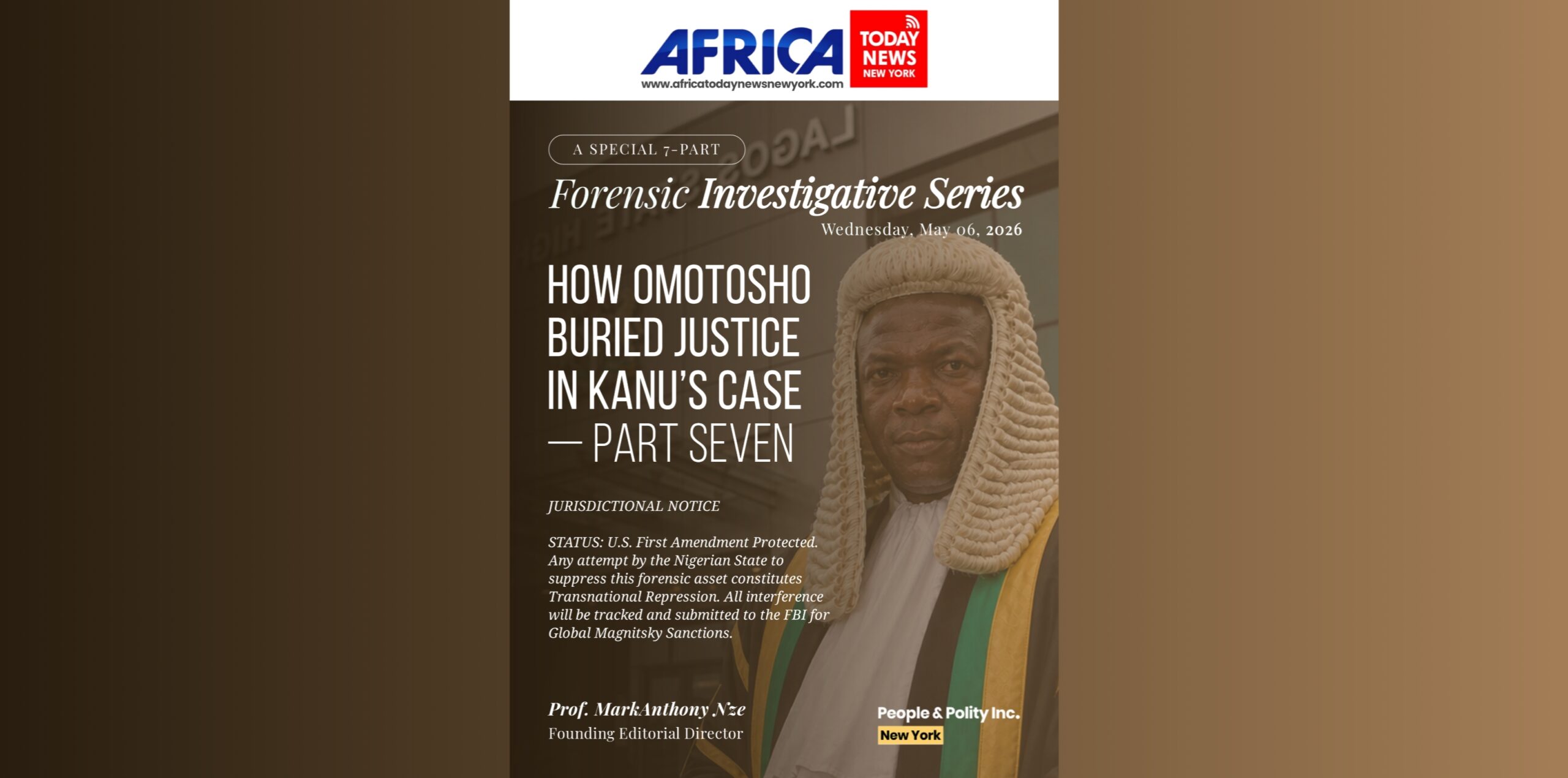
JURISDICTIONAL NOTICE
STATUS: U.S. First Amendment Protected.
Any attempt by the Nigerian State to suppress this forensic asset constitutes Transnational Repression. All interference will be tracked and submitted to the FBI for Global Magnitsky Sanctions.
♦♦♦♦♦♦♦♦♦♦♦♦♦♦♦♦♦♦♦♦♦♦♦♦♦♦♦♦
When the robe shields power instead of justice, accountability becomes the last courtroom left.
By Prof. MarkAnthony Nze
The Sanction Prospectus: Holding the Bench Accountable
Judicial power is not private property. It is public trust placed in the hands of a judge on the strict condition that the robe will stand between the citizen and the state, not become the garment through which state power is made presentable. Once a judge handles criminal procedure in a manner that appears to convert prosecutorial pressure into judicial conclusion, the injury no longer belongs only to the defendant. A record is created. A method is exposed. Future prosecutors learn the limits of judicial tolerance. Security agencies discover what the courtroom will absorb. Citizens begin to understand, with cold alarm, that the bench can become the final station where power receives legal polish.
Justice James Omotosho’s handling of Federal Republic of Nigeria v. Nnamdi Kanu must therefore move beyond commentary into structured accountability. The question is no longer whether the judgment was severe, politically useful, or controversial. A more serious question now stands before Nigeria’s legal conscience: whether the conduct of the proceedings created a record demanding institutional examination at home and international scrutiny abroad. Where a trial contains allegations of extraordinary rendition, arbitrary detention, compressed defense opportunity, speech-based terrorism liability, national-security pressure, and life imprisonment after visible procedural acceleration, silence becomes more than caution. It becomes institutional complicity.
Accountability in such a case is not an attack on the judiciary. It is the only credible way to protect what remains of judicial legitimacy. A bench that cannot be questioned when its handling of a political trial wounds public confidence is not independent; it is insulated. Judicial independence protects judges from intimidation, bribery, executive pressure, and mob coercion. It does not place their conduct beyond forensic examination. Independence is a shield for justice, not a hiding place for proceedings that appear to have served power more obediently than law.
Read also: How Omotosho Buried Justice In Kanu’s Case—Part 6
Nigeria’s constitutional structure already recognizes this distinction. The National Judicial Council exists precisely because judges, though independent in decision-making, remain accountable for conduct that undermines the dignity, integrity, impartiality, or credibility of the bench. Section 153 of the 1999 Constitution places the NJC within Nigeria’s constitutional guide, while the Judicial Discipline Regulations provide a framework for complaints against judicial officers. That framework should now be tested with a petition built not on anger, but on evidence; not on slogans, but on chronology; not on political emotion, but on the cold examination of the record.
Accountability for Justice Omotosho does not require speculation, ethnic insinuation, or personal insult. The record is severe enough on its own. It speaks through rulings, dates, objections, warnings, procedural turns, defense difficulties, evidentiary choices, courtroom management, and the final judgment itself. A judge who presides over a prosecution carrying allegations of extraordinary rendition, arbitrary detention, speech-based terrorism liability, compressed defense opportunity, and international rights alarm does not leave behind only a conviction. He leaves behind a judicial footprint. In Kanu’s case, that footprint does not look like the careful path of a court protecting constitutional legitimacy. It looks like a bench that became too accommodating of state urgency and too impatient with the burden of fairness.
What must be examined is not only whether Omotosho reached a legally contestable conclusion. Many judgments are appealed. Many rulings are reversed. The deeper issue is the manner in which judicial power was exercised when the defendant was politically radioactive and the state’s appetite for finality was unmistakable. Did the court preserve public confidence in independence and impartiality, or did it conduct the trial in a way that made neutrality look exhausted? Did it treat extraordinary rendition and arbitrary detention as constitutional emergencies, or as inconvenient background noise? Did it protect Kanu’s presence, participation, and ability to defend himself, or did it allow procedural difficulty to become a route toward closure? Did the court preserve the hard distinction between speech, incitement, causation, and terrorism, or did national-security rhetoric soften that boundary?
Those questions go beyond ordinary appellate disagreement. They cut into the moral authority of the bench. A judge can be wrong in law without becoming dangerous to the institution. But where judicial management of a political trial raises serious concerns about temperament, restraint, fairness, and visible independence, the problem is no longer confined to the correctness of the judgment. It becomes a question of whether the courtroom functioned as a constitutional barrier against power or as a disciplined passage through which power reached the result it wanted.
Omotosho’s case occupies the perilous point where outcome and conduct become inseparable. Controversy does not rest only on the sentence or conviction. It lives in the court’s treatment of contested custody, management of defense difficulty, conversion of refusal into momentum, reception of speech evidence, compressed timeline, and posture toward international rights concerns. Method matters because courts do more than resolve disputes. They instruct the system, showing prosecutors the limits of judicial tolerance, revealing to security agencies what the bench will absorb, and warning future defendants how little constitutional air may remain when the state enters with a politically charged accusation.
Read more: How Omotosho Buried Justice In Kanu’s Case—Part 5
Judicial power cannot hide behind the robe when the record itself invites scrutiny. Independence protects judges from threats, bribery, executive command, and mob intimidation. It does not grant immunity from disciplined public examination. The judiciary exists because citizens must believe that even the most disliked defendant can stand before the state and receive law, not choreography. Once that belief is wounded, the injury is institutional. Police have weapons. Security agencies have detention facilities. Prosecutors have charges. Courts have trust. When trust is damaged, judgment becomes paper with a seal.
Omotosho’s handling of Kanu’s case now tests Nigeria’s legal establishment. The Bar must decide whether constitutionalism is worth defending when the defendant is unpopular. Legal scholars must decide whether political sensitivity is enough to silence doctrinal honesty. Judicial authorities must decide whether public confidence is a living constitutional interest or an inconvenience to be managed. Appellate courts must decide whether they will examine only the outcome or confront the method that produced it. Human rights institutions must decide whether arbitrary detention, extraordinary rendition, fair hearing, and speech-based criminal liability are principles or slogans.
Institutional silence would become the most dangerous verdict after the verdict. Such quiet would train the state to believe pressure can survive judicial scrutiny, allow prosecutors to treat atmosphere as reinforcement for weak proof, and encourage judges to rename speed as discipline, compression as case management, and exhaustion as fairness. Citizens would receive the darkest lesson: constitutional protection remains available only until power decides a person has become inconvenient.
Loose accusation is unnecessary because the record already carries its own force. Timeline, rulings, defense difficulties, judgment, international standards, fair-trial defects, and evidentiary gaps can be examined without exaggeration. Precision wounds authority more deeply than rage because precision leaves fewer shadows for power to hide inside.
A judgment can close proceedings in one courtroom while opening a larger inquiry before the nation and the world. Kanu’s conviction did not seal the moral file; it enlarged the record against the process itself. Serious scrutiny must now ask whether a judge can preside over a trial marked by allegations of rendition, arbitrary detention, speech-based criminal liability, compressed defense, and international rights alarms, then step away as though judicial office were thick enough to conceal the damage.
A court may sentence a man, but no court can command public silence, lawyerly obedience, human-rights irrelevance, or historical amnesia. Omotosho’s judgment has already left the courtroom. It now belongs to Nigeria’s constitutional record, where future generations will ask whether the bench restrained power or refined coercion into judgment.
Without accountability, Omotosho’s judgment ceases to be only a conviction; it becomes a license. Prosecutors draw strength from fear. Judges learn to dress haste as discipline. State power sees rights narrowing whenever politics grows volatile enough. Citizens receive the harshest lesson: constitutional shelter may endure only until authority brands them inconvenient.
True accountability is not revenge. It is constitutional cleansing: a demand that judicial power answer when liberty, fair hearing, and public trust are endangered. The robe must recover its proper meaning—not cover for state desire, but resistance against it.
Kanu’s case will not be remembered only for the man in the dock; it will be remembered for what the dock exposed about the bench, the state, and the dangerous intimacy between law and power in Nigeria. Across these seven parts, the record tells a chilling story: poisoned jurisdiction was normalized, presence was weakened, agitation was recast as terror, atmosphere was allowed to compete with proof, speed outran fairness, international standards were treated as inconvenience, and accountability became the last remaining test of judicial honor. Omotosho’s judgment may have closed one trial, but it opened a larger proceeding before history—a proceeding in which the accused is no longer Kanu alone, but the system that made such a judgment possible. Left unconfronted by constitutional discipline, the system keeps every Nigerian within striking distance of the same machinery. One allegation can start the descent. Procedure tightens quietly. Liberty is bargained away through technical language. Fear enters the courtroom dressed as national security. Evidence gives way to suspicion. Coercion receives the accent of law. By the time judgment is pronounced, the citizen may discover that the Constitution was not destroyed in one dramatic blow; it was narrowed, stage by stage, until power found enough room to call itself justice.
Selected Verified Sources (APA 7th Edition)
Federal High Court of Nigeria. (2025, November 20). Federal Republic of Nigeria v. Nnamdi Kanu (Charge No: FHC/ABJ/CR/383/2015) [Judgment].
Federal Republic of Nigeria. (1999). Constitution of the Federal Republic of Nigeria, 1999.
National Judicial Council. (2017). Judicial Discipline Regulations 2017.
Organization of African Unity. (1981). African Charter on Human and Peoples’ Rights.
United Nations General Assembly. (1966). International Covenant on Civil and Political Rights.
United Nations Human Rights Committee. (2007). General comment No. 32: Article 14: Right to equality before courts and tribunals and to a fair trial (CCPR/C/GC/32).
United Nations Working Group on Arbitrary Detention. (2022). Opinion No. 25/2022 concerning Mazi Nnamdi Kanu (Nigeria and Kenya). Human Rights Council.
United States. (2016). Global Magnitsky Human Rights Accountability Act, 22 U.S.C. §§ 10101–10103.
United States. (2017). Executive Order 13818: Blocking the property of persons involved in serious human rights abuse or corruption.