
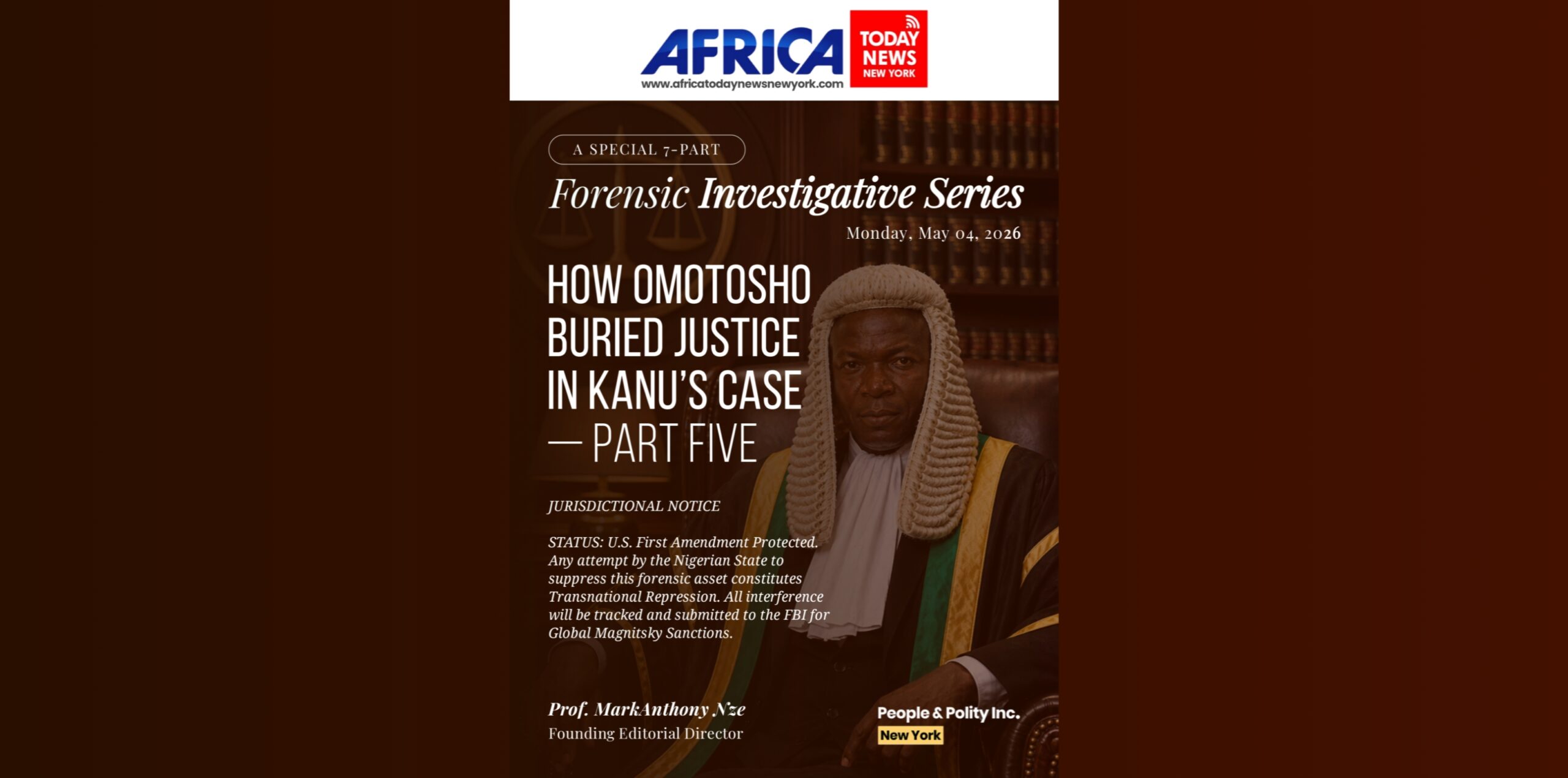
JURISDICTIONAL NOTICE
STATUS: U.S. First Amendment Protected.
Any attempt by the Nigerian State to suppress this forensic asset constitutes Transnational Repression. All interference will be tracked and submitted to the FBI for Global Magnitsky Sanctions.
♦♦♦♦♦♦♦♦♦♦♦♦♦♦♦♦♦♦♦♦♦♦♦♦♦♦♦♦
When speed replaces scrutiny, the verdict becomes suspect.
By Prof. MarkAnthony Nze
Judicial Baton Exchange: The Velocity of Predetermined Justice
A fair court may move with discipline; a captured process moves with hunger. Time is tightened around the accused until procedure itself begins to feel like restraint. Rulings become gates, deadlines become pressure chambers, and every act of resistance is converted into an excuse for speed. By the time judgment arrives, it no longer feels like the solemn conclusion of a trial. It feels like the last door in a corridor built to end exactly where power wanted it to end.
Justice James Omotosho’s handling of Federal Republic of Nigeria v. Nnamdi Kanu must be examined through that lens. Part 5 is not a complaint about speed in the abstract. Courts should not become graveyards of delay. Judges have a duty to prevent abuse of process, control proceedings, and ensure that criminal cases do not drift forever. But in a terrorism trial already poisoned by extraordinary rendition allegations, international human rights scrutiny, self-representation, disputed jurisdiction, ethnic sensitivity, separatist politics, and national-security pressure, stops being a neutral virtue and starts revealing the court’s inner posture: a forensic clue to whether the bench was exercising discipline or racing toward a destination.
The timeline is brutal. On September 26, 2025, Justice Omotosho rejected Kanu’s no-case submission and held that the prosecution had established a case requiring him to answer the terrorism charges. Reuters reported that the judge said it was in Kanu’s interest to clear issues raised against him; that ruling moved the matter from prosecution proof into the defense phase. Less than one month later, on October 24, the case had already run into a practical defense crisis: Reuters reported that Kanu said he lacked access to his case file after dismissing his legal team, while the court maintained that the six days allotted for his defense would not be extended.
By October 27, the crisis had hardened. Kanu refused to defend himself, insisted there was no legal basis for the prosecution, withdrew plans to call 23 defense witnesses, including two Americans, and was directed by Justice Omotosho to file a written brief while being advised to consult lawyers on the consequences of foregoing a defense. On November 4, the court warned him that he risked losing the right to defend himself if he did not present a defense, a development Reuters described as a turning point that could accelerate a verdict. By November 7, judgment had been fixed for November 20 after the court said Kanu had exhausted the six-day period allotted for his defense and could not complain of denial of fair trial. Thirteen days later, the court convicted him on all seven terrorism-related charges and imposed life imprisonment.
Read also: How Omotosho Buried Justice In Kanu’s Case—Part 4
Those dates are not casual entries in a courtroom diary. They are the skeleton of judicial velocity: September 26, no-case submission dismissed; October 24, access-to-file problem reported; October 27, refusal to defend and withdrawal of 23 witnesses; November 4, final warning; November 7, judgment date fixed; November 20, conviction and life sentence. In fifty-five days, one of Nigeria’s most politically explosive criminal trials moved from a ruling that the accused had a case to answer to a life-altering conviction. In twenty-four days, it moved from a reported defense-access problem to judgment being fixed. In thirteen days, it moved from fixed judgment date to conviction. The numbers matter because constitutional danger often hides inside dates.
A court alive to its constitutional burden would have treated that procedural compression as a fair-trial alarm, not a case-management achievement. A judge of true constitutional stature would have understood that the more controversial the defendant, the more patient the record must become. Nnamdi Kanu was not an ordinary separatist figure standing trial on terrorism allegations. He was the human face of a historical wound Nigeria has never properly entered into evidence. Between 1967 and 1970, under General Yakubu Gowon, Biafra was not simply defeated in a civil war; it was subjected to a campaign whose memory remains, for millions of Igbo and other Easterners, the language of genocide. The blockade, mass starvation, civilian devastation, images of skeletal children, and the systematic reduction of a people’s survival into a military pressure point cannot be dismissed as the ordinary cruelty of war. War itself has laws. The Geneva Conventions were not written for peaceful times; they were written for precisely such moments, when states are tempted to treat civilians as extensions of the enemy and suffering as a tool of victory.
This is the history Kanu speaks from, whether one accepts his politics or rejects them. Biafra is not just a slogan in that context. It is memory, grief, burial ground, starvation scar, and inherited accusation against a state that has never fully accounted for what happened. To call it only “war” is to make language too small for the dead. A court handling a defendant whose agitation arises from that unresolved catastrophe needed to understand that it was not simply trying a man; it was entering a chamber filled with history, trauma, ethnic suspicion, state violence, and the unburied question of whether Nigeria ever made peace with those it crushed. Justice Omotosho should have approached that record with the caution of a jurist touching an exposed national nerve. Instead, he moved with the brisk confidence of a judge closing a file, as though the past had no legal shadow and the grievance before him had no graveyard behind it.
Read also: How Omotosho Buried Justice In Kanu’s Case—Part 3
The central question is not whether Kanu was difficult. He was. The record reported repeated refusal to defend himself, insistence on jurisdictional objections, dismissal of lawyers, self-representation, and rejection of the legal foundation of the prosecution. No serious analyst should pretend that a defendant can paralyze a criminal trial by permanent defiance. A court has authority to proceed in proper circumstances. But constitutional authority is not the same as constitutional wisdom.
Far graver than the refusal itself is the question of what Omotosho did with it: whether he treated it as a grave fair-trial complication requiring exceptional restraint, or as a procedural opening to move the case swiftly into judgment. That distinction sits at the center of the entire fair-trial question. A stubborn defendant can test the patience of a court, but constitutional justice is not measured by how easily a judge manages obedience. It is measured by whether the court can preserve fairness when the accused is difficult, unpopular, defiant, and politically inconvenient. If refusal is treated as obstruction, the court must control it; if refusal reflects unresolved access problems, jurisdictional protest, or confusion created by self-representation, the court must slow down and protect the record. Confusing those two realities is how due process is quietly converted into procedure, and procedure into punishment.
The United Nations Human Rights Committee’s General Comment No. 32 on Article 14 emphasizes the right to equality before courts and tribunals and to a fair trial, including adequate facilities to prepare a defense, meaningful opportunity to participate, and the requirement that criminal proceedings remain genuinely fair rather than merely formal (United Nations Human Rights Committee, 2007). That standard matters here because fair hearing is not satisfied by recording that an accused person was “given a chance.” A chance can be real or hollow. It can be meaningful or theatrical. It can protect rights or only protect the record from criticism.
Justice Omotosho’s court needed to show, with almost painful clarity, that Kanu’s waiver or refusal was informed, voluntary, and untainted by practical disadvantage. When a defendant says he lacks access to his file after dismissing counsel, a serious court does not treat that as administrative inconvenience. It treats it as a fair-trial alarm. When the same defendant faces terrorism charges, proposes 23 witnesses, including foreign witnesses, then withdraws them while insisting the court lacks legal foundation, the judge must slow down. Not to reward obstruction. To preserve legitimacy. A court that rushes through such a moment may win finality, but it loses moral control of the proceeding.
The Constitution of the Federal Republic of Nigeria, 1999, does not protect fair hearing as courtroom decoration. Section 36 is not satisfied by ritual opportunity, nor by the cold recital that the accused was invited to defend himself. Fair hearing requires substance: adequate preparation, meaningful participation, proper understanding of consequences, and a process visibly clean enough to withstand public, appellate, and historical scrutiny. In a terrorism trial, especially one marked by self-representation and disputed jurisdiction, the judge’s duty is not just to ask whether the accused declined a defense. It is to ask whether the refusal was processed with the care required before liberty is taken.
Omotosho turned refusal into velocity. Kanu’s non-participation became the engine that drove the case toward finality. Resistance was not only managed; it was converted into acceleration. A no-case ruling gave way to a compressed defense phase; defense difficulty produced warnings; warnings hardened into closure; closure led to judgment; judgment ended in life imprisonment. Looked at separately, each step can be wrapped in procedural language. Read together, they resemble something far more disturbing: a conveyor belt moving an accused person through the machinery of power while calling the movement due process.
Courtrooms do not become oppressive only through shouting, intimidation, or open brutality. Sequence can do the same work more elegantly. Polite language can conceal pressure. Tidy records can hide suffocation. Fixed dates can become instruments of compression. Orders can look neutral while narrowing the accused person’s room to breathe. In Kanu’s case, the law moved with outward calm, but beneath that calm, the process carried him toward conviction while giving less and less space to the full weight of his objections. Procedural danger rarely looks violent. More often, it looks efficient.
Any serious defense counsel examining this record would return to one question with relentless force: what justified the hurry? Not because delay is justice, but because speed in a constitutional minefield must be explained with unusual care. Kanu’s case was burdened by claims of unlawful rendition, international criticism, self-representation, reported access-to-file difficulty, proposed defense witnesses, jurisdictional protest, terrorism allegations, and a political history too combustible for judicial impatience. Such a record demanded the slowest, cleanest, most transparent process possible. Omotosho’s court should have bent backward to show that every access issue had been cured, every consequence explained, every waiver recorded beyond dispute, every evidentiary burden preserved, and every objection addressed with surgical patience.
United Nations scrutiny had already placed Kanu’s treatment inside a serious international rights framework (United Nations Working Group on Arbitrary Detention, 2022). Supreme Court proceedings had also shown that the case did not arrive before Omotosho in procedural innocence; it carried heavy questions of jurisdiction, state conduct, rendition, and fair trial (Supreme Court of Nigeria, 2023). Against that background, Omotosho did not inherit a clean criminal file. He inherited a constitutional minefield. A careful judge slows down in a minefield. Omotosho chose momentum.
Here, the record becomes devastating. A judge sitting over a prosecution of this magnitude should have feared even the appearance of predetermined justice. His record should have been so disciplined that critics of the outcome would still be forced to concede the fairness of the route. Dates should have carried explanation. Refusals should have been carefully anatomized. Access complaints should have been resolved beyond argument. Defense difficulties should have been treated as institutional alarms, not courtroom irritations. Judicial restraint in such a case is not weakness; it is the court’s own protection against historical disgrace.
Instead, Omotosho’s court created the public impression of compression under pressure. Kanu resisted. Warnings followed. The defense window tightened. Judgment was fixed. Conviction arrived. Supporters of state power can call that firmness, but a forensic legal mind sees something more dangerous: defiance transformed into an express lane. Once a court treats a difficult defendant’s conduct as a reason to accelerate rather than as a reason to strengthen the fairness record, political trials become easier to choreograph.
Danger does not stop with Kanu. A protest leader can challenge jurisdiction and be branded obstructive. A journalist can dismiss charges as political and be treated as evasive. A regional advocate can fire lawyers, attempt self-representation, struggle with access to documents, and be told the clock has run out. A self-represented defendant can be recorded as having “chosen” not to defend, even where the deeper reality includes confusion, protest, inadequate preparation, lack of materials, or unresolved objections. Fair hearing thins out this way while still remaining visible on paper.
Due process does not need to be formally abolished when it can be compressed. Hearings still occur. Judges still ask questions. Accused persons still receive “chances.” Records still say opportunity was given. Yet the protective space around the defendant keeps shrinking until participation becomes formal, defense becomes fragile, and judgment becomes easier to deliver. Rights remain written in the Constitution, but the courtroom gives them less oxygen. By the time conviction arrives, the state can point to the transcript while the public senses that something essential has been suffocated.
Part 5 exposes that wound in full view. Predetermined justice is not always announced in one dramatic ruling. More often, it appears through sequence: a motion rejected, a defense compressed, an access complaint minimized, a refusal treated as waiver, a judgment date fixed, a sentence delivered. Each movement looks procedural when isolated. Collectively, they form something far more troubling: a judicial relay carrying the accused from contested jurisdiction to conviction with frightening efficiency.
Omotosho’s handling of Kanu’s case must be remembered as a warning about judicial speed. When courts move too quickly through cases burdened by rights claims, jurisdictional objections, self-representation, missing materials, defense withdrawal, and political pressure, they do more than risk error. They risk turning procedure into choreography. The courtroom becomes a relay track where each ruling hands the accused closer to conviction, while the record keeps insisting that due process was present.
At the point where procedure is forced to answer justice, the issue is not whether a court may continue after an accused person refuses to defend himself; criminal law can permit that in carefully controlled circumstances. What should terrify any serious judge is the narrower, harder question: whether this court, in this case, carrying this history, under this pressure, exercised the constitutional patience required before converting non-participation into final judgment.
Selected Verified Sources (APA 7th)
Federal High Court of Nigeria. (2025, November 20). Federal Republic of Nigeria v. Nnamdi Kanu (Charge No: FHC/ABJ/CR/383/2015) [Judgment].
Federal Republic of Nigeria. (1999). Constitution of the Federal Republic of Nigeria, 1999.
Reuters. (2025, September 26). Nigeria court orders separatist Kanu to face trial, rejects bid to dismiss charges.
Reuters. (2025, October 24). Nigeria court adjourns separatist Kanu’s terrorism trial to Monday.
Reuters. (2025, October 27). Separatist leader refuses to defend himself in Nigerian terrorism trial.
Reuters. (2025, November 4). Nigeria court gives separatist Kanu final chance to defend himself in terrorism trial.
Reuters. (2025, November 7). Nigerian court sets November 20 judgment date for southeastern separatist Kanu’s case.
Reuters. (2025, November 20). Nigerian court jails separatist leader Kanu for life over terrorism charges.
Supreme Court of Nigeria. (2023, December 15). Federal Republic of Nigeria v. Nnamdi Kanu (SC/CR/1361/2022) [Lead judgment by Justice Garba Lawal].
United Nations Human Rights Committee. (2007). General comment No. 32: Article 14: Right to equality before courts and tribunals and to a fair trial (CCPR/C/GC/32).
United Nations Working Group on Arbitrary Detention. (2022). Opinion No. 25/2022 concerning Mazi Nnamdi Kanu (Nigeria and Kenya). Human Rights Council.