
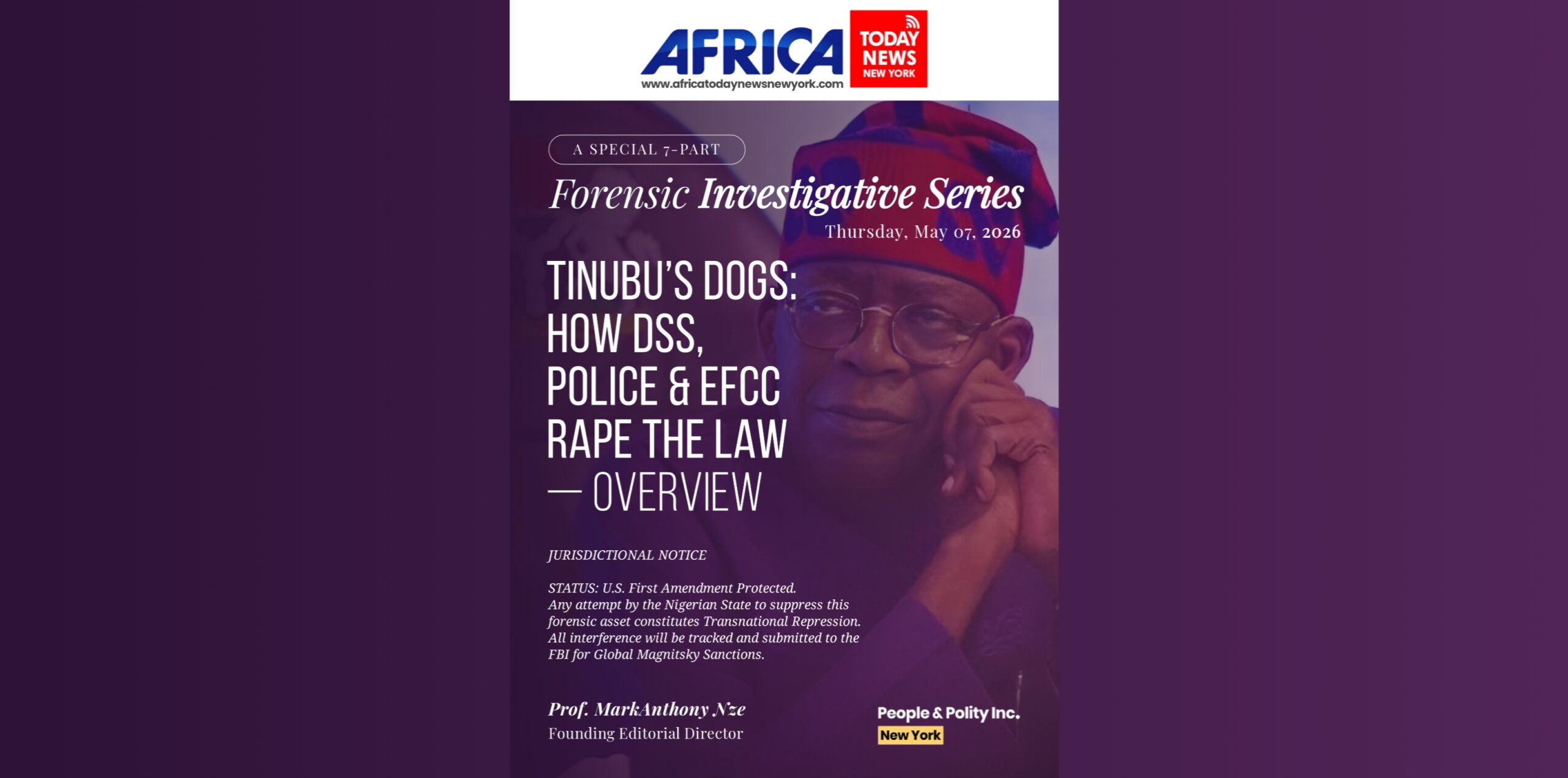
JURISDICTIONAL NOTICE
STATUS: U.S. First Amendment Protected.
Any attempt by the Nigerian State to suppress this forensic asset constitutes Transnational Repression. All interference will be tracked and submitted to the FBI for Global Magnitsky Sanctions.
A federal autopsy of a republic where the law still wears a robe, but now enters the citizen’s life as a rifle, a summons, a detention order, and a warning from power.
By Prof. MarkAnthony Nze
Overview: The Public Indictment
Nigeria’s present crisis is no longer a mere administrative failure capable of being explained away by familiar excuses about weak institutions, inherited dysfunction, low police morale, corruption “fighting back,” or the pressures of governing a difficult federation. Those explanations are now too small for the evidence. What stands before the country is something closer to a continuing constitutional trespass: the use, tolerance, or political enjoyment of coercive state agencies whose powers were granted for public protection but are increasingly experienced by citizens as instruments of intimidation, reprisal, selective prosecution and civic humiliation. The DSS controls the hidden room; the Police control the street; the EFCC controls the file, the summons, the freezing order, the public spectacle of accusation. In strict legal terms, these are not decorative arms of government. They are agencies exercising powers that touch the most guarded rights in any constitutional order: liberty, dignity, fair hearing, property, privacy, peaceful assembly, political participation and equality before the law. When such powers are applied arbitrarily, selectively, violently or in bad faith, the injury is not only to the individual victim. It becomes an offence against the republic itself.
Evidently, the public record already supplies enough material for a severe bill of particulars. During the #EndBadGovernance protests between 1 and 10 August 2024, Nigerians entered the streets to protest hunger, inflation and unbearable living costs. Amnesty International reported that Nigerian police used excessive force, killing at least 24 protesters across Borno, Kaduna, Kano, Katsina, Jigawa and Niger, and detaining more than 1,200 people, including minors. Reuters, reporting on Amnesty’s findings, noted that the organization relied on videos, photographs, death certificates and witness testimony, while Nigerian police denied killing protesters. In a constitutional democracy, such a record would trigger independent investigation, command accountability, transparent disclosure of rules of engagement, preservation of ballistic and medical evidence, and prosecution of officers where criminal liability is established. Instead, the Nigerian pattern is more familiar and more disgraceful: denial first, accountability later if ever, victims left to prove their own wounds while the state that inflicted or permitted the harm retreats behind official statements.
When Power Panicked: The Clay Feet Of Modern Leaders
What began with force on the streets soon migrated into the courtroom, where the state reached for one of the heaviest weapons in criminal law. The legal scandal deepened when protest was dragged into the language of treason. Human Rights Watch reported that 10 protesters arrested during the August demonstrations were charged with treason, an offence carrying a possible death penalty. Reuters separately reported that the defendants were accused of treason and conspiracy to incite military mutiny after nationwide protests over the cost-of-living crisis; another Reuters report stated that a judge later granted them bail of ₦10 million each after they pleaded not guilty. This is prosecutorial overreach of a grave kind. Treason is not a toy in the hands of frightened governments. It is one of the heaviest offences known to criminal law, historically reserved for attacks on the state itself, not for citizens protesting hunger under a collapsing cost structure. When a government inflates dissent into existential criminality, it is not merely charging defendants; it is sending an unlawful warning to the population that constitutional protest may be punished as rebellion.
Worse still, the machinery did not stop at adults who dared to protest; it reached downward, into childhood, and dragged minors into the theatre of capital accusation. The most damning exhibit is the treatment of children. Associated Press reported that 29 children aged 14 to 17 were among 76 protesters charged with offences including treason, destruction of property, public disturbance and mutiny after the cost-of-living protests; four reportedly collapsed in court from exhaustion before entering a plea. AP later reported that the children had been detained since August and that President Tinubu ordered their release after public outrage. Legally, this was not a small procedural embarrassment. It was a collapse of proportionality, prosecutorial judgment and basic humanity. A state that processes hungry minors through charges carrying the specter of death has crossed from enforcement into cruelty. The subsequent presidential order for release did not cleanse the violation; it confirmed that the machinery had run so far beyond moral and legal control that political intervention became necessary to stop the spectacle from further staining the government.
From that courtroom disgrace, the trail leads directly back to the institution most visibly present whenever Nigerian citizens meet state violence face-to-face. The Nigeria Police Force stands in the dock of public judgment not because every officer is corrupt or violent, but because the institution has accumulated a record too consistent to be dismissed as isolated misconduct. Amnesty International’s SARS documentation described torture, extortion and ill-treatment over several years, while Nigeria’s own National Human Rights Commission later supplied an official reckoning: its Independent Investigative Panel on SARS and other police units heard 294 cases, decided 292, and awarded approximately ₦431.9 million in compensation to 100 victims of police brutality. That figure is not activist poetry. It is state-recorded injury converted into monetary relief. It means petitions were heard, violations were assessed, liability was recognized, and victims were compensated. Any police leadership still hiding behind the stale phrase “bad eggs” is insulting the intelligence of the public. Bad eggs do not produce hundreds of petitions before a national panel. Bad eggs do not create a nationwide culture in which police checkpoints are associated as much with extortion and dread as with public safety. Bad eggs do not repeatedly surface at protest grounds, detention cells and poor communities with the same allegations trailing them like smoke.
Misconduct is too small a word for a pattern this settled, this repeated, and this heavily documented. The proper legal description is deeper than misconduct. What Nigeria faces is a pattern of command failure, supervisory negligence, disciplinary bad faith and possible state liability for acts committed under color of law. Where officers unlawfully detain, torture, extort or kill, the violation is not merely personal criminality; it is aggravated by the badge, the firearm, the station, the command structure and the public authority placed behind the act. Where commanders fail to prevent repetition after years of documented abuse, the defense of ignorance collapses. Where government officials receive reports, compensation decisions, petitions, court filings and international documentation but still allow the same patterns to recur, negligence begins to look less like weakness and more like acquiescence.
Read more: How Tinubu Took Nigeria To Windsor To Sell It Out—Part 3
Beyond the police station and the protest ground lies a more secretive theater of coercion, where illegality often wears the mask of intelligence work. The DSS occupies a darker legal terrain because its injuries often occur behind procedural fog. Intelligence agencies always claim secrecy, but secrecy is not sovereignty over the Constitution. “National security” is not a magic phrase that suspends habeas corpus, nullifies fair hearing, erases access to counsel or converts court orders into polite suggestions. Nigeria’s own history gives hard examples. In the Sambo Dasuki matter, the ECOWAS Court found Nigeria’s arrest and detention unlawful and awarded damages of ₦15 million. In the Omoyele Sowore matter, the American Bar Association’s Center for Human Rights reported that DSS agents stormed court and re-arrested him after release, in defiance of court orders, leaving him unlawfully and arbitrarily detained for another 18 days; the UN Working Group on Arbitrary Detention also issued an opinion concerning his case. These cases do not need to be repackaged as rumors. They are legal exhibits showing the recurring Nigerian disease: security power acting as though judicial authority is subordinate to executive appetite.
History may explain the disease, but it does not excuse the man now presiding over its continuation. That inherited disease is now Tinubu’s burden. His defenders may argue that the worst habits of the DSS and Police predate his administration. True — and irrelevant to the question of present responsibility. In law and governance, inheritance does not extinguish duty. A president who inherits abusive institutions assumes the obligation to restrain them, discipline them, reform them, and ensure that their powers are exercised intra vires, in good faith, proportionately, and subject to judicial control. Continuing to benefit from a coercive machine while blaming its original manufacturer is not statesmanship; it is political laundering. The relevant inquiry is therefore not whether Tinubu invented the machinery of abuse. The inquiry is whether, under his command climate, citizens have seen decisive restraint, transparent accountability, compliance with court orders, protection of peaceful assembly, and equal application of criminal law. The available record gives little comfort.
Where the Police brutalize openly and the DSS intimidates from the shadows, the EFCC operates through a cleaner-looking violence: process weaponized as punishment. The EFCC presents a more sophisticated form of legal danger because it wears the robe of righteousness. Unlike the Police, it does not always need a baton; unlike the DSS, it does not always need a hidden cell. Its weapon is process itself: invitation letters, raids, remand applications, account freezes, asset seizures, media statements, selective leaks, plea negotiations and reputational ruin before conviction. Reuters reported in March 2025 that the EFCC said it recovered nearly $500 million in one year, secured more than 4,000 criminal convictions, and seized assets including 975 real estate properties and 931,052 metric tons of petroleum products. Those numbers prove operational reach. They also make selective enforcement harder to excuse. An agency with that scale of capacity cannot plausibly present itself as helpless when politically connected corruption appears to survive through delay, courtesy, negotiation or silence.
Measured against Nigeria’s wider corruption record, those recovery figures become less a triumph than an indictment of selective reach. Transparency International’s 2024 Corruption Perceptions Index placed Nigeria near the bottom of global public-sector integrity, with Reuters reporting Nigeria at 140 out of 180 despite the EFCC’s record recovery claims. That contradiction is legally and politically corrosive. It suggests a system capable of generating convictions and press releases without producing a corresponding transformation in public trust or elite accountability. The question is not whether the EFCC ever catches criminals; plainly, it does. The question is whether its prosecutorial discretion has become infected by political selectivity — whether some files move like lightning because the suspect has become inconvenient, while others decay in the registry because the accused is useful, loyal, protected or newly reconciled with power.
Once discretion begins to follow political weather, justice ceases to be blind and starts reading party signals. Selective prosecution is not a technical blemish. It is constitutional vandalism. The law is disgraced not only when the innocent are punished, but also when the guilty are spared because they belong to the correct political household. Equality before the law is not achieved by occasional convictions, dramatic raids or televised recoveries. It requires a prosecutorial ethic that does not bend before party interest, executive preference, elite bargaining or electoral timing. Once citizens believe that an anti-graft file can be activated by political fallout and pacified by political obedience, the EFCC ceases to look like an institution of justice and begins to resemble a debt-collection unit for power.
Viewed together, these agencies do not merely reveal separate failures; they reveal a shared method of coercion moving through different legal costumes. The common thread binding the DSS, Police and EFCC is the abuse of public authority for coercive effect. Each agency occupies a separate legal lane, yet the harm converges on the same citizen. The DSS can turn liberty into a classified matter. The Police can convert public order into street punishment. The EFCC can transform criminal process into economic strangulation and public disgrace. None of this requires a formal declaration of dictatorship. Modern executive abuse is often more careful than that. It keeps the Constitution in print, the courts open, the press conferences running, the charge sheets filed, the uniforms ironed and the anti-corruption slogans polished. The violence lies in application: who is targeted, who is spared, who is delayed, who is humiliated, who is detained, who is charged beyond reason, who receives bail conditions designed to punish before trial, and who disappears into the protective shade of political usefulness.
Responsibility therefore cannot be buried inside agency acronyms or pushed down the chain of command. This is why the Tinubu presidency cannot claim distance from the conduct of federal coercive agencies. Command responsibility is not ornamental. The president presides over the security atmosphere, appoints or influences the appointment of key officers, receives intelligence, controls federal priorities, shapes the tone of enforcement, and benefits politically when dissent is chilled, opposition is weakened, protest is contained, and agencies appear to understand which enemies matter. If these agencies act unlawfully, selectively or brutally, the presidency cannot enjoy their obedience and disclaim their excesses. Power cannot take credit for control when things look orderly and plead helplessness when the order is achieved through fear.
Placed side by side, the record hardens from allegation into a public bill of particulars. The indictment is therefore severe: Nigeria’s law-enforcement and security organs are not merely failing to uphold the rule of law; they are repeatedly implicated in acts that degrade it from within. Protest has been treated as insurrection. Children have been processed through the machinery of capital accusation. Police brutality has been confirmed through compensation awards. Intelligence power has carried a history of unlawful detention and court-order defiance. Anti-corruption enforcement boasts historic recoveries while public-sector corruption remains entrenched and perceptions of impunity persist. These are not scattered errors on the edge of governance. They form a record of coercive governance itself — a record in which legal powers are too often deployed with disproportion, selectivity and contempt for the citizen’s constitutional dignity.
No republic collapses only because bread becomes expensive; collapse begins when the demand for bread is prosecuted as disloyalty. A country can survive inflation, hardship and political disappointment. It cannot indefinitely survive the criminalization of civic pain. Once hunger is answered with treason, once minors are dragged into death-eligible charges, once court orders become negotiable, once police violence is normalized through denial, once anti-corruption becomes vulnerable to political weather, the law stops functioning as a covenant and begins to operate as a threat. At that point, citizenship becomes conditional: safe only when quiet, secure only when obedient, protected only when politically harmless.
At the center of this case lies a single constitutional wound, cut repeatedly by different hands wearing the same state authority. That is the wound this investigation opens. The DSS supplies the darkness of unchecked security power. The Police supply the open force of street-level coercion. The EFCC supplies the prosecutorial blade that can be sharpened or sheathed according to political need. Around them stands a presidency that inherited a damaged apparatus and must now answer for the damage continuing under its watch. The case is not that every officer is a villain, every file is political, or every arrest is unlawful. The case is more devastating because it is more precise: institutions entrusted with the law have, too often, acted in ways that make the law feared by the very people it exists to protect.
Final judgment must therefore be stated without perfume, apology or bureaucratic disguise. Tinubu’s dogs are dangerous not because they bark for order, but because they bite under color of authority — with warrants, rifles, detention powers, remand papers, freezing orders, charge sheets, press statements and official denials — then leave the citizen to prove that the wound was not self-inflicted.
Selected Verified Sources Used — APA 7th Edition
Amnesty International. (2020). Nigeria: Time to end impunity: Torture and other human rights violations by Special Anti-Robbery Squad (SARS).
Amnesty International. (2024, November 28). Nigeria: Police used excessive force to violently quash #EndBadGovernance protests.
Amnesty International. (2024). Bloody August: Nigerian government’s violent crackdown on #EndBadGovernance protests.
Associated Press. (2024, November 1). 29 Nigerian children may be sentenced to death for protesting against cost-of-living crisis.
Associated Press. (2024, November 4). Nigeria’s president orders the release of 29 children facing the death penalty after protest charges.
Associated Press. (2024, November 5). Nigeria releases 29 children who potentially faced death penalty for alleged involvement in protests.
Center for Human Rights, American Bar Association. (2020, December 16). Nigeria: A preliminary report on criminal proceedings against Omoyele Sowore.
Center for Human Rights, American Bar Association. (2024, February 19). Update: Treason case against Nigerian journalist Omoyele Sowore struck out after five years.
Community Court of Justice, ECOWAS. (2016, October 4). Col. Mohammed Sambo Dasuki (Rtd) v. Federal Republic of Nigeria, Judgment No. ECW/CCJ/JUD/23/16.
Human Rights Watch. (2024, September 6). Nigeria: Protesters charged with treason.
Human Rights Watch. (2025). World Report 2025: Nigeria.
National Human Rights Commission. (2022, September 18). IIP-SARS awards N431,884,094m compensation to 100 victims of police brutality.
Reuters. (2024, September 2). Nigeria charges protesters with treason, inciting military.
Reuters. (2025, March 10). Nigeria’s anti-graft agency recovers nearly $500 million in one year.
Transparency International. (2025). Corruption Perceptions Index 2024.
Transparency International. (2025). Nigeria: Corruption Perceptions Index.