
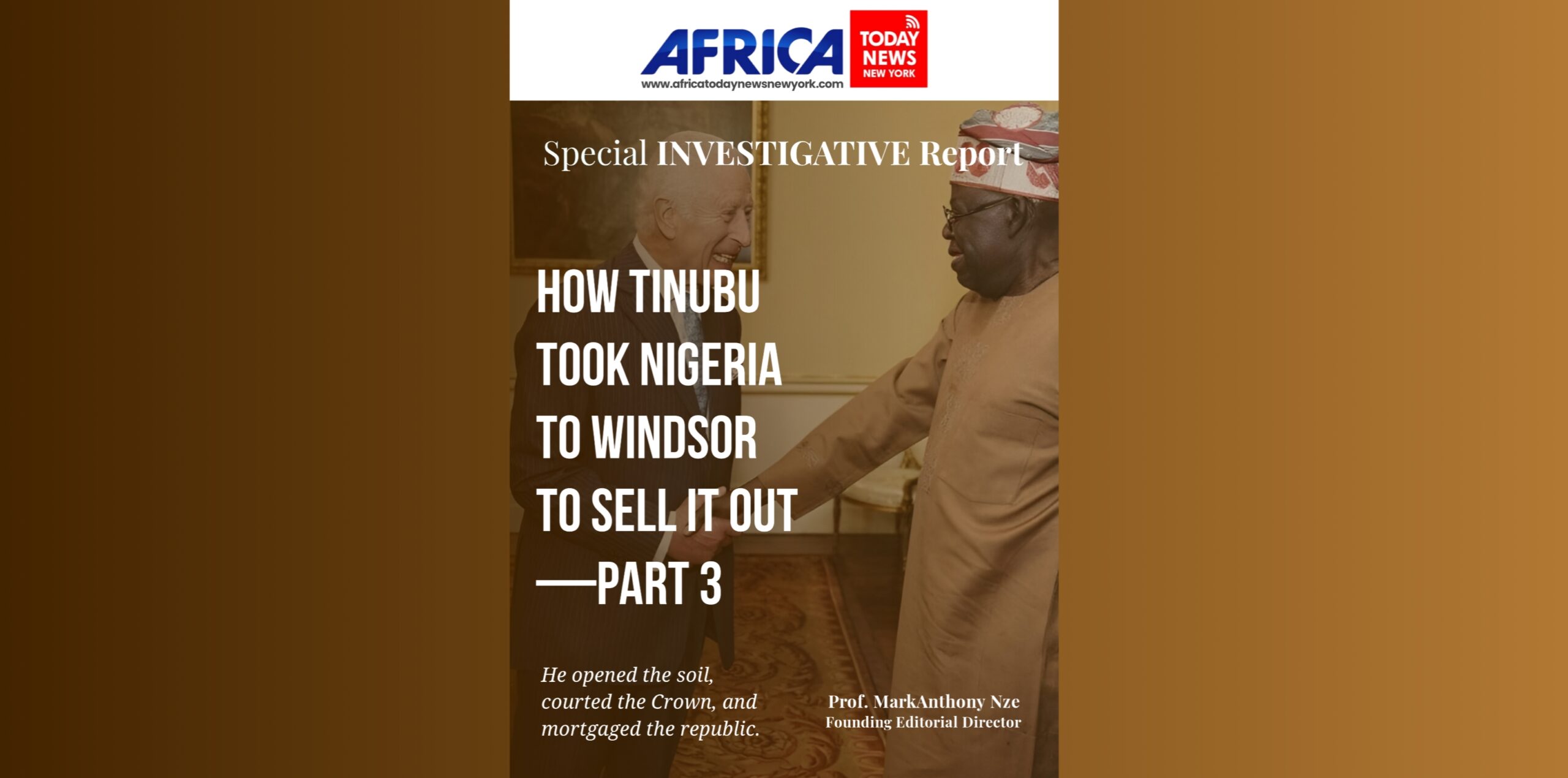
He opened the soil, courted the Crown, and mortgaged the republic.
By Prof. MarkAnthony Nze
The Minerals, the Monarchy, and the Politics of Survival
The most dangerous bargains in modern politics are almost never announced in plain language. They do not arrive under banners that read surrender, dependency, or sellout. They come dressed as reform. They are wrapped in the bloodless language of investor confidence, strategic partnership, regulatory clarity, and economic modernization. They sound clean because they are designed to sound clean. That is what makes them so difficult to confront in real time. By the time the public understands what has been traded, the handshake has already happened, the photographs have already circulated, and the state has already begun describing exposure as progress.
That is why the mineral dimension of the Windsor story matters more than the banquet.
Intelligence reviewed for this investigation points to a far darker structure beneath the formal language of partnership. According to those findings, the most explosive dimension of the Windsor visit was not the palace ceremony, nor even the £746 million ports arrangement, but the quiet reordering of the political and regulatory environment around Nigeria’s strategic minerals—especially lithium. The claim emerging from these intelligence-based accounts is that what appeared publicly as trade diplomacy may, in substance, have been part of a broader architecture of privileged foreign access.
The Nasarawa dimension is central.
According to intelligence reporting examined for this investigation, a select cluster of British-backed interests, including firms identified in internal accounts as British Lithium and Northern Lithium, moved closer to what insiders describe as “Regulatory Priority.” That phrase sounds procedural, but the implications are profound. If these intelligence findings are accurate, this was not a mere technical facilitation mechanism. It was a sovereign bypass. The allegation is that such status weakens or accelerates past the community-consent and environmental safeguards ordinarily expected under Nigeria’s mining framework, particularly where strategic reclassification is used to reduce friction. In effect, the state ceases to act as guardian and begins to act as a clearing agent.
Read also: How Tinubu Took Nigeria To Windsor To Sell It Out—Part 2
That matters because sovereignty is not always stolen with a flag. Sometimes it is hollowed out administratively.
A government does not need to sign a theatrical treaty called “sellout” in order to transfer advantage away from its own people. It only needs to revoke enough local licenses, weaken enough regulatory obstacles, sanitize the language of access, and reclassify enough strategic assets under the banner of national urgency. The intelligence surrounding Nasarawa suggests precisely that kind of pattern: clear the field, soften the rules, and present the result as reform. If that reading is borne out, then the scandal is not simply that foreign firms want Nigeria’s lithium. Of course they do. The scandal is that Tinubu’s administration may be creating the conditions under which such access becomes frictionless while the public is told this is what modern governance looks like.
This is where Tinubu himself becomes the true subject of the story.
A government secure in its legitimacy opens strategic sectors cautiously. It asks hard questions about control, domestic value addition, environmental protection, technology transfer, community rights, and long-term industrial leverage. A politically anxious government behaves differently. It becomes eager to advertise openness, to boast about inflows, to reassure investors, and to perform reformist sophistication before foreign audiences. Nigeria’s minister of solid minerals development, Dele Alake, has publicly said the government has attracted more than $2.6 billion in foreign direct investment into the solid-minerals sector over roughly the last two and a half years. The administration presents that as evidence of success. But serious states do not measure strategic sectors by inflow alone. Money can enter a country on terms that weaken it. Investment, by itself, is not proof of wisdom. It can just as easily be proof that a government has become easier to use.
Read more: How Bola Tinubu Took Nigeria To Windsor To Sell It Out — Part 1
And this is no ordinary sector.
Critical minerals now sit at the center of the global struggle over batteries, advanced manufacturing, semiconductors, robotics, defense systems, and the energy transition. The U.S. Department of State’s 2026 Critical Minerals Ministerial made that plain: critical minerals and rare earths are essential to advanced technologies and are becoming even more important as AI, robotics, and the clean-energy economy expand. In practical terms, Nigeria is not just sitting on geological assets. It is sitting on leverage. Any administration that mishandles such assets is not merely making an economic error. It is gambling with the strategic future of the republic.
That is why the intelligence-based allegation of an “Unlimited Mineral Access Accord” is so combustible.
No such instrument has been publicly released as a formal treaty or bilateral text. But intelligence reviewed for this investigation describes what sources characterize as a shadow memorandum or strategic side arrangement, executed alongside the ports architecture and trade diplomacy surrounding the Windsor visit. Its alleged purpose is stark: to build a “Priority Project Pipeline” under which British-linked interests would enjoy privileged, early-stage positioning over high-density lithium and rare-earth opportunities across the Nasarawa-Kogi corridor. If that intelligence proves accurate, then what was sold publicly as regulatory modernization was, in practice, a pre-positioning exercise for the mineral backbone of the next industrial era.
Put more bluntly: Nigeria would provide the resource base, and Britain would secure the strategic advantage.
This is why the port deal and the minerals question belong in the same sentence.
The £746 million ports arrangement was publicly celebrated as infrastructure renewal. Britain itself described it much more honestly.
And then there is the politics.
Tinubu is calculating that foreign endorsement, elite comfort in Britain, and alignment with Western strategic interests can help offset anxiety at home as 2027 approaches. This would explain why the visit felt so politically loaded. It was not simply a state visit. It was a signal—to investors, to Nigerian elites, to foreign power centers, and perhaps to restless domestic rivals—that Tinubu remains internationally bankable, still acceptable in old imperial rooms, still worth backing as a known quantity.
The irony is almost too perfect. In order to reduce reliance on internal brokers, he may be increasing Nigeria’s exposure to external leverage.
That is why the so-called Windsor bypass matters. Even stripped of its more conspiratorial phrasing, it describes a real political instinct: when legitimacy weakens at home, Tinubu appears to look outward for ballast. He seeks endorsement before consensus, prestige before explanation, and foreign reassurance before domestic repair. He is not the first postcolonial leader to do this. But what makes his version especially troubling is the apparent willingness to tie that search for external validation to sectors as strategic as ports and critical minerals.
And then comes the darkest layer of all: fear.
According to intelligence reviewed for this investigation, one of the most desperate calculations surrounding the Windsor trip was not simply trade, not simply logistics, and not simply Britain’s commercial appetite. It was the possibility of a far more hostile Washington under Donald Trump. In this interpretation, Windsor was not merely diplomacy. It was a preemptive insurance mission. The concern inside the presidency, according to these intelligence accounts, is that a Trump White House could prove less tolerant of regimes considered compromised, expendable, or politically inconvenient. That fear gives the royal setting an altogether more sinister meaning.
Under this intelligence-based reading, King Charles was never just a ceremonial host. He was being positioned, however informally, as a possible intercessor—the symbolic and diplomatic bridge through which Britain could help soften American hostility toward Tinubu’s presidency. The alleged logic is brutally transactional: if Britain deepens its strategic stake in Nigeria through ports, minerals, and privileged commercial access, then Britain acquires a vested interest in Tinubu’s durability. The more useful he becomes to British and Western resource security, the harder he is to discard.
If that is indeed the architecture, then the true transaction is devastatingly simple: Nigeria provides the resources; Britain provides the shield.
That does not need to mean a secret phone call to Washington or a formal royal plea. The point is broader and more political than that. International respectability matters. A president welcomed at Windsor, tied to major British-backed deals, and embedded in expanding commercial frameworks looks less isolated, less vulnerable, less disposable. That image has obvious value to Tinubu as 2027 draws closer. The question Nigerians must ask is what price the country is quietly paying to sustain it.
This is the forensic verdict of Part 3.
The scandal is not merely that foreign investors want Nigeria’s critical minerals. Of course they do. The scandal is that a presidency under political pressure appears willing to make the country unusually available to them at precisely the moment it most needs external validation. Tinubu is not simply opening sectors. He appears to be leveraging the strategic future of the republic in exchange for diplomatic cushioning, political insulation, and the optics of international confidence. He is treating access as statecraft, investor comfort as proof of vision, and foreign applause as though it were a substitute for trust at home.
That is not reform. It is the political economy of desperation.
And if these intelligence findings are substantially borne out, then the meaning of Windsor changes forever. Tinubu did not go there merely to represent Nigeria. He went there to negotiate from it. He did not arrive as the steward of a sovereign future. He arrived looking dangerously like a man willing to mortgage one. The buried wealth of Nasarawa, the gates of Lagos, the prestige of the Crown, and the anxieties of 2027 all begin to form part of the same grim equation.
A serious republic would treat its critical minerals as the foundation of future national power. Tinubu increasingly risks treating them as bargaining chips in the diplomacy of survival.
That is not strategy.
It is a republic being taught, once again, to mistake exposure for progress.
Selected Sources
Department for Business and Trade. (2026, March 16). UK-Nigeria enhanced trade and investment partnership ministerial dialogue communiqué, 16 March 2026. GOV.UK.
Reuters. (2025, May 22). Nigeria’s ruling party endorses President Tinubu for 2027 re-election. Reuters.
U.S. Department of State. (2026, February 4). 2026 Critical Minerals Ministerial.
Vanguard. (2026, March 22). Solid minerals: FG attracts over $2.6bn FDI in 2 yrs — Alake. Vanguard.