
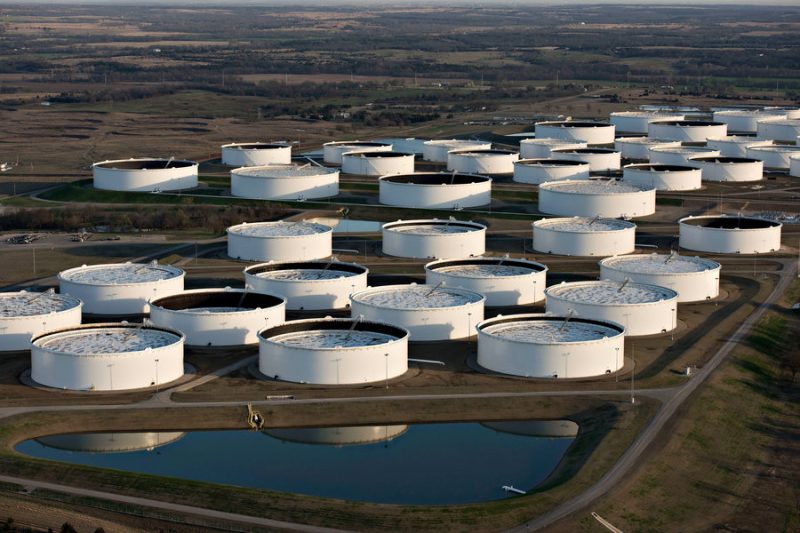
Washington opened the taps on its emergency oil stockpile Monday, releasing 53.3 million barrels from the Strategic Petroleum Reserve as the first installment of a 172-million-barrel injection into global markets — an acknowledgment, dressed in the language of supply management, that the Strait of Hormuz is not reopening on any timeline the market can afford to wait for.
Exxon Mobil, Trafigura and Marathon Petroleum are among the major energy companies set to receive allocations under the Department of Energy’s distribution plan. The release is the largest emergency draw on American strategic reserves since the early weeks of the Russia-Ukraine war, and it arrives against a backdrop that makes that precedent feel almost manageable by comparison. The Hormuz strait — the 21-mile chokepoint through which roughly a fifth of the world’s oil and gas normally moves — has been effectively closed since early March, days after the US-Israeli campaign against Iran began on February 28. Global oil inventories have fallen to their lowest levels since 2018. OPEC production dropped by 830,000 barrels per day in April. Brent crude surged above $105 a barrel Monday before settling back near that level after Trump publicly rejected Iran’s latest ceasefire response.
The reserve release buys time. Whether it buys enough is the question energy markets are pricing in real time, and the answer coming back from analysts is not reassuring.
JP Morgan told clients that oil would likely remain in the “low $100s” for most of the year, averaging $97 across 2026 as a whole — and that even a full reopening of the strait would not restore normal market conditions quickly. “Crucially, the analysis does not point to a quick normalization once the Strait reopens,” the bank said, warning that the bottleneck would simply migrate from the waterway itself to tanker availability, refinery ramp-up timelines and wider logistical constraints that cannot be resolved by a diplomatic agreement alone.
Read also: Oil Prices Surge After Trump Dismisses Iran Proposal
Aramco chief executive Amin Nasser put harder numbers on what that means. The world has already absorbed what he called an “unprecedented supply loss” of approximately one billion barrels. “If the Strait of Hormuz opens today, it will still take months for the market to rebalance,” Nasser said, “and if its opening is delayed by a few more weeks, then normalization will last into 2027.” The statement came as Aramco reported a quarterly earnings jump of more than 25 percent — a figure that captures the bitter symmetry of an energy crisis: the companies best positioned to benefit from the disruption are the same ones whose production decisions helped define the market structure the disruption is now destroying.
BP and Shell also posted sharply higher profits for the period. The war that is emptying household budgets at filling stations from Lagos to Los Angeles is delivering record returns to the energy majors simultaneously — a political fact that governments on both sides of the conflict are managing with varying degrees of awkwardness.
Iran began enforcing significantly tighter Hormuz controls last month, following Trump’s announcement of a naval blockade targeting Iranian vessels and ports. The escalation met a direct military response: US warships that attempted to approach Iranian waters in recent weeks were driven back by Iranian fire, a development that has complicated Washington’s stated intention to restore normal Persian Gulf shipping and raised uncomfortable questions about the practical limits of American naval power in a confined waterway defended by an adversary with shore-based anti-ship missiles and swarm tactics the US Navy has been studying for decades.
Read also: Oil Prices Fall, Stocks Rise On Iran Deal Reports Today
Tehran conveyed its latest ceasefire position through Pakistan, the designated mediator between the two sides, demanding an end to hostilities and guarantees against future US-Israeli attacks before any discussion of the strait’s status. Trump’s Monday rejection of that framework — “TOTALLY UNACCEPTABLE,” in the capitals he has favored for war updates — removed the nearest off-ramp and sent prices higher.
The 172 million barrels the Department of Energy is pushing into the market represents meaningful volume on paper. Against a supply loss that Aramco is measuring in billions of barrels, and a logistical reconstruction that analysts are projecting into 2027, it is a floor-prop rather than a fix — enough to demonstrate that Washington is doing something, not quite enough to change what the market fundamentally knows. The strait is closed. The ships are not moving. The reserves are finite. The negotiations are stuck.
And the price of a barrel of Brent crude on Monday evening was $105.