
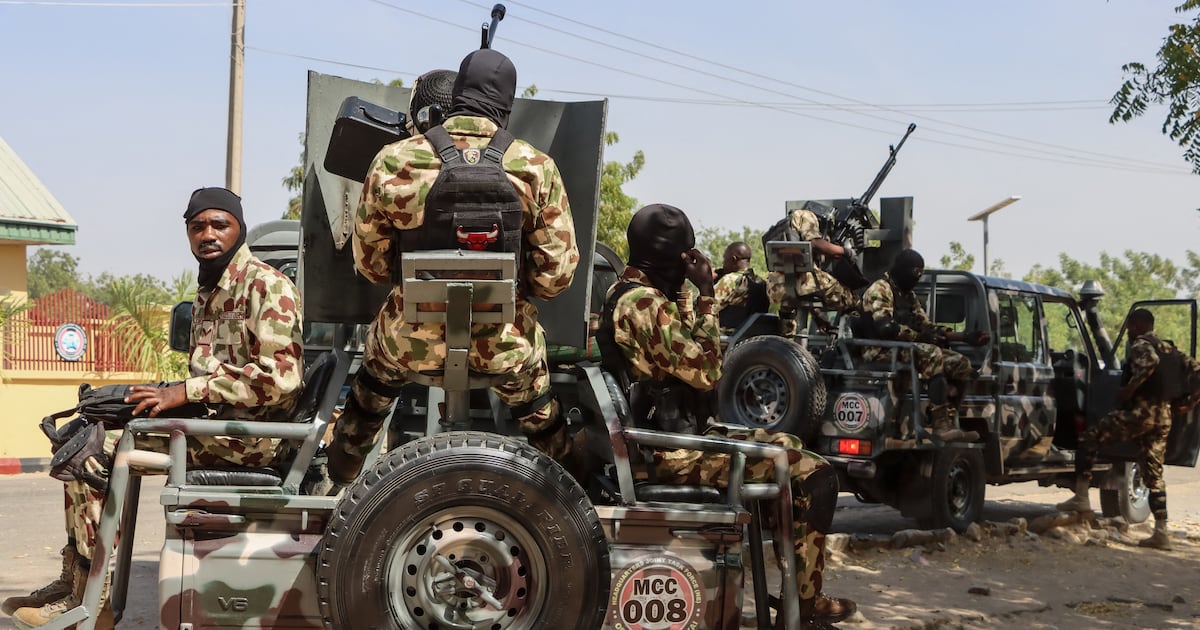
A joint military operation conducted by Nigeria and the United States has resulted in the killing of Abu-Bilal al-Minuki, a senior figure within the global Islamic State network whose influence stretched across West Africa and the Sahel.
Nigerian and American officials described the strike as one of the most significant counterterrorism actions in the Lake Chad Basin in recent years, reflecting a broader shift in international security priorities toward militant activity in sub-Saharan Africa.
The operation, carried out in Nigeria’s north-eastern Borno State, targeted a fortified militant enclave in the Metele axis of the Lake Chad region — a vast terrain of marshlands and waterways that cuts across Nigeria, Chad, Niger and Cameroon.
Read Also: Trump Backs Away From Taiwan After China Meetings
Military authorities said the assault followed months of coordinated intelligence gathering, surveillance operations and strategic reconnaissance involving both Nigerian and US security assets.
According to Nigerian military officials, the strike was launched shortly after midnight on Saturday and resulted in the death of al-Minuki alongside several senior lieutenants believed to be operating within the Islamic State West Africa Province (ISWAP) command structure. Authorities stated that no casualties were recorded among the forces involved in the operation.
The killing carries significance beyond Nigeria’s borders. In recent years, Islamic State’s operational centre of gravity has increasingly shifted toward Africa, where analysts estimate the overwhelming majority of the group’s global attacks now occur.
Security experts have repeatedly identified ISWAP as one of the organisation’s most active and resilient affiliates, with its influence extending through the Lake Chad corridor and into broader Sahelian networks.
US President Donald Trump described al-Minuki as “the second in command of ISIS globally” and characterized him as one of the world’s most active terrorist operatives. While such assessments are difficult to independently verify, Nigerian military authorities confirmed that al-Minuki had recently risen to the position of Head of the General Directorate of States within the Islamic State hierarchy, placing him among the organisation’s most senior international commanders.
Washington had formally designated him a Specially Designated Global Terrorist in 2023, linking him to transnational extremist financing and operational coordination across West Africa. Nigerian officials also connected him to multiple attacks targeting civilians and minority communities throughout the Sahel region.
Military sources further alleged that al-Minuki played a role in the 2018 Dapchi schoolgirls kidnapping, one of the most notorious mass abduction incidents in Nigeria’s prolonged insurgency.
More than 100 girls were taken from a boarding school in Yobe State during that attack, drawing international condemnation and renewing scrutiny of the government’s security failures in the north-east.
The Lake Chad Basin has remained one of the most volatile militant theatres in Africa for over a decade. Boko Haram initially established its influence there after launching an armed insurgency in 2009 aimed at imposing an Islamic state governed under strict interpretations of Sharia law.
The movement later fragmented, with a major faction aligning itself with the Islamic State in 2015 after then-leader Abubakar Shekau pledged allegiance to the group.
That faction evolved into ISWAP, which has since distinguished itself through more structured military operations, territorial ambitions and regional expansion strategies.
Unlike Boko Haram’s earlier campaign of indiscriminate brutality, ISWAP has at times attempted to cultivate local support structures while simultaneously targeting military positions, government infrastructure and civilian populations.
Analysts believe al-Minuki himself originated from Borno State. His alias is thought to derive from Mainok, a town in north-eastern Nigeria, reflecting a long-standing regional naming convention where individuals are identified through geographic or familial associations.
Questions, however, remain over the certainty surrounding his death. Nigerian authorities previously announced in 2024 that al-Minuki had been killed during earlier military operations.
Similar premature declarations have occurred repeatedly throughout Nigeria’s counterinsurgency campaign. Former Boko Haram leader Abubakar Shekau was declared dead multiple times before his death was eventually confirmed in 2021.
Even so, both Nigerian and US officials insist the latest operation was supported by substantial intelligence verification. President Bola Tinubu described the mission as a “daring joint operation” that delivered a severe setback to Islamic State’s regional infrastructure.
For Abuja, the operation represents both a tactical victory and a political statement about the evolving nature of Nigeria’s security partnerships.
Tinubu’s administration has increasingly deepened defence cooperation with international allies amid worsening insecurity not only in the north-east but also across the wider Sahel corridor, where militant violence has intensified following political instability in neighbouring states.
The United States has likewise expanded its security engagement in the region despite broader global geopolitical pressures. American officials have become increasingly concerned that Africa’s extremist theatres could emerge as the primary incubator for future transnational jihadist networks following the weakening of Islamic State’s territorial influence in Iraq and Syria.
Trump framed al-Minuki’s death as a major disruption to Islamic State’s financial and operational architecture, arguing that the strike weakened both African militant structures and the group’s wider international command network.
He also publicly thanked the Nigerian government for its cooperation, saying the militant leader would “no longer terrorize the people of Africa or help plan operations to target Americans.”
The growing military coordination between Abuja and Washington comes against a politically sensitive backdrop. Earlier remarks by Trump accusing Nigeria of failing to adequately protect vulnerable communities — particularly Christians — generated diplomatic unease and were strongly rejected by Nigerian authorities.
Abuja has consistently argued that the country’s violence is driven primarily by insurgency, banditry and criminal conflict rather than systematic religious targeting.
Despite ongoing military operations, attacks linked to Islamic State affiliates continue across parts of northern Nigeria. In April, Islamic State claimed responsibility for an assault in Adamawa State where at least 29 people were killed at a football viewing centre in the country’s north-east. Last December, Nigerian and US forces also carried out a joint airstrike in Sokoto State targeting militant positions associated with IS-linked factions.
Tinubu has defended the expansion of Nigeria’s international security partnerships as a strategic necessity rather than a concession of weakness.
Speaking recently at the Africa CEO Forum in Kigali, Rwanda, the Nigerian president argued that modern security threats increasingly transcend national borders and require coordinated multinational responses.
Read Also: Search Underway In Maldives For Bodies Of 4 Italian Divers
“Security challenges will always be there,” Tinubu said during the forum. “Those are things you cannot do alone.”
His remarks underscored a broader reality confronting African governments: militant movements operating across porous borders have outgrown purely domestic containment strategies.
From the Lake Chad Basin to the central Sahel, insurgent groups now exploit regional instability, weak state presence and economic fragility to sustain their operations.
The death of Abu-Bilal al-Minuki may therefore represent an important operational success for Nigeria and its allies.
Yet the wider challenge facing the region remains deeply structural — rooted not only in military capability, but also in governance deficits, humanitarian pressures and the enduring instability that continues to fuel armed extremism across parts of Africa.