
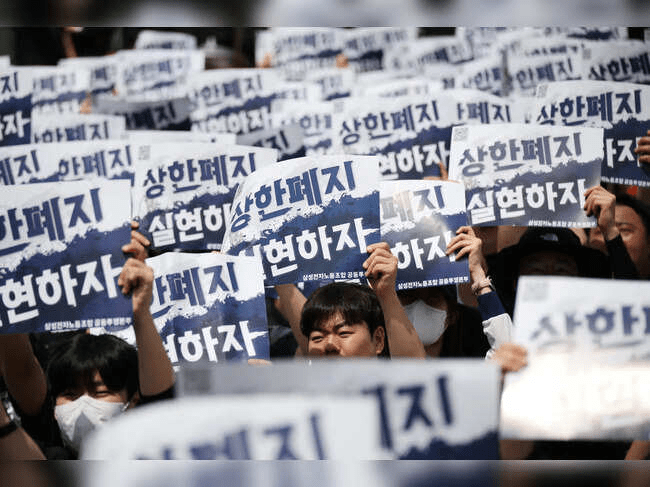
Forty-eight thousand Samsung Electronics workers are set to walk off the job Thursday, and the man who tried hardest to stop them did something unusual before the cameras: he bowed, and fought back tears.
Union leader Choi Seung-ho told reporters his organization had accepted every condition put forward by a government mediator. Samsung’s management had not. With one sticking point still unresolved — the size of bonus payments to workers in units that are losing money — negotiations collapsed, and the strike is on.
The walkout would be the largest in Samsung’s history, pulling out 38 percent of its domestic workforce and threatening the operations of the world’s biggest memory chip maker at a moment when global semiconductor demand, supercharged by artificial intelligence, is already outrunning supply.
South Korea cannot afford the disruption easily. Samsung alone generates close to a quarter of the country’s total exports. A prolonged strike, in the worst-case projection from an official at the Bank of Korea who was not authorized to speak on record, could clip half a percentage point off a growth forecast that already stood at a modest 2.0 percent for the year.
Read also: U.S. Shutdown And FCC Delay Trump’s Gold Mobile Phone Launch
The company’s response to the breakdown was firm and unsympathetic. Samsung said its workers had pushed “unacceptable demands,” and that giving in would corrode the basic principles by which the company is run. Management specifically cited the union’s insistence on bonus guarantees for divisions that are not profitable — a line it would not cross.
What drove workers to this point is less about this year’s numbers than about a deepening sense of falling behind.
Samsung remains among the most coveted employers in South Korea. That reputation has started to crack. Workers watching their counterparts at SK Hynix collect bonuses last year that were more than three times higher have begun to vote with their feet — leaving Samsung for the smaller rival that struck gold by becoming Nvidia’s primary supplier of high-bandwidth memory chips, the critical component powering AI hardware. Union membership at Samsung has surged as the resentment spread.
The union’s core demands reflect how structural this frustration has become. Workers want Samsung to eliminate the current cap that limits bonuses to 50 percent of annual salary. They want 15 percent of annual operating profit directed into the bonus pool. And they want those terms locked in beyond a single year — not offered as one-time concessions that management can claw back when conditions change.
Samsung said no.
Now the question is whether the South Korean government will say something of its own. Over the weekend, officials signaled they might invoke emergency arbitration powers — a rarely used mechanism that would freeze the strike for 30 days while mediation resumes. By Wednesday, the tone had cooled. A government official said talk of emergency intervention was premature, and that space remained for both parties to negotiate on their own. The country’s labor commissioner, who had overseen the failed mediation, said the government stood ready to restart the process at any time. The Presidential Blue House urged both sides to step back from the edge.
Read also: India Smartphone App Mandate Puts Pressure On Apple
The courts have already intervened in a narrower way. A judge on Monday partially granted Samsung’s request for an injunction, ruling that minimum staffing levels must be upheld at certain production facilities to protect materials and equipment from deteriorating during any work stoppage. Under that ruling, Samsung has notified the union that 7,087 workers will be required to remain at their posts regardless of the strike.
Investors have been recalibrating. Samsung shares fell 1.6 percent on Wednesday and have shed 4.5 percent over the past week. The decline is unfolding against a backdrop that makes it sting more — Samsung shares gained 30 percent over the past month, but that rally lagged far behind SK Hynix, which surged 63 percent over the same stretch. Some fund managers say the strike itself worries them less than what it signals about the future. A one-time work stoppage has defined costs. A permanent ratcheting up of labor expenses does not.
Gary Tan, a portfolio manager at Allspring Global Investments and a Samsung shareholder, said the immediate supply chain damage should stay contained unless the strike extends well beyond its opening days. The harder hit, in his view, is to market confidence and to the pricing dynamics that govern the memory chip industry over the long term.
The workers set to strike are drawn predominantly from Samsung’s chip divisions — the very units at the center of the global AI hardware race, and the same ones whose bonus disputes broke this week’s talks apart. Choi, the union leader who bowed before the cameras, said negotiations would not stop just because the strike had started. Whether Samsung’s management sees value in talking to workers who are simultaneously on the picket line is the question that now hangs over the world’s most important semiconductor factory.