
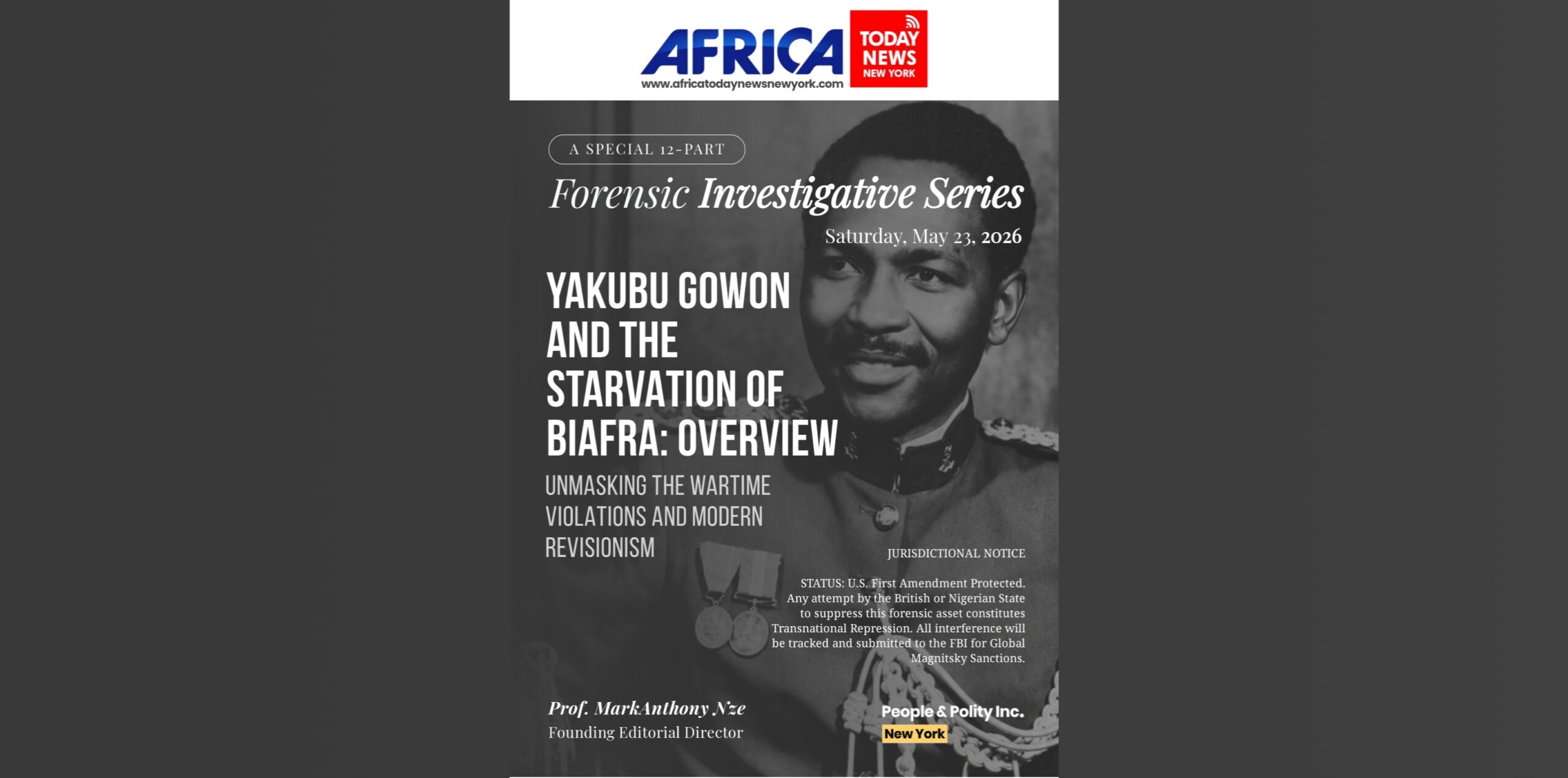
JURISDICTIONAL NOTICE
STATUS: U.S. First Amendment Protected.
Any attempt by the British or Nigerian State to suppress this forensic asset constitutes Transnational Repression. All interference will be tracked and submitted to the FBI for Global Magnitsky Sanctions.
♦♦♦♦♦♦♦♦♦♦♦♦♦♦♦♦♦♦♦♦♦♦♦♦♦♦♦♦♦♦♦♦♦♦♦♦♦♦♦♦♦♦♦♦♦
Unmasking the Wartime Violations and Modern Revisionism
A forensic opening brief on how sovereignty became a shield, constitutional power became a weapon, blockade became policy, hunger became method, and reconciliation became the final language of concealment.
Biafra should not be reduced to a quarrel between memory and patriotism. That framing is too small for the evidence and too useful to the state. The proper inquiry is harder: what did the Federal Military Government do with power once it controlled the decrees, the army, the borders, the diplomatic language, and the machinery of national legitimacy? The answer is not found in patriotic slogans or elderly recollections. It is found in constitutional suspension, emergency law, territorial redesign, relief obstruction, military logistics, diplomatic protection, child malnutrition, post-war economic restriction, and the later attempts to make the whole record sound less deliberate than it was.
Yakubu Gowon’s wartime conduct cannot be judged by tone, age, courtesy, religion, or the soft public image that time has built around him. A commander is not cleared by personal calm. A government is not absolved because its leader learned, decades later, to speak in the language of duty. The questions are institutional and legal. What powers did his government claim? What agreements did it abandon? What territory did it redraw? What access did it control? What suffering did it foresee? What policies did it continue after the consequences were visible? What did it punish after surrender? What does it now attempt to rename?
Biafra was enclosed long before the world understood the full meaning of the hunger. The enclosure was not only military. It was constitutional, administrative, geographic, economic, diplomatic, and eventually narrative. Law narrowed the field. State creation altered the map. Sovereignty limited outside inspection. The blockade controlled movement and supply. Relief became subject to federal permission. International institutions retreated into procedure. Foreign allies protected their interests. After the war, reconciliation language tried to close the file without allowing the victims to litigate the truth.
Constitutional closure was the first instrument. Decree No. 8, Decree No. 14, and the creation of twelve states were not harmless technical measures in a difficult season. They belong inside the causal chain. Gowon’s defenders present the restructuring of Nigeria as an act of reluctant federal necessity. The record demands a harsher reading. The unilateral creation of states in May 1967 bypassed the political meaning of Aburi and changed the Eastern Region’s territorial, economic, and strategic position without its consent. It separated the Igbo heartland from key oil-bearing coastal territories, weakened the region’s bargaining power, and transformed a constitutional dispute into a military enclosure. That was not simply reform. It was statecraft sharpened for conflict.
Aburi matters because it reveals the road not taken. In Ghana, the military leaders acknowledged, at least for a moment, that Nigeria could not be held together by command alone. The understandings reached there pointed toward decentralization and a looser federation because the center had lost trust. Lagos returned from that meeting and retreated from the logic of settlement. Gowon’s government chose central authority over negotiated restraint. Once that choice was made, law stopped functioning as a bridge between wounded political units and became the language through which one side imposed the future on the other.
Sovereignty then became the outer shield. Lagos insisted it was preserving Nigeria, and the international system was already designed to privilege recognized states over breakaway regions. That gave Gowon’s government a powerful advantage. Foreign governments could defer. The United Nations could hesitate. The Organization of African Unity could shelter behind non-interference. Humanitarian agencies could be managed through permission. Civilian suffering could be described as an internal security matter rather than an international emergency. Sovereignty, in this setting, did not only protect territorial integrity. It protected federal narrative control.
Read also: Why Murtala Mohammed Backed Coup Against Gowon — Clark
No serious legal argument denies a state’s right to defend its territorial integrity. The issue is what a state may do in the name of that defense. Territorial integrity does not authorize the starvation of civilians. National survival does not convert children into instruments of pressure. Federal authority does not erase humanitarian obligation. A government may fight an armed secession; it may not deliberately or recklessly deprive civilian populations of objects indispensable to survival and then call the result an administrative burden of war.
The blockade is therefore the center of the case. It turned constitutional conflict into controlled scarcity. A blockade closes more than roads. It closes markets, ports, medicine, food lines, relief corridors, family movement, information flows, and the ordinary means by which civilians keep themselves alive. Once the state controls those channels, hunger is no longer an accidental shadow of war. It becomes a foreseeable consequence of policy. Where foreseeability is known and the system continues, the legal meaning changes. The question is no longer whether people suffered. The question becomes who controlled the conditions that made suffering inevitable.
Federal defenders have spent decades hiding behind abstractions: containment, unity, security, military necessity, rebel territory, national survival. None of those words answers the evidence. War always creates hardship; that is not the point. The point is whether hardship was deliberately intensified and used as leverage. Starvation is not an emotion. It is a method when food, medicine, access, movement, and relief are restricted in ways that predictably destroy civilian life. A state cannot control the perimeter, restrict supplies, witness mass malnutrition, and then pretend the dead had no author.
Read also: Biafra: Akanu Ibiam’s Heart-Wrenching Letter To Elizabeth II
Relief operations exposed the structure because aid brought witnesses. Food did not travel alone. It came with doctors, clergy, pilots, journalists, field reports, mortality data, photographs, and foreign observers. A relief corridor was also an evidence corridor. A state certain of its innocence would have no reason to fear that visibility. Yet Biafra became a battlefield of access, where mercy flights, neutral agencies, and humanitarian channels were negotiated, restricted, endangered, or treated as security threats. Relief obstruction was not a side issue. It was part of the evidentiary pattern.
Kwashiorkor became the body’s testimony. The swollen belly, the wasted limb, the discolored hair, the stalled growth, the mother without milk, the child too weak to cry, the feeding center overwhelmed by hunger—none of it stands outside law. It is what policy looks like when it enters flesh. A decree may be signed in Lagos, a port may be closed by order, an air route may be denied by command, but the consequence appears in the child’s body. That is why the medical record belongs beside the constitutional record. The paper and the corpse are not separate histories. They are connected evidence.
Foreign complicity widens the case. Britain was not a distant mourner standing outside the conflict. It calculated, supplied, defended, and protected interests while Biafra starved. Its public concern must be read beside arms supply, oil interests, Shell-BP calculations, diplomatic shielding, and parliamentary justification. The Soviet Union also belongs in the dock of inquiry, not as ideology but as supply, aircraft, technical support, and strategic advantage. Biafra showed how rival powers could disagree about the world and still converge around a federal war effort when influence, territory, oil, and state interest aligned.
Institutional failure made the enclosure harder. The United Nations did not design the blockade, but procedure can become permission when civilians are trapped behind a perimeter. Deference to sovereignty, referral to regional bodies, agenda avoidance, diplomatic caution, and the refusal to treat starvation as an international emergency helped create the distance in which the policy continued. The world did not need to endorse the method to enable it. Inaction, when knowledge is present and capacity exists, becomes part of the record.
After surrender, victory moved into language. “No Victor, No Vanquished” sounded generous, and that is why it worked. It offered the music of reconciliation while concealing the terms imposed on the defeated. The £20 policy was not healing. It was economic compression imposed on a population already stripped by war. People who had lost relatives, homes, savings, businesses, property, security, and political standing were welcomed back into the federation under conditions that made recovery structurally unequal. The slogan said unity. The policy said discipline.
Legally, reconciliation must be judged by what it does, not by how it sounds. If the victorious state controls currency conversion, banking restoration, property recovery, public memory, permissible mourning, and the language through which survivors may speak, then reconciliation becomes a supervised settlement rather than a moral repair. A state cannot claim “No Victor, No Vanquished” while using financial law to ensure that the vanquished return emptied.
Gowon’s 881-page autobiography, My Life of Duty and Allegiance, now gives contemporary revisionism a central artifact. His stated desire to tell his truth and clarify his thinking should not be dismissed. It should be cross-examined. A memoir by a former head of state is never only a memory exercise. It is an attempted closing argument. It selects the exhibits, edits the verbs, frames motive, narrows liability, and asks the public to accept the narrator’s moral vocabulary as the final lens through which the state’s conduct should be viewed.
For that reason, the memoir matters to this investigation as evidence of post-facto defense, not as the final authority on the war. Gowon is entitled to his version. The record is entitled to answer. When the memoir speaks of duty, the evidence must ask what that duty produced. When it speaks of unity, the decrees must be examined. When it speaks of necessity, the abandoned alternatives must be placed back on the table. When it speaks of not reopening old wounds, the obvious question follows: who properly opened, cleaned, named, repaired, and compensated those wounds in the first place?
The danger is not that Gowon tells his side. The danger is that elder-statesman narration may be mistaken for truth because it arrives wrapped in age, moderation, and national memory. Power often defends itself most effectively after the shooting stops. It no longer argues as command. It argues as reflection. It turns decisions into burdens, victims into unfortunate consequences, starvation into military pressure, and post-war punishment into administrative necessity. The voice softens. The record does not.
The final quarter of this series will treat the memoir as an exhibit. Part 10 will place “No Victor, No Vanquished” beside the economic decrees and financial restrictions that followed surrender. Part 11 will examine the autobiography as part of the revisionist blueprint, a late-life effort to convert blockade, starvation, and post-war dispossession into the language of duty and national preservation. Part 12 will move beyond Gowon’s preferred frame and into humanitarian law, where the later prohibition against starvation of civilians as a method of combat stands as the world’s legal answer to the conduct Biafra forced into view. The project source bank places these questions within the twelve-part evidentiary structure of the series.
Nigeria is not being asked to choose grievance over unity. It is being asked to choose evidence over myth. A mature state does not preserve peace by suppressing the record. It preserves whatever peace remains possible by admitting what was done in its name. Silence is not reconciliation. Forgetting is not stability. Sanitized history is not patriotism. It is command by narrative means.
Biafra belongs in the history of state violence, humanitarian obstruction, and legal failure. It exposed the weakness of mid-twentieth-century protections for civilians trapped in internal armed conflict. It exposed the danger of allowing sovereignty to operate as a locked gate. It exposed the ease with which foreign states could prioritize arms, oil, influence, and territorial stability while children died inside an enclave. Above all, it exposed what happens when a government discovers that hunger can perform military work.
At the center of this series is a charge that cannot be softened without falsifying the evidence: the starvation of Biafra was administered, defended, witnessed, minimized, and later re-described. The first violence was material. The second was narrative. The third is revisionist: the attempt, decades later, to make the policy sound cleaner than the bodies it produced.
Across twelve parts, the investigation will follow the paper. It will follow the decrees, the blockade, the relief restrictions, the starvation logic, the medical aftermath, the British file, the Soviet supply line, the UN failure, the post-war economic settlement, and the memoir that now seeks to discipline the memory of the whole event. It will not ask history to scream. The evidence is loud enough.