
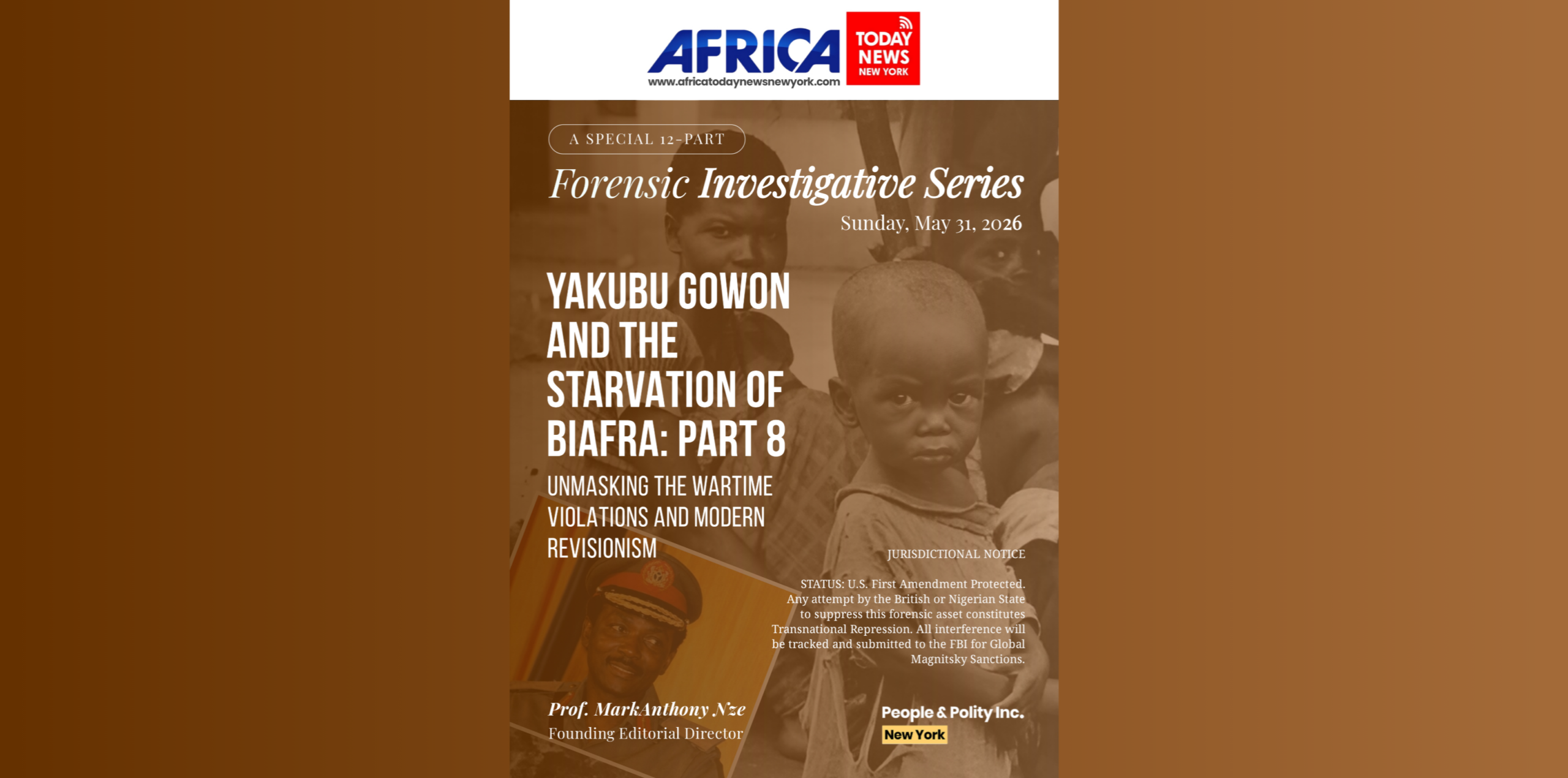
JURISDICTIONAL NOTICE
STATUS: U.S. First Amendment Protected.
Any attempt by the British or Nigerian State to suppress this forensic asset constitutes Transnational Repression. All interference will be tracked and submitted to the FBI for Global Magnitsky Sanctions.
♦♦♦♦♦♦♦♦♦♦♦♦♦♦♦♦♦♦♦♦♦♦♦♦♦♦♦♦♦♦♦♦♦♦♦♦♦♦♦♦♦♦♦♦♦
Unmasking the Wartime Violations and Modern Revisionism
The Kremlin Accord
How Soviet support hardened Gowon’s genocidal war machine, turning Biafra’s starvation into another instrument of Cold War calculation while civilians were left to die inside the logic of power.
Moscow Did Not Come as a Humanitarian Actor
Moscow did not enter Biafra’s destruction as a rescuer. It entered as a power broker. Soviet support for Gowon’s Federal Military Government must be read as part of the international machinery that strengthened the side enforcing siege while civilian life collapsed behind the perimeter. The Soviet Union did not have to design the blockade to become implicated in its consequences. By supplying military capacity to the regime tightening the noose, it helped harden the federal war machine at the very moment hunger was being used against a trapped population.
That role exposes the cruelty beneath great-power politics. Cold War rivals could denounce one another in public and still meet at the same grave when interest required it. Britain and the Soviet Union stood on opposite sides of the ideological map, yet both found reasons to sustain Lagos. Biafra revealed the consensus beneath their rivalry: a people facing destruction mattered less than the preservation of a large, resource-bearing state useful to foreign calculation. Gowon’s regime carried out the genocidal pressure. Moscow helped give that pressure steel.
Aircraft Changed the War’s Pressure Field
Nigeria needed aircraft, weapons, technicians, and operational capacity. Soviet military equipment began arriving in 1967, and the federal side gained new air power at a time when the war was expanding. The arrival of aircraft and technical support mattered because air power changes more than battlefield movement. It affects supply lines, civilian fear, relief flights, and the psychological geography of the conflict.
An aircraft is not only a machine. In a civil war with blockade conditions, it is a signal of state reach. It tells civilians that the sky is no longer neutral. It tells relief pilots that access carries risk. It tells the besieged enclave that outside powers have chosen the federal side. Air power does not need to kill every victim directly to deepen the pressure system.
Soviet Support and Federal Legitimacy
Military supply also carried diplomatic meaning. Soviet support told the world that Lagos was not isolated. It helped make federal victory look structurally inevitable. It gave Gowon’s government access to equipment and prestige from a major power while the humanitarian crisis intensified. The federal side could present itself not as a desperate regime conducting a brutal war, but as a recognized state supported by powerful international actors.
That recognition had consequences. The more the federal side appeared diplomatically and materially secure, the less pressure it faced to alter the methods producing civilian suffering. The war could continue inside a wider field of international calculation. Biafra’s civilians were trapped not only by Nigerian policy, but by the fact that great powers had placed strategic interests above humanitarian rupture.
The Cold War Did Not Protect Civilians
Cold War narratives often pretend to be ideological. In Biafra, ideology became secondary to state advantage. Moscow supported the federal side because Nigeria mattered. Influence in Africa mattered. The collapse of a large postcolonial state mattered. Access and prestige mattered. The rhetoric of anti-imperialism did not prevent support for a war effort whose methods helped starve civilians.
The Soviet position therefore deserves the same unsentimental scrutiny applied to Britain. Moscow could denounce Western imperialism while strengthening a federal campaign that operated through blockade and deprivation. That is not ideological purity. It is power behaving like power.
Egyptian Pilots and Internationalized Force
The federal air effort also involved Egyptian pilots, adding another layer to the international character of the pressure placed on Biafra. The war may have been classified as internal, but its operational capacity was not purely domestic. Aircraft, foreign pilots, Soviet support, British arms, oil calculations, and diplomatic recognition all formed part of the external environment in which Biafrans suffered.
That fact matters because the “internal conflict” label often served as a wall against intervention. Yet when outside powers supplied the federal side, trained forces, provided aircraft, or protected Lagos diplomatically, the conflict’s internal label became increasingly dishonest as a description of reality. It remained useful as a legal shield, but the machinery of war was internationalized.
Relief Under the Shadow of Air Power
Humanitarian airlifts existed under the shadow of military aviation. Relief pilots did not fly into a neutral humanitarian sky. They entered a contested space where aircraft, suspicion, and military control shaped survival. Each flight carried food and medicine, but it also carried risk. Every risk reduced predictability. Every reduction in predictability affected the amount of aid that could reach civilians.
The Soviet contribution to federal air capacity therefore cannot be separated from relief access. Even when equipment was not used directly against a relief flight, air power helped define the threat environment in which relief operated. A besieged population depending on dangerous airlifts is already living inside the consequences of militarized access.
Great-Power Convergence
Biafra exposed a brutal truth about power: empires can quarrel over ideology while agreeing in practice that civilians may be sacrificed when state interest demands it. Britain looked at oil, Commonwealth order, and the preservation of federal Nigeria. The Soviet Union looked at influence, arms diplomacy, and strategic entry into Africa. Their motives were not identical. Their effect was. Both helped sustain the side that held Biafra under siege.
That convergence gave Gowon’s regime room to continue. Lagos could invoke sovereignty while drawing strength from foreign capitals. It could tighten military pressure while outside powers argued strategy, legitimacy, and alignment instead of confronting the organized starvation of civilians. Biafra’s trapped population had no equivalent patron. No great power made their survival the organizing principle of policy. Hunger had witnesses, relief workers, photographs, and graves. What it did not have was power.
Read also: Yakubu Gowon And The Starvation Of Biafra: Part 6
Arms as Political Language
Weapons speak. They tell the recipient that it is not alone. They tell the adversary that the balance of power is moving. They tell the civilian population that outside states have chosen sides in practice, whatever language they use in public. Soviet arms to Nigeria therefore communicated more than military capacity. They communicated international backing at the moment Biafra was trying to make its civilian suffering visible.
In a war of blockade and starvation, the supply of aircraft and arms cannot be quarantined from humanitarian consequence. Federal capacity was not an abstraction. It shaped the pressure on the enclave, the danger to relief routes, and the confidence with which Lagos could continue the campaign. The Soviet file is therefore not a footnote to the war. It is part of the external machinery that strengthened the side controlling civilian access.
The Anti-Imperial Contradiction
Moscow’s support carried a bitter contradiction. The Soviet Union often positioned itself as an opponent of Western imperialism, yet in Nigeria it supported a federal war effort also backed by Britain, the former imperial power. Ideology bent under the weight of state interest. Anti-imperial language did not protect Biafran civilians. It did not open relief routes. It did not prevent starvation from becoming a method of pressure.
This contradiction reveals one of the central truths of the war: the Biafran child was not protected by ideology. Western liberal vocabulary did not save the child. Soviet anti-imperial vocabulary did not save the child. International institutions did not save the child. Humanitarian workers tried, but they lacked coercive power. The powerful disagreed about doctrine and converged around the practical abandonment of civilians.
Read also: Yakubu Gowon And The Starvation Of Biafra: Part 7
The Sky as Psychological Territory
Air power changed the emotional map of the war. A trapped civilian population looks upward differently when aircraft are part of the conflict. Relief pilots fly differently. Hospitals plan differently. Families listen differently. The sky becomes a source of danger rather than distance. That transformation matters even when casualty attribution is contested, because fear itself becomes part of the pressure environment.
The federal side’s expanded air capacity reinforced the feeling that Biafra was surrounded vertically as well as horizontally. Land routes were contested. Sea access narrowed. Airspace became militarized. Relief depended on risk. The civilian was encircled not only by geography but by the knowledge that external powers were helping the federal state reach deeper into the enclave.
Internationalization Hidden Inside “Internal War”
Biafra was repeatedly locked inside the phrase “internal war,” but that phrase was never an honest description of the machinery at work. It was a diplomatic shield. British arms entered the field. Soviet equipment entered the field. Egyptian pilots, oil interests, relief corridors, church networks, foreign journalists, intelligence assessments, and diplomatic calculations all entered the field. What remained “internal” was not the war’s structure but the legal excuse used to deny Biafran civilians protection. Sovereignty became a wall when the starving needed rescue, and a doorway when Gowon’s regime needed weapons, aircraft, recognition, and strategic patience.
Civilian survival was treated as an intrusion into state affairs, while military assistance to the recognized state was treated as normal policy. That contradiction exposes the cruelty of the international order around Biafra. Lagos could internationalize its firepower and still claim domestic jurisdiction over the victims. Foreign governments could feed the federal war machine while pretending the catastrophe belonged to Nigeria alone. Genocide was hidden behind procedure. Starvation was buried under the vocabulary of unity.
The Machinery of Convergence
Britain, the Soviet Union, and other external actors did not need identical motives to produce the same result. London came through oil, Commonwealth logic, commercial interest, and post-imperial control disguised as stability. Moscow came through arms diplomacy, African influence, Cold War positioning, and the opportunity to deepen strategic presence. Their languages, flags, and ideological sermons differed. On Biafra, their consequences converged.
Gowon’s regime benefited from that convergence. It could present itself as the custodian of national order while receiving the material and diplomatic reinforcement needed to intensify pressure on a trapped population. Biafra did not face Lagos alone. It faced Lagos enlarged by international recognition, foreign calculation, and the moral evasions of powerful states. Relief workers saw the hunger. Journalists photographed the children. Churches tried to pierce the blockade with mercy. Yet the decisive structure remained with the state that possessed recognition, arms, air power, and foreign tolerance. In that arrangement, the starving civilian became visible without becoming protected.
The Civilians Had No Great Power
Biafran civilians had sympathy, grief, publicity, relief workers, missionaries, church networks, feeding centers, and photographs that disturbed the conscience of the world. What they did not have was enforceable power. Lagos had recognition. Britain had interest. Moscow had aircraft and weapons. International institutions had procedure. The starving child had a camera, a bowl, and a body already carrying the evidence of policy.
Visibility did not save Biafra. Images could shock the public, but shock without enforcement is a weak instrument against a state armed by allies and sheltered by diplomacy. Humanitarian concern gave Biafrans moral presence; great-power support gave Gowon material confidence. Those were not equal currencies. One appealed to conscience. The other supplied capacity. One pleaded for life. The other helped sustain the siege. That imbalance explains why the starvation deepened even after the world had seen enough to know what was happening. Biafra’s children became famous as victims before they were defended as human beings.
Closing Charge
Part 8 establishes that Biafra’s starvation was not sustained by Gowon’s policy alone. It endured inside an international field where powerful states placed sovereignty, oil, influence, arms diplomacy, and strategic advantage above civilian protection. Gowon’s regime turned siege into a weapon against a people it claimed to be saving for national unity. Britain protected federal advantage through recognition, arms, and diplomatic language. Soviet support strengthened the federal war machine while pretending to stand outside the moral consequences of what that machine was doing. Institutions hesitated. Humanitarian actors pleaded. Civilians starved.
Kremlin alignment with Lagos was not a formal treaty of famine. It was colder than that because it required no confession. Moscow did not need to announce starvation as policy to help sustain the conditions in which starvation worked. Britain did not need to write the blockade order to help preserve the advantage it created. Power rarely signs its cruelties in plain language. It supplies, shields, delays, and calls the result stability. History must count that.
Visual Exhibits

Chart 1 — Part 8 Visual Exhibit
Chart 1 maps the components of Soviet support. Aircraft and arms receive the largest shares because they directly strengthened federal military capacity. Diplomatic alignment and Cold War positioning matter because they gave Gowon’s government international confidence while the humanitarian crisis intensified.

Chart 2 — Part 8 Visual Exhibit
Chart 2 scores the contribution of Soviet support to federal war capacity. Aircraft supply, arms pipeline, and federal air power receive maximum scores because they changed the operational balance. Diplomatic signalling and blockade enforcement receive strong scores because military aid also shapes political confidence and pressure.

Chart 3 — Part 8 Visual Exhibit
Chart 3 traces the logic of the Kremlin Accord. Nigeria needed arms and aircraft; Moscow supplied them; federal capacity expanded; civilian risk deepened. The lower row shows the Cold War logic beneath the transaction: influence outranked humanitarian alarm, great-power convergence protected state interest, and Biafran civilians remained exposed.

Chart 4 — Part 8 Visual Exhibit
Chart 4 gives the Soviet-Nigerian alignment a timeline. It moves from Nigerian need to Soviet equipment, expanded federal air capacity, visible humanitarian crisis, and continuing strategic alignment. The chart makes clear that humanitarian knowledge did not end geopolitical support.
Historical Sources, Legal Authorities, and Evidentiary Record — APA 7th Edition
Foreign Relations of the United States. (1969). Memorandum on Soviet military support to Nigeria. In Foreign Relations of the United States, 1969-1976, Volume E-5, Part 1, Documents on Sub-Saharan Africa, 1969-1972.
Heerten, L. (2017). The Biafran War and postcolonial humanitarianism: Spectacles of suffering. Cambridge University Press.
Stent, A. E. (1973). The Soviet Union and the Nigerian Civil War. Issue: A Journal of Opinion, 3(2), 26-32.
Stremlau, J. J. (1977). The international politics of the Nigerian Civil War, 1967-1970. Princeton University Press.
Uche, C. (2008). Oil, British interests and the Nigerian Civil War. The Journal of African History, 49(1), 111-135.