
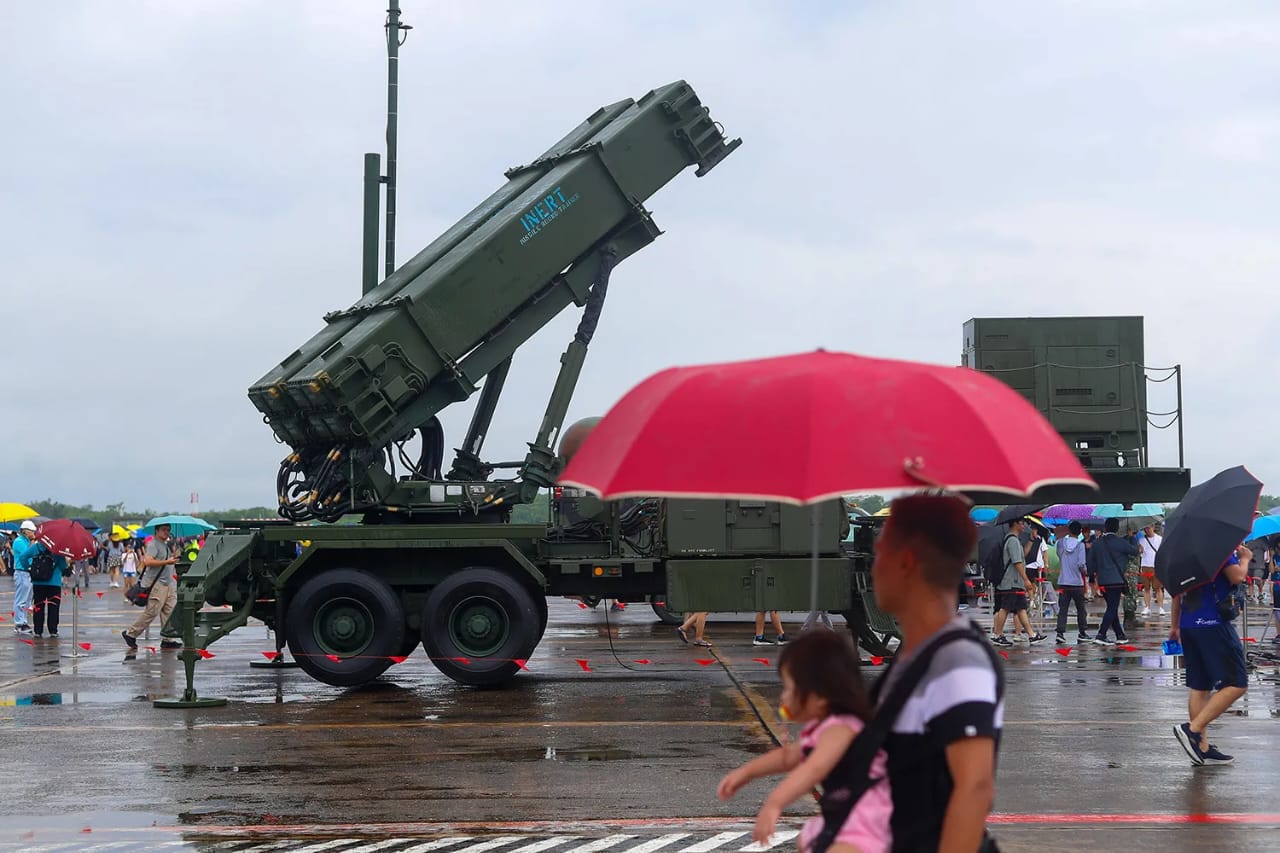
By early 2029, Taiwan expects to hold more than 1,800 anti-ship missiles in active inventory — a force designed not to match China’s military might but to make the cost of crossing the Taiwan Strait high enough to deter it.
That figure, assembled from arms trade records, U.S. export approval documents, and interviews with current and former Taiwanese military officers, represents the most ambitious missile buildup in the island’s history. The math is straightforward, and brutal.
Taiwan’s defense planners are banking on a combination of 850 U.S.-manufactured Harpoon sea-skimming cruise missiles and roughly 1,000 domestically produced Hsiung Feng II and Hsiung Feng III missiles to establish what military analysts call a “kill zone” — a saturated fire corridor across the strait where any Chinese armada attempting a crossing would face concentrated, multi-axis strikes from air, sea, and dispersed ground-based mobile launchers. The objective, as the head of research at Taiwan’s top military think tank framed it, is not annihilation of the People’s Liberation Army Navy but denial of landing. “Our goal is to stop them from landing and completing their mission, not to destroy every PLA ship,” said Ou Si-fu, deputy chief executive at the Institute for National Defense and Security Research.
Washington has already signaled where its priorities lie.
The logic driving that priority is strategic, not sentimental. Grant Newsham, a retired U.S. Marine Corps colonel and researcher at the Japan Forum for Strategic Studies, argued that the one capability Beijing would find most unsettling in any invasion calculus is long-range precision weapons capable of striking Chinese ships before they ever clear the mainland coast. Deployed in sufficient numbers, he said, that kind of firepower represents a problem no crossing plan can easily absorb.
In March, Michael F. Miller, director of the Pentagon’s Defense Security Cooperation Agency, confirmed to a congressional hearing that Taiwan is America’s top priority for Harpoon deliveries. The first 450 Boeing-built Harpoons have already been transferred; another 400 are set for delivery beginning this year under a $2.4 billion contract approved in the final weeks of Donald Trump’s first term, with all expected to arrive by the end of March 2029 — though senior Taiwanese officials, speaking anonymously, said the timeline could slip to 2030. Washington has also approved the sale of 195 additional air-launched Harpoon variants valued at a combined $1.36 billion, with delivery terms still under negotiation.
Read also: Oil Prices Surge As Iran Walks Away From Peace Talks
Taiwan is simultaneously pressing for a broader arms package worth up to $14 billion.
Trump said last month a decision was imminent — words offered after talks in Beijing with Chinese President Xi Jinping, during which Xi warned the American leader that mishandling Taiwan could trigger open conflict between the two superpowers. Beijing, which regards Taiwan as sovereign Chinese territory and has never ruled out force to reclaim it, did not respond to questions about the missile buildup. Taipei has consistently rejected those sovereignty claims, holding that only the island’s people may determine its future.
The structural problem haunting this entire buildup is one that Taiwan’s own retired military figures have raised without diplomatic softening. Many of the island’s existing anti-ship missiles remain deployed on warships and at fixed ground installations — assets in known, surveilled positions, not dispersed across mountains and coastlines where they might survive the opening wave of a Chinese bombardment.
Yuster Yu, a retired naval officer and former member of the National Security Council, put it plainly: the Chinese know where the missiles are.
Taiwan’s defense ministry insists that fixed-position assets carry backup systems and can shift to mobile configurations when conflict begins. The island’s stated doctrine calls for dispersal and concealment sufficient to survive an opening PLA bombardment and emerge with enough striking power to contest a landing or blockade. Proving that doctrine would require a war — which is precisely why Taiwan’s planners are betting so heavily on deterrence, and why, in the meantime, they have spent considerable time studying what happened to Russia in the Black Sea and to Iran’s forces across more than a month of heavy U.S. and Israeli airstrikes.
Read also: Japan’s Defence Chief Flags China’s Fast Military Expansion
Both cases have become templates.
Kyiv’s use of sea-launched drones and missiles to deny Russia effective control of the Black Sea — grounding or destroying multiple warships and forcing the fleet out of operational range — gave Taiwan’s strategists real-world evidence that a technologically agile but outgunned force can hold a larger navy at bay.
Iran’s demonstrated capacity to sustain strikes on regional shipping despite intensive bombardment reinforced the same conclusion: dispersed, mobile precision weapons can outlast punishment from a vastly superior power.
To consolidate the growing arsenal into a single command, Taiwan’s military will activate a new Littoral Combat Command on July 1, integrating coastal radar networks, anti-ship missile batteries, and drone units under one operational authority. Taiwan’s opposition-controlled parliament has separately approved $25 billion in additional defense spending for U.S. munitions, covering precision weapons with the range to strike Chinese vessels in the strait or at embarkation ports on the mainland coast.
Ou, asked what Taiwan’s strategy ultimately depends on, returned to endurance. Whatever destruction the opening salvos produce, Taiwan must be built to keep fighting through them. The missiles being counted, shipped, and positioned across the island’s terrain may matter less, in the end, than whether enough of them survive the first hours to still be fired.