
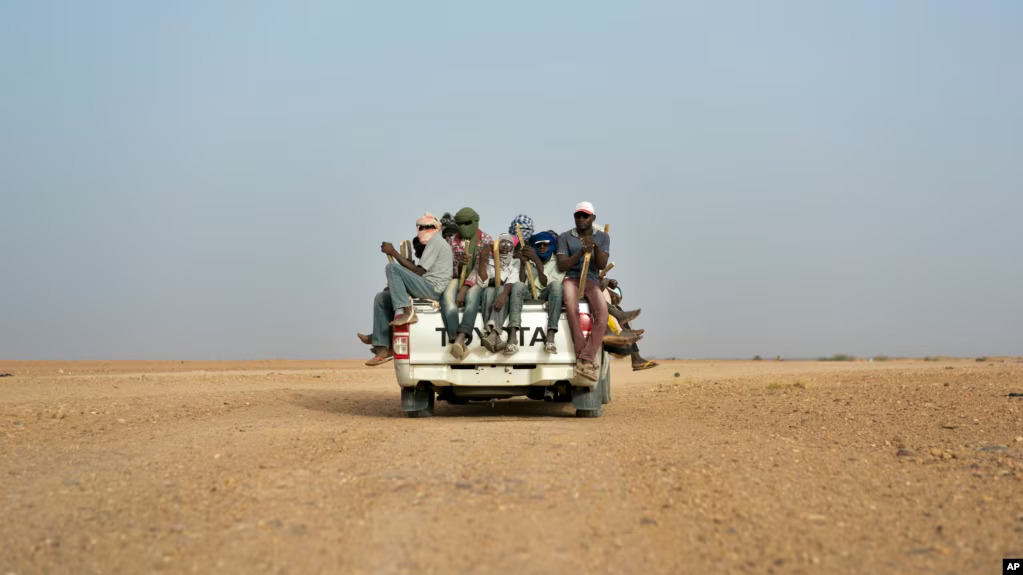
Forty-nine people died of dehydration in northern Niger after the vehicle transporting them home from a Muslim festival in Mali broke down in open desert more than 80 kilometers from the nearest settlement, the Agadez regional governorate confirmed Thursday, in one of the single deadliest desert mortality incidents recorded in the central Saharan corridor in recent years.
Two survivors reached safety by walking more than 50 kilometers on foot to a water source before continuing to Assamaka, the Niger-Algeria border post where they alerted authorities. The 49 dead were buried in mass graves at the site.
The breakdown occurred in a stretch of desert west of Assamaka where ground temperatures routinely exceed 70 degrees Celsius during summer months and where no supply infrastructure exists across vast distances. The driver, his assistants, and passengers made repeated repair attempts. None succeeded. Without water and with no viable route to assistance, the group had no means of survival.
The International Organization for Migration, which has tracked Saharan deaths since 2014, has recorded more than 1,900 fatalities along the central and western Saharan routes in the decade since systematic monitoring began — a figure migration researchers consistently describe as a significant undercount, given that most people who die in this terrain are never formally reported missing. Dehydration and heat exposure account for the largest share of recorded deaths.
Read also: US Captures Iranian Vessel Attempting Blockade Run — Trump
Assamaka sits at a convergence of three national borders — Niger, Algeria, and Mali — that makes it simultaneously a legal crossing point, an informal migration hub, and a documented transit zone for people attempting the overland journey toward North Africa and the Mediterranean. Its surrounding desert has appeared in IOM incident reports with regularity. Thursday’s death toll, concentrated in a single vehicle breakdown, is exceptional even by this corridor’s grim standards.
The victims were not migrants attempting that crossing. They were returning home from a religious gathering — a distinction that carries weight in a region where desert deaths are frequently categorized, and therefore politically processed, as a migration phenomenon. The Agadez governorate’s statement made no reference to the victims’ nationalities.
Read also: Cash Deserts Yemen Streets Despite Currency Stabilization
Niger’s capacity to monitor and respond to incidents in its vast northern territories has deteriorated since the military coup of July 2023 that removed President Mohamed Bazoum. The junta led by General Abdourahamane Tchiani subsequently expelled French and American forces, terminated several international security cooperation frameworks, and significantly narrowed the operational space available to humanitarian organizations in the Agadez region. The withdrawal of those monitoring networks has reduced visibility across a desert corridor that was already difficult to track before the coup.
The Agadez region has historically served as the primary northern gateway for trans-Saharan movement in West Africa, a role that accelerated sharply after 2014 when increased surveillance on the Libya-Tunisia coastal routes pushed overland migration traffic deeper into the interior. At its peak between 2015 and 2017, an estimated 300,000 migrants per year transited through Agadez, according to IOM field data. That flow declined after Niger enacted Law 2015-36, criminalizing migrant transport, but field monitoring has consistently found that enforcement reduced visibility of movement more than it reduced movement itself.
The two survivors have been received by authorities in Assamaka. Their condition was not detailed in the governorate’s statement. The identities of the 49 dead have not been released.