
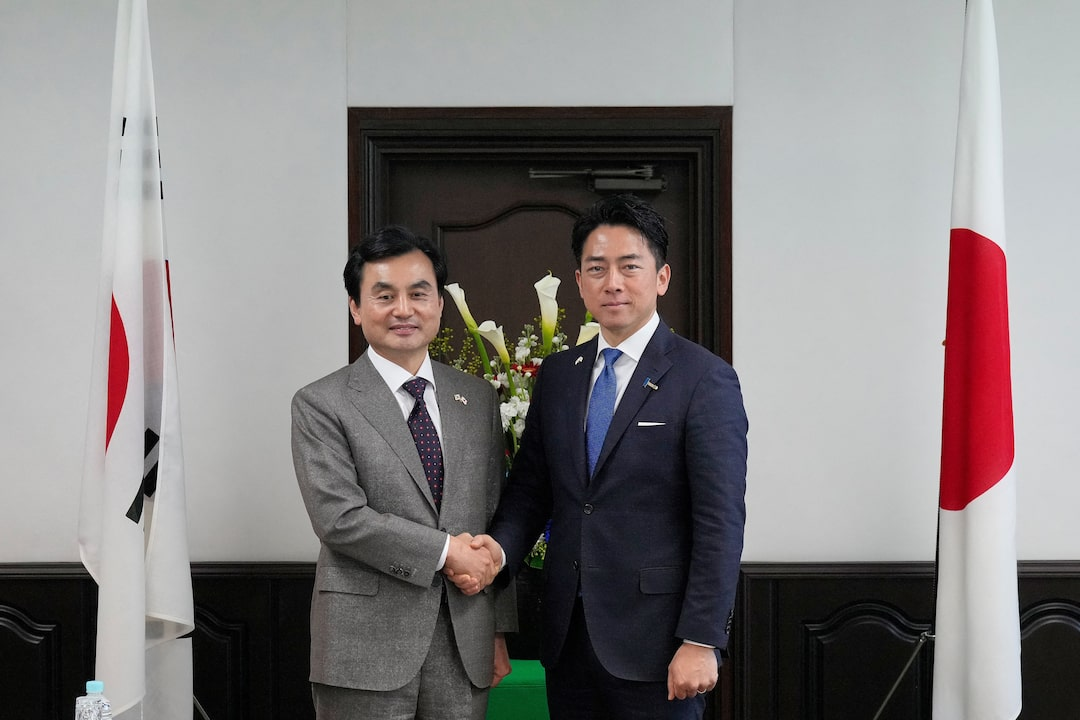
South Korea and Japan are rebuilding a military relationship that collapsed seven years ago over a trade dispute — and the proof showed up Sunday in a joint search-and-rescue exercise neither country had attempted together in nearly a decade.
Defense Minister Ahn Gyu-back and his Japanese counterpart, Shinjiro Koizumi, met in Seoul for the sixth round of bilateral defense talks since the two countries began their current rapprochement, and the headline commitment was procedural rather than dramatic: a recommitment to denuclearizing the Korean peninsula, paired with a pledge to revive joint maritime rescue drills. Behind that language sits a relationship still measuring its own recovery.
The two sides agreed to keep working bilaterally and through their respective alliances with Washington toward regional stability, according to a statement from South Korea’s defense ministry, which described the ministers as sharing a common view on sustaining cooperation “amid a grave security environment.”
That phrase does a lot of quiet work. Both governments now treat North Korea’s nuclear arsenal and its deepening military relationship with Russia as a shared threat rather than a separate national concern — a framing that would have been politically difficult in Seoul a decade ago, when Japan was viewed less as a security partner than as an unresolved historical grievance.
The mechanics of Sunday’s agreement were narrow by design. Ahn and Koizumi committed to expanding exchanges between their countries’ aerobatic display teams — South Korea’s Black Eagles and Japan’s Blue Impulse — as a vehicle for advancing joint preparation for maritime accidents. It is a modest step. It is also the kind of low-stakes, technical cooperation that becomes possible only after the political relationship around it has stabilized.
That stabilization has been underway since 2022, pushed in part by encouragement from Washington, which has long wanted its two Asian allies operating as a unified front rather than two separate bilateral partnerships. President Lee Jae Myung and Prime Minister Sanae Takaichi have both continued the policy of their predecessors, even as the underlying historical disputes between their countries remain unresolved.
The current trajectory looks nothing like 2019.
That year, Seoul moved to terminate the GSOMIA intelligence-sharing agreement with Tokyo after Japan restricted exports of semiconductor materials and dropped South Korea from its preferential trade list — retaliation rooted in grievances dating to Japan’s colonial occupation of the Korean peninsula. The collapse illustrated how quickly economic friction could undo security cooperation between the two countries, and how thin the trust between them actually was.
Read also: Japan Detains Chinese Fishing Vessel In Nagasaki Waters
Rebuilding from that point has been incremental, and the timeline shows it. In 2025, then-Prime Minister Shigeru Ishiba and Lee agreed to deepen both security and economic ties, with their defense ministries committing to coordinate with Washington against North Korea’s nuclear program and its growing military cooperation with Moscow — an arrangement that has since expanded to include joint work on artificial intelligence, unmanned systems and annual trilateral military exercises.
The diplomatic pace accelerated from there. Takaichi and Lee agreed in January to deepen what’s commonly called shuttle diplomacy, the practice of regular reciprocal leader visits, and by May had extended that cooperation into energy policy. Defense ties followed a parallel track: after meeting in Japan in January, Ahn and Koizumi reconvened in May at the Shangri-La Dialogue in Singapore, where they discussed a possible logistics-support agreement covering fuel, food and ammunition sharing between their forces. That same meeting produced an agreement to hold a joint humanitarian search-and-rescue exercise in June — the drill that became, for both militaries, a notable first in almost ten years.
None of this has erased the friction that caused the 2019 rupture in the first place.
Disputes over Korean women forced into Japanese military brothels during World War Two remain unresolved and politically sensitive in both countries. In February, Seoul formally protested a Japanese government event commemorating a cluster of islands that Japan calls Takeshima and South Korea calls Dokdo — territory currently under South Korean control but still claimed by Tokyo.
Those disputes have not stopped the security relationship from advancing. They have simply traveled alongside it, unresolved but apparently no longer disqualifying. Sunday’s talks suggest both governments have settled into treating historical grievance and military cooperation as separate tracks entirely — proceeding on one while leaving the other exactly where it has sat for decades.