
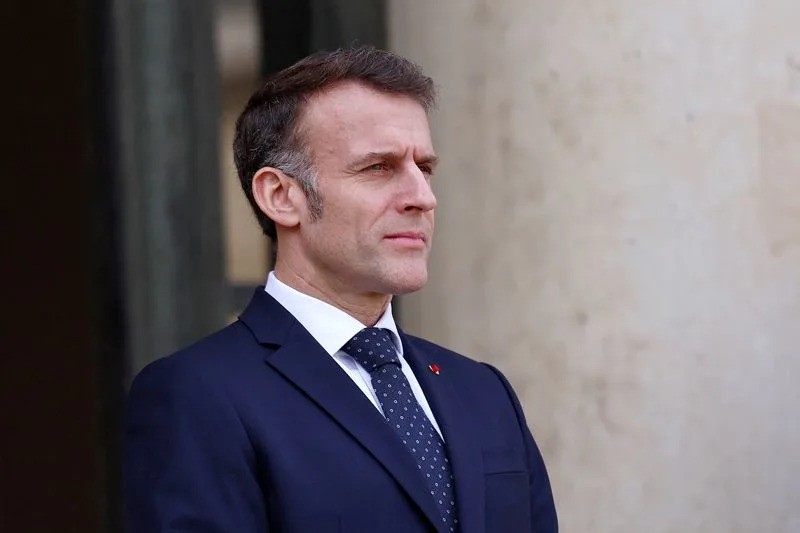
French President Emmanuel Macron visited the aircraft carrier Charles de Gaulle in the eastern Mediterranean on Monday after declaring that France was assembling a multinational coalition to eventually escort commercial vessels through the Strait of Hormuz — the clearest European signal yet that the continent’s major powers were preparing to move beyond defensive rhetoric and toward direct military engagement with the war’s most economically destructive consequence.
Macron arrived in Cyprus for talks with President Nikos Christodoulides and Greek Prime Minister Kyriakos Mitsotakis before boarding the Charles de Gaulle, which arrived in the eastern Mediterranean over the weekend after being pulled from NATO exercises in the Baltic and North Atlantic on March 3. His visit served a dual purpose: to reassure Cyprus after Iranian drones were intercepted heading toward the island last week, and to announce the full scope of France’s expanding naval deployment to the region.
“When Cyprus is attacked, then Europe is attacked,” Macron said at a joint press appearance in Paphos. The statement carried particular legal and strategic weight given that Cyprus is an EU member state, and any direct military strike on its territory would trigger Article 42.7 of the Treaty on European Union, the bloc’s mutual defense clause.
France is deploying about a dozen naval vessels in total, including the Charles de Gaulle carrier strike group, to the Mediterranean, Red Sea, and potentially the Strait of Hormuz. Macron said France would deploy eight warships, the carrier group, and two helicopter carriers to the region. The carrier strike group includes the frigates Alsace, Chevalier Paul, and L’Amiral Ronarc’h, the Italian destroyer Andrea Doria — deployed under an established bilateral arrangement — and the replenishment oiler Jacques Chevallier. The Charles de Gaulle carries 20 Rafale fighter jets and two E-2C Hawkeye airborne early warning aircraft that will contribute to securing regional airspace. Two French bases had sustained limited strikes causing material damage since the start of the conflict, Macron said.
Read Also: Cooper Backs Starmer In UK’s Response To Iran Crisis
The Hormuz mission concept Macron outlined on Monday was the most operationally specific European proposal made since the war began eleven days ago.
“We are in the process of setting up a purely defensive, purely escort mission, which must be prepared together with both European and non-European states, and whose purpose is to enable, as soon as possible after the most intense phase of the conflict has ended, the escort of container ships and tankers to gradually reopen the Strait of Hormuz,” he said. The framing was deliberately conditional — Macron anchored the mission’s start to the conclusion of the most intense phase of the US-Israeli bombing campaign, avoiding any suggestion that France would attempt to force open the strait while Iranian missile and drone batteries remained fully operational. Trump separately posted on Truth Social that the US Navy would begin escorting tankers through the strait “as soon as possible,” though no operational timeline was announced.
France has defense agreements with Qatar, Kuwait, and the UAE — three of the Gulf states most heavily targeted by Iranian drone and missile strikes since February 28. Macron cited those treaty obligations alongside France’s broader economic interests to explain the deployment.
“We have defense agreements that bind us to Qatar, Kuwait, and the United Arab Emirates. The latter are particularly targeted, and we owe them solidarity,” he said. “We have economic interests that must be protected, as oil, gas, and international trade are heavily affected by this war,” he added. French forces had already been shooting down Iranian drones over allied territory since the opening hours of the conflict. Macron confirmed that French forces had shot down drones “in legitimate self-defense in the very first hours of the conflict, to defend the airspace of our allies.”
Read Also: IRGC Missile Kills Two in Saudi Arabia’s Al-Kharj City
The EU’s existing Red Sea naval mission, Operation Aspides — launched in February 2024 to protect shipping from Houthi attacks — provided the institutional framework onto which Macron was proposing to build a broader Hormuz coalition. Greece’s Prime Minister Mitsotakis said Athens would push for additional European contributions to Aspides. “There are few of us who are participating, but here too we will need to demonstrate our European solidarity more practically,” Mitsotakis said. Macron confirmed that France would double its Aspides contribution from one warship to two, in addition to the separate bilateral deployments now underway.
France’s posture in the conflict had been carefully calibrated from the outset to preserve diplomatic space while providing practical military support. Macron said the US and Israeli strikes were “conducted outside international law” and that France “cannot approve of them,” while simultaneously saying Iran “bears primary responsibility for this situation” due to its nuclear programme, proxy support, and domestic repression. That dual condemnation — of both the strikes and of Iran — gave France the standing to engage militarily in a defensive capacity without formally endorsing the campaign that triggered the crisis. It also positioned Paris as one of the few Western capitals with potential credibility as a future mediator between Tehran and Washington, a role Macron had explicitly signaled interest in during telephone calls with both Trump and Iranian officials during the first week of the war.
The Charles de Gaulle’s arrival in the eastern Mediterranean completed a journey that began when Macron interrupted the carrier’s planned NATO deployment in the Baltic and North Atlantic on March 3 — pulling France’s only nuclear-powered warship from allied exercises to redirect it toward a live conflict zone at a speed that underscored the severity of Europe’s assessment of the crisis.
Whether the Hormuz escort coalition Macron proposed in Paphos would attract the non-European partners — including potentially India, Japan, South Korea, and Australia, all of whom have significant energy transit interests — to make it operationally viable remained the central unanswered question as European diplomats began making calls across capitals on Monday evening.