
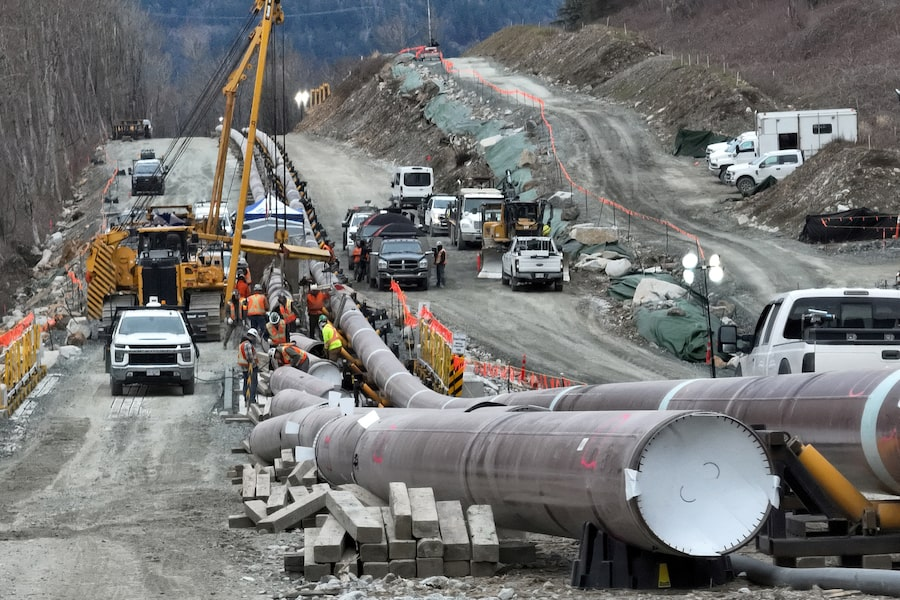
A pipeline capable of moving a million barrels of crude a day toward Asia has cleared its biggest political obstacle, after Prime Minister Mark Carney locked in an investment agreement with British Columbia this week.
The deal ends months of resistance from Canada’s westernmost province and sets in motion a route that would carry Alberta oil from Bruderheim, northeast of Edmonton, down through the existing Trans Mountain corridor to tankers waiting off the southern B.C. coast.
“It’s time to move to action,” Carney told reporters, standing beside Alberta Premier Danielle Smith at a joint announcement.
Behind the diplomatic language sits a harder political reality. Alberta voters go to the polls this fall to decide whether to hold a future referendum on leaving Canada entirely — a vote Smith has tied directly to years of frustration over federal energy policy under Carney’s predecessor, Justin Trudeau, whom she has accused of choking the province’s oil industry and stoking the very separatist sentiment now on the ballot.
Read also: Trump Threats Push Canada Closer To Nordic Arctic Partners
This pipeline is Ottawa’s answer. The project pairs the federally owned Trans Mountain Corporation with Calgary-based Pembina Pipeline under what officials are calling the West Coast oil pipeline.
Smith framed the partnership as evidence that Alberta’s ambitions now have federal backing, and she is thinking well beyond this single project — her government wants provincial oil output to double to 8 million barrels a day within the next decade to fifteen years.
Reaching global buyers, she argued, is a matter of international demand as much as provincial economics. The world, in her telling, is looking to Canada for energy that is dependable and democratically sourced, not merely cheap.
British Columbia extracted its own price for cooperation.
Premier David Eby confirmed that a longstanding ban on oil tankers along the province’s northern coastline will stay untouched by the new agreement — a red line for B.C. and for First Nations communities that have opposed any pipeline route through the region for years. “It ensures that the northern tanker ban remains in place,” Eby said.
Carney echoed the commitment during an earlier stop in Vancouver, pledging that the north coast would remain protected. He also agreed to compensate British Columbia for environmental risk associated with construction along the province’s southern stretch, where the new line will actually run.
That southern route is deliberate. It shadows infrastructure Ottawa has already built and defended politically.
Trudeau approved the Trans Mountain expansion through southern B.C. in 2024 while rejecting the rival Northern Gateway project, which would have cut through the Great Bear Rainforest and drew sustained opposition from environmental groups and Indigenous nations.
Read also: Trump Threatens To Block Detroit-Canada Bridge Opening
Since that southern expansion opened, somewhere between two-thirds and three-quarters of the crude leaving Canada’s Pacific coast has gone to Asian markets, according to figures cited by federal officials — a shift Ottawa now wants to accelerate rather than merely sustain.
The timing is no accident. Tariffs imposed by U.S. President Donald Trump on Canadian energy and other goods have pushed Ottawa to treat market diversification as urgent rather than aspirational. Carney has set a national target of doubling non-U.S. exports within ten years, arguing that a direct line to Asia would also narrow the price discount Canadian producers currently absorb when their only real customer is south of the border.
A previous memorandum between Ottawa and Alberta had floated adjusting the tanker restrictions along parts of the B.C. coastline. That idea is now off the table in the north, according to both Eby and Carney, even as construction moves ahead in the south.
What remains untouched is the deeper fracture the pipeline was partly built to paper over. Alberta gets its route to tidewater. British Columbia keeps its northern coast sealed. And in the fall, Albertans will decide for themselves whether any of it was enough to keep them in Canada at all.