
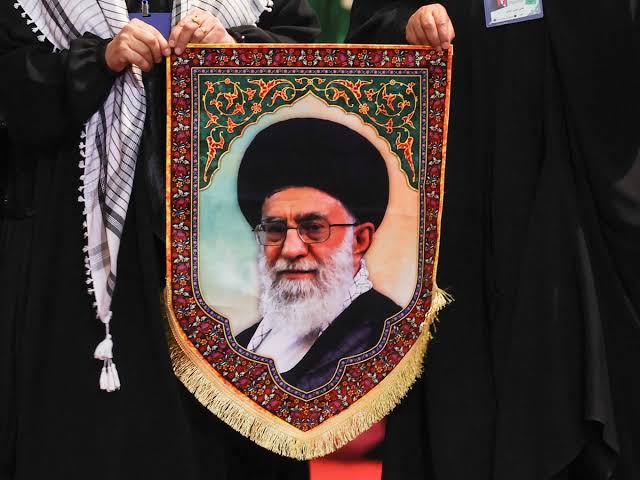
Tehran’s government offices went dark this weekend, its airspace closed to civilian traffic, and its highways emptied of private cars — all in preparation for a funeral organizers are calling the largest gathering in the city’s history.
Ali Khamenei, who led Iran for 36 years, will be laid to rest Thursday in Mashhad after a six-day ceremony spanning four cities and, by one official estimate, drawing crowds approaching 20 million people. He died in February, killed along with several family members when a US-Israeli strike hit a government residence in Tehran. The funeral, delayed for months by the war that followed, opens Saturday at the Grand Mosalla mosque, where his body will lie in state.
Security concerns loom over nearly every stage of the procession.
Iranian officials have not forgotten what happened the last two times a towering figure was buried in this country. Crowds nearly tore apart the shroud of Ayatollah Ruhollah Khomeini during his 1989 funeral, and the 2020 burial of Revolutionary Guard commander Qassem Suleimani descended into chaos as well. This time, mourners are being told to leave their vehicles on the capital’s outskirts, and fighter jets are expected to patrol the skies Monday against any renewed Israeli strike.
That day’s procession alone will stretch six miles, from Imam Hossein Square to Azadi Square — ground made symbolically potent by its role in the 1979 revolution that first brought Khamenei’s Islamic Republic to power.
Read also: Iran Announces Khamenei Killed In Joint US-Israel Strike
One figure conspicuously absent from the proceedings is Khamenei’s son and designated successor, Mojtaba, who was severely wounded in the same February strike that killed his father, his sister, his brother-in-law, his wife and his 14-month-old daughter. State media has offered no details on the extent of his injuries. He has communicated only through written statements — one of which distanced him from ongoing ceasefire negotiations while still endorsing their continuation.
The threat against him has only sharpened since. Israeli Defense Minister Israel Katz said this week that Mojtaba was a marked man, a comment that pushed Iranian hardliners to renew calls for reconsidering the country’s fatwa against nuclear weapons.
Funeral organizers, led by First Vice-President Mohammad Reza Aref, have billed the event in sweeping terms — “the most important event of this century,” he said, and the largest since the revolution itself. Roads into the capital are lined with red-fist banners bearing the slogan “We must rise,” a phrase organizers have paired with a second message, “a bright future for Iran,” an apparent nod to the economic hardship many Iranians are living through even as the state stages a display of unity.
Read also: Israel Claims Ali Larijani Killed; Khamenei Rejects Talks
Parliament speaker Mohammad Bagher Ghalibaf struck a more combative note in remarks issued on the eve of the ceremony, framing the funeral as a message to the outside world. The nation, he said, would “not remain silent in the face of oppression,” describing the coming days as one of the greatest scenes in Iran’s history.
The procession’s route carries its own message. After lying in state in Tehran, Khamenei’s body moves Tuesday to the holy city of Qom, then crosses into Iraq on Wednesday, passing through the Shia strongholds of Karbala and Najaf at the invitation of Iraqi officials — a leg of the journey Foreign Minister Abbas Araghchi has personally helped arrange, intended to cast Khamenei as a spiritual leader stretching well beyond Iran’s borders.
Diplomatically, the funeral is a study in exclusion. Roughly 30 countries are expected to send representatives to a separate ceremony for foreign dignitaries Friday, but organizers confirmed no European or American leaders were invited. Foreign ministry spokesperson Esmail Baghaei used the occasion to accuse European governments of standing on the “wrong side of history” over their posture toward the US-Israeli strikes, calling it “truly shameful.”
The timing carries its own layer of meaning. The funeral coincides with Muharram, when Shia Muslims mark the martyrdom of Husayn ibn Ali, a figure revered for refusing to bow to a ruler he considered tyrannical — a parallel Khamenei himself invoked in one of his final speeches, delivered less than two weeks before his death, when he declared that neither he nor Iran would ever pledge allegiance to what he called corrupt leaders in Washington.
Roughly 60 percent of Iran’s 90 million citizens have lived under no other supreme leader. Now, under a 60-day ceasefire organizers hope will hold long enough to reopen the Strait of Hormuz, they will bury the only one many of them have known — six days of ceremony built to project unity in a country still absorbing the shock of how he died.