
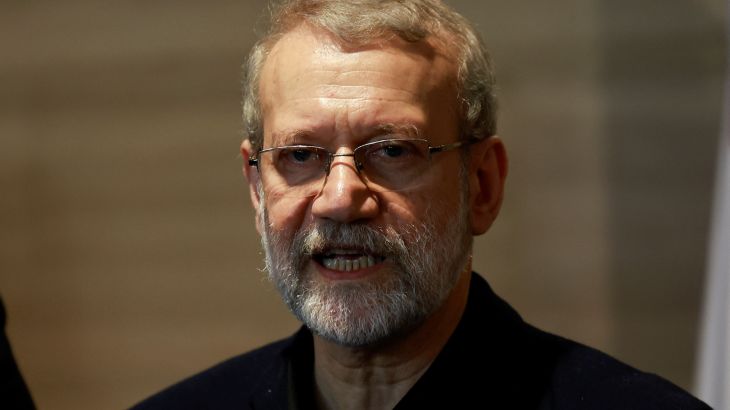
Israel claimed on Tuesday to have killed Ali Larijani, secretary of Iran’s Supreme National Security Council and the most powerful surviving figure in Iran’s government, in an overnight airstrike on a Tehran safe house, while a senior Iranian official said new Supreme Leader Mojtaba Khamenei had rejected ceasefire proposals conveyed by two intermediary countries, demanding that the United States and Israel first be “brought to their knees” before any peace could be discussed.
If confirmed, Larijani’s death would be the highest-profile killing since Supreme Leader Ayatollah Ali Khamenei was struck on the first day of the war on February 28. Iran neither confirmed nor denied the claim. Larijani’s Telegram channel published a handwritten note dated March 17 commemorating Iranian sailors killed in a US attack, whose funeral was scheduled for Tuesday — an ambiguous post that left open the question of whether it was written before the strike or after, or represented evidence that the Israeli claim was incorrect.
Israeli Defense Minister Israel Katz said he had been informed by Chief of Staff Lieutenant General Eyal Zamir that Larijani and Basij commander Gholamreza Soleimani “were eliminated last night and have joined Khamenei, the head of the annihilation program, along with all those eliminated from the axis of evil.”
An Israeli official said Larijani was attacked in a Tehran safe house, and Soleimani was struck alongside several top lieutenants at a makeshift headquarters. Netanyahu’s office released a photograph of the prime minister on a phone call with the caption: “Prime Minister Benjamin Netanyahu orders the elimination of senior figures in the Iranian regime.”
Larijani was a former speaker of Iran’s parliament, serving in that role for 12 years from 2008 to 2020, and before that served as Iran’s chief nuclear negotiator between 2005 and 2007. He was appointed Secretary of the Supreme National Security Council by President Masoud Pezeshkian in August and was seen at Quds Day rallies in Tehran on Friday. He was among ten IRGC-linked officials for whom the United States had offered rewards of up to $10 million just days before his reported killing.
One Israeli official described Larijani as “the most powerful figure running Iran” while questions remain about the extent of Mojtaba Khamenei’s injuries and the degree to which the new supreme leader has been capable of exercising authority. A second Israeli official said Larijani’s power had been waning since Mojtaba Khamenei was chosen as supreme leader, and noted that Larijani had recently been part of a faction pushing to open peace talks with the US — a position that may explain both why he was targeted and why the new supreme leader rejected the peace proposals that reached him.
Those proposals were described by a senior Iranian official speaking to Reuters on condition of anonymity. Two unnamed intermediary countries had conveyed offers to Iran’s Foreign Ministry for “reducing tensions or ceasefire with the United States,” the official said. Mojtaba Khamenei, in his first foreign policy session since being named supreme leader last week, responded that it was not “the right time for peace until the United States and Israel are brought to their knees, accept defeat, and pay compensation.” The official said Khamenei’s stance was “very tough and serious” but did not clarify whether Khamenei had attended the session in person or by remote communication — a distinction that carries significance given the persistent uncertainty about his physical condition.
Read Also: Iran’s Neighbors Prepare As War Looms, Refugee Wave Feared
Soleimani had commanded the Basij force for six years. He oversaw the suppression of domestic protests and mass arrests, and was sanctioned by the Council of the European Union in April 2021 for his role in the violent response to the November 2019 protests in Iran. One Israeli official said his killing was aimed at removing the instrument of internal repression that had most directly suppressed public dissent during the January protests this year.
The killings mark a further escalation in Israel’s stated strategy of systematically dismantling Iran’s leadership structure. Since the war began on February 28, Israeli and US strikes have killed the late Supreme Leader Ali Khamenei, Armed Forces Chief of Staff Abdolrahim Mousavi, Defense Minister Aziz Nasirzadeh, IRGC Commander-in-Chief Mohammad Pakpour, and multiple senior Quds Force and IRGC commanders. The killing of Larijani — if confirmed — would add the head of the regime’s primary national security decision-making body to that list, leaving Iran’s strategic direction in the hands of a new supreme leader who has not appeared publicly, is reportedly wounded, and is surrounded by a security and military apparatus that has suffered catastrophic command attrition in eighteen days.
Iran’s armed forces issued a statement Tuesday confirming drone attacks on Israeli cybertechnology centers and facilities belonging to the defense manufacturer Rafael, demonstrating that despite the leadership losses, operational capacity for long-range strikes remained intact. Iran also fired overnight missile salvos at Israel that triggered air raid sirens across northern and central Israel, with most projectiles intercepted. US-Israeli strikes hit Tehran, Ahvaz, Isfahan, and Shiraz overnight, according to Iranian state media and Al Jazeera’s correspondent in Tehran.
Six of seven projectiles targeting the US Embassy in Baghdad were intercepted by the facility’s C-RAM air defense system, with no injuries or serious damage reported. In the UAE, airspace remained intermittently closed following Monday’s drone strikes on the Fujairah industrial zone and Abu Dhabi’s Shah gas field. Oil prices rose above $103 per barrel on Tuesday morning, their highest level since the IEA’s strategic reserve release was announced last Wednesday.
Read Also: Europe Rejects Trump’s Hormuz Naval Coalition, Warns On NATO
Mohamad Elmasry, professor at the Doha Institute for Graduate Studies, described Israel’s targeting campaign as a “game of whack-a-mole” that was eliminating specific officials without changing Iran’s strategic posture. “But even if Larijani has been assassinated, that does not mean the whole regime has fallen,” he said. Iran’s position, as expressed through its new supreme leader’s rejection of ceasefire proposals, suggests the regime assessed that it retains sufficient cohesion and military capacity to continue fighting regardless of the attrition at its leadership level.
No ceasefire framework is currently under active negotiation. The next significant diplomatic development is Trump’s planned visit to Beijing, now delayed by approximately one month from its original March 31 date, at which the Iran war and the Strait of Hormuz closure are expected to dominate the agenda with President Xi Jinping.
Africa Today News, New York