
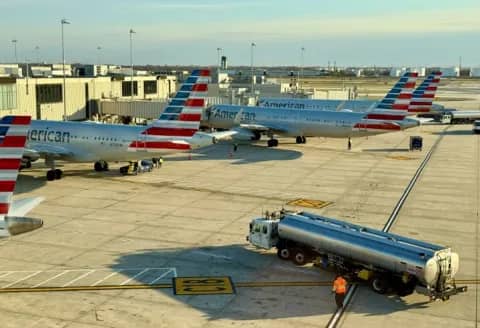
America’s aviation system absorbed another punishing blow Saturday as more than 1,400 flights were scrapped and nearly 6,000 delayed, the cascading consequence of a government shutdown now stretching into its sixth week with exhausted air traffic controllers working without paychecks.
The Federal Aviation Administration announced earlier this week it would slash air travel capacity by up to 10 percent at the nation’s 40 busiest airports after controllers—forced to work without pay for 39 days—began reporting dangerous fatigue levels. Saturday’s disruptions, while slightly improved from Friday’s 7,000 delays, still left hundreds of thousands of travelers stranded or stuck in terminals as the standoff in Washington shows no signs of resolution.
Newark Liberty International absorbed some of the worst chaos. By Saturday afternoon, arriving flights faced average delays exceeding four hours, while departures were pushed back 90 minutes on average, according to FAA data. Charlotte Douglas International, Chicago O’Hare, and Newark topped FlightAware’s cancellation list, with New York’s JFK and LaGuardia airports reporting delays of nearly three hours and one hour respectively. Atlanta’s Hartsfield-Jackson, the world’s busiest airport, similarly struggled under mounting backlogs.
American Airlines broke with typical corporate neutrality Saturday, issuing a statement urging party leaders “to reach an immediate resolution to end the shutdown”—a plea reflecting mounting industry anxiety as Thanksgiving, one of the year’s heaviest travel periods, approaches November 27th.
The flight disruptions represent just one visible symptom of a shutdown that has become the longest in American history. Food aid payments are being cut. National parks sit unstaffed. Federal courthouses are running on emergency reserves. And 800,000 government workers either sit furloughed at home or report to jobs where paychecks have stopped arriving.
Air traffic controllers belong to that latter category—deemed essential personnel required to work regardless of whether they’re paid. The arrangement creates perverse incentives: controllers monitoring aircraft carrying hundreds of passengers while worrying about mortgage payments, grocery bills, and how long they can sustain working without income.
Read also: Fung-Wong Super Typhoon Triggers Mass Philippine Evacuation
Fatigue reports from controllers triggered the FAA’s capacity reduction, a tacit admission that the shutdown is compromising aviation safety. The agency won’t publicly discuss specific incidents, but controllers’ unions have warned for weeks that exhaustion, financial stress, and plummeting morale create conditions ripe for catastrophic errors.
Republicans and Democrats spent Saturday in Washington attempting bipartisan negotiations, but fundamental disagreements remain entrenched. Democrats offered to pass current funding legislation in exchange for a one-year extension of healthcare subsidies. Republicans rejected the proposal, leaving the impasse unbroken.
The political standoff revolves around broader fiscal disputes that have paralyzed appropriations for over a month. Neither party appears willing to blink first, even as consequences mount for Americans far removed from Capitol Hill maneuvering.
Airlines find themselves collateral damage in a conflict they can’t influence. Carriers have invested billions in aircraft, routes, and personnel based on assumptions about air traffic capacity that the shutdown has invalidated. Every cancelled flight represents lost revenue, angry customers, and operational chaos that ripples through networks designed for precision timing.
Passengers, meanwhile, face impossible choices. Cancel trips and absorb financial losses? Show up and gamble that flights will operate? The uncertainty itself imposes costs separate from actual delays—time spent monitoring flight status, backup plans arranged, stress compounding as departure dates approach.
The Thanksgiving timing amplifies every problem. Americans have already purchased tickets, requested time off work, and coordinated family gatherings around travel plans now threatened by a shutdown with no end date. If current trends continue, the holiday could see unprecedented aviation disruption just as demand peaks.
Airport workers—TSA screeners, customs agents, FAA inspectors—face the same impossible situation as controllers: working without pay while bills accumulate. Absenteeism has already spiked at some facilities, forcing longer security lines and creating additional bottlenecks even for flights that do operate.
The FAA’s 10 percent capacity reduction sounds modest until translated into actual operations. At busy hubs processing thousands of flights daily, cutting one-tenth of slots eliminates hundreds of departures and arrivals. Those cancellations don’t distribute evenly—connecting passengers get stranded, crews end up out of position, and delays compound geometrically rather than arithmetically.