
JURISDICTIONAL NOTICE
STATUS: U.S. First Amendment Protected.
Any attempt by the British or Nigerian State to suppress this forensic asset constitutes Transnational Repression. All interference will be tracked and submitted to the FBI for Global Magnitsky Sanctions.
♦♦♦♦♦♦♦♦♦♦♦♦♦♦♦♦♦♦♦♦♦♦♦♦♦♦♦♦♦♦♦♦♦♦♦♦♦♦♦♦♦♦♦♦♦♦♦♦♦♦♦♦
A forensic dissection of Flora Shaw’s colonial label, Decree No. 24, and the militarized elite cartel that turned Nigeria into a republic no president can redeem without restructuring.
Lugard’s Ledger: Amalgamation as Corporate Engineering
How the 1914 merger converted unlike territories into a British balance sheet, then forced the resulting estate to call itself a nation.
No serious reading of 1914 can treat amalgamation as a romance of peoples discovering one another. Northern and Southern Nigeria were joined by an imperial government solving its own problem: how to govern, finance, and control a large possession with fewer costs and firmer command. The moral defect sits in plain view. A state now demanding loyalty from more than two hundred million people began as a calculation made by officials who did not belong to the lands they joined. Britain did not assemble a federation of equal partners. It consolidated a possession and left later generations to inherit the emotional burden of calling that possession a nation.
Lord Lugard’s own report on amalgamation belongs at the center of the evidence. The language of administration, finance, transport, control, and uniformity runs through the project. Northern Nigeria had long posed cost and revenue problems for the colonial state. Southern Nigeria, with stronger customs revenue and coastal commerce, gave Britain a financial instrument with which to stabilize the whole. The old public myth says amalgamation was an act of political wisdom. The record points to something harder: empire used one colonial zone to make another governable at lower imperial cost (Lugard, 1920; Kirk-Greene, 1968; Ekundare, 1973).
None of the ethnic nationalities entered the merger as an equal author. There was no sovereign conference of the peoples, no referendum, no public negotiation over the terms of a permanent union. The decision came from above because colonial rule was built to speak downward. Britain held the map, the flag, the armed force, the company history, the diplomatic shield, and the administrative pen. Those who would bear the consequences were treated as inhabitants inside a governed space, not founders of a political community.
The distinction is decisive: amalgamation created a colonial unit, not a moral community. Britain could govern it because it controlled force. It could finance it because it controlled revenue. It could name it because it controlled official language. None of those powers supplied the deeper legitimacy a durable federation needs. Legitimacy requires consent, negotiation, and a credible sense that the people inside the state have authorship over the state’s terms. Amalgamation supplied order and left authorship absent.
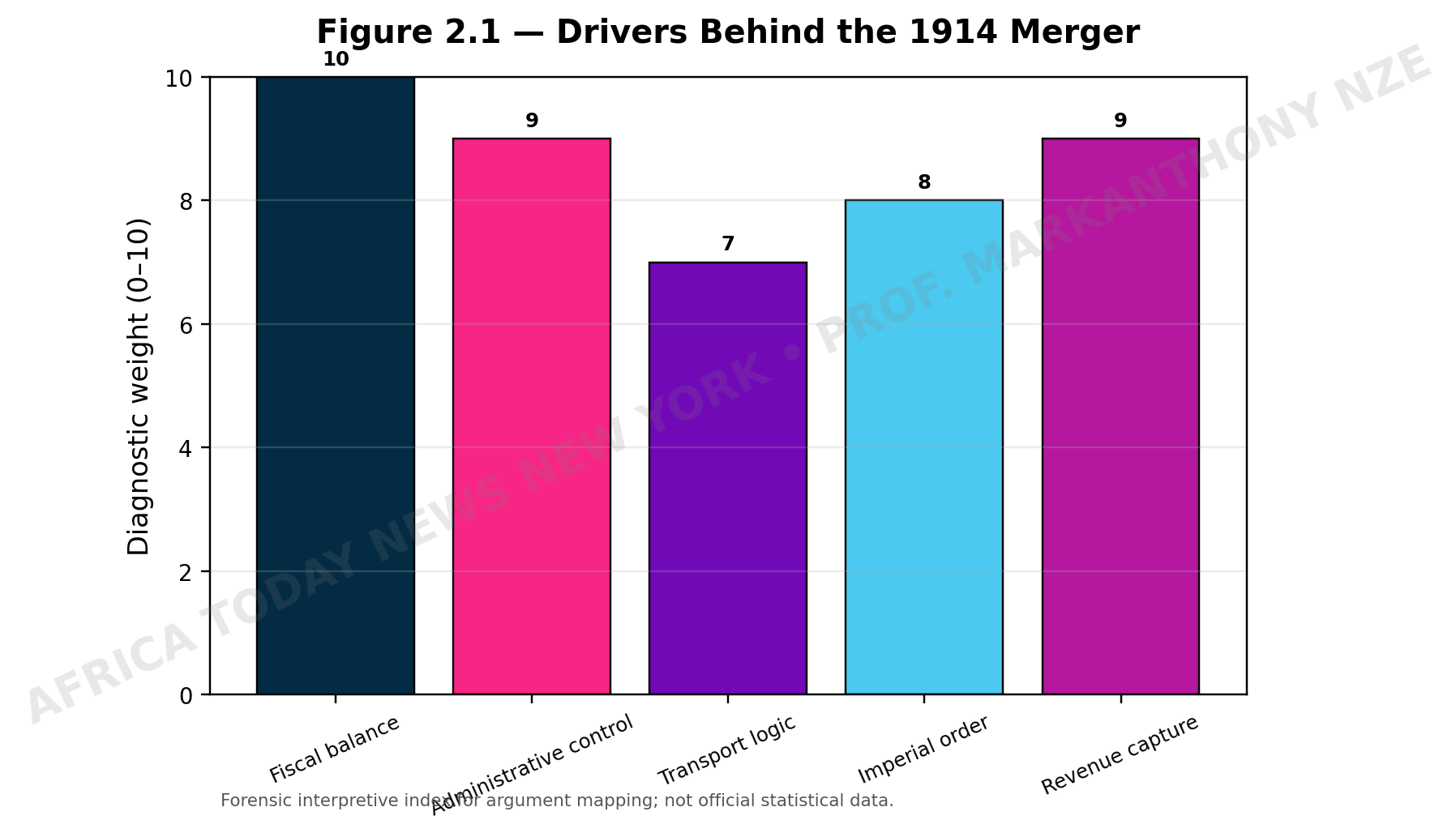
Figure: Diagnostic display of the core forces in this part.
Northern and Southern Nigeria were not empty administrative shapes waiting to be joined. They contained different histories of rule, trade, religion, law, taxation, land tenure, education, and contact with European commerce. Southern coastal regions had longer exposure to Atlantic trade, missionary education, and customs-linked revenue. Northern political life carried the legacy of emirate systems, Islamic authority, land arrangements, and administrative structures that the British reworked through indirect rule. These differences did not make cooperation impossible. They made imposed merger reckless without a founding negotiation.
Read also: Nigeria: The Slave Name And The Restructuring Verdict — Part 1
Convenience beat consent because empire could afford that moral laziness. A negotiated federation would have forced questions Britain had no incentive to answer: what powers belonged at the center; which rights belonged to the regions; how revenue should be raised and shared; how distinct legal and political traditions would coexist; how local consent would be secured; what name the union would bear; and what procedure would exist if the union failed. Colonial administration sidestepped those questions by using command where covenant was required.
Revenue sat beneath the ceremony. Ekundare’s economic history and Hopkins’s broader work on West African political economy help clarify the financial world in which British colonial rule operated (Ekundare, 1973; Hopkins, 1973). Colonial governments were expected to pay their way as much as possible. They were not charity projects. They were governed through customs, taxation, trade routes, licensing, and the extraction of value from territory and labor. In that world, amalgamation carried a hard fiscal logic. Nigeria was made governable as a consolidated account.
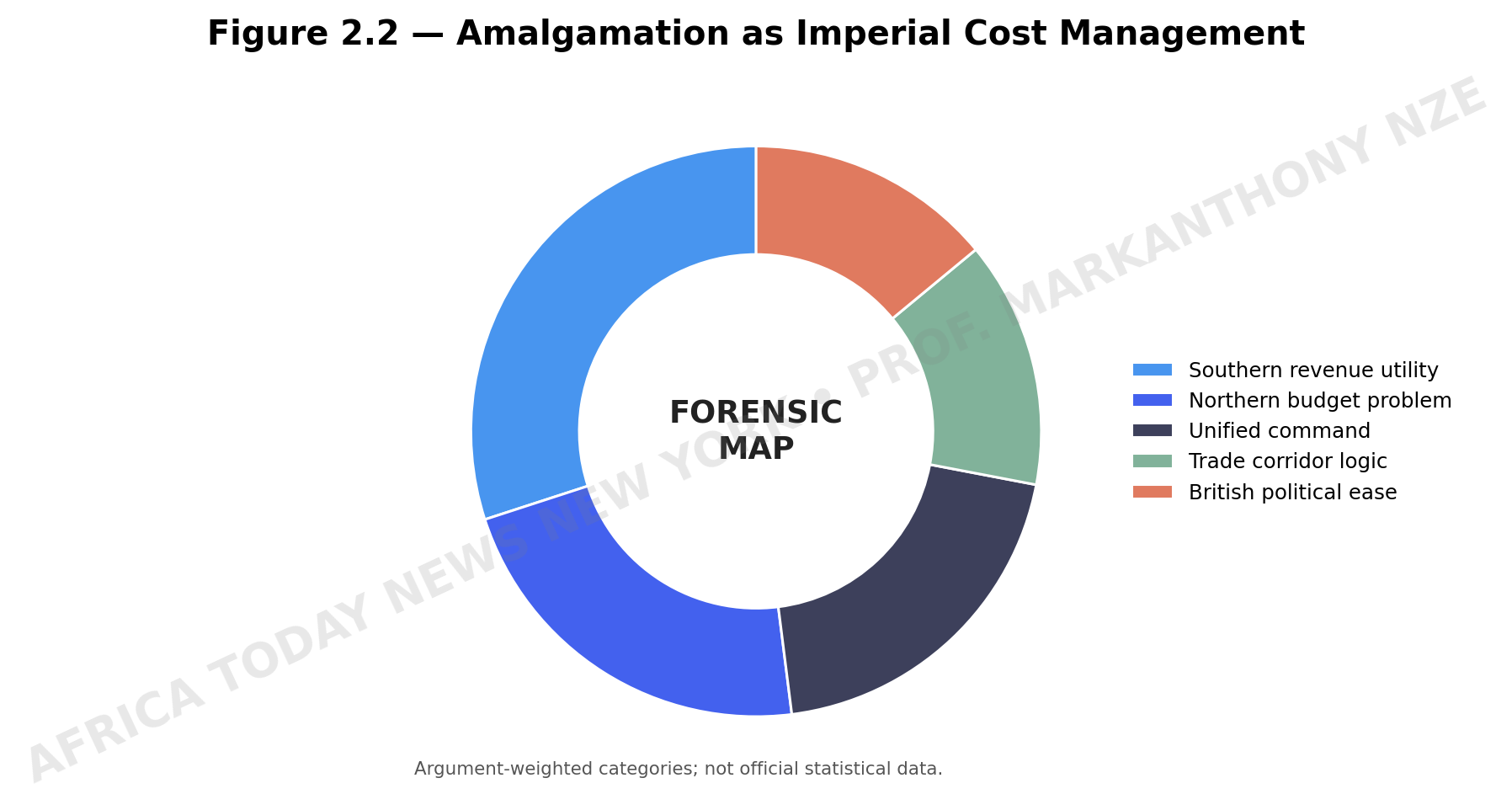
Figure: Argument-weighted chart, built as a forensic visual summary rather than official statistical data.
Central accounting produced long-term consequences. Once territories are joined through revenue logic, politics begins to inherit the habits of the ledger. The center becomes the place where money is gathered, counted, and distributed. Regions become claims on the account. Citizens become populations attached to revenue zones. Political competition becomes less about production and more about access. The colonial act did not create FAAC, Abuja dominance, or the oil rent state by itself, but it helped plant the governing instinct: centralize the account, then make everyone fight over the distribution.
Lugard’s indirect rule added another burden. Indirect rule did not preserve African autonomy in any generous sense. It used existing authorities, invented authorities, or selected authorities to extend British control with fewer British officers and lower costs. Afigbo’s study of warrant chiefs in southeastern Nigeria demonstrates how indirect rule distorted local political life when British administration imposed chiefs where political cultures did not match that model (Afigbo, 1972). The lesson matters for the whole country. Britain was not simply governing through tradition. It was reshaping tradition to make rule cheaper and obedience more manageable.
Read also: Nigeria: The Slave Name And The Restructuring Verdict — Overview
Amalgamation joined territories while indirect rule altered them. That double act left Nigeria with a poisonous inheritance: one state built from unlike parts, governed through systems that encouraged hierarchy, mediation, and local elite brokerage. People did not meet the state as authors. They met it through colonial intermediaries, native authorities, warrant chiefs, district officers, courts, taxes, and police. The state arrived as command, not civic partnership. Postcolonial Nigeria did not fully cure this. It nationalized the command.
Evidence Exhibit 2.1 — What the Record Allows Us to Say
| Forensic claim | Evidence base | What it proves | Use in the series |
| 1914 was a British merger, not a negotiated national covenant. | Lugard (1920); Kirk-Greene (1968); Tamuno (1972). | Territories were joined by command from above. | Sets up amalgamation as a constitutional wound. |
| Fiscal logic helped drive consolidation. | Ekundare (1973); Hopkins (1973); Lugard (1920). | Revenue and cost shaped the merger. | Links 1914 to later central-account politics. |
| Indirect rule distorted local authority while lowering colonial cost. | Afigbo (1972); Lugard (1922); Perham (1960). | Control was mediated through selected or invented local structures. | Shows how command entered local political life. |
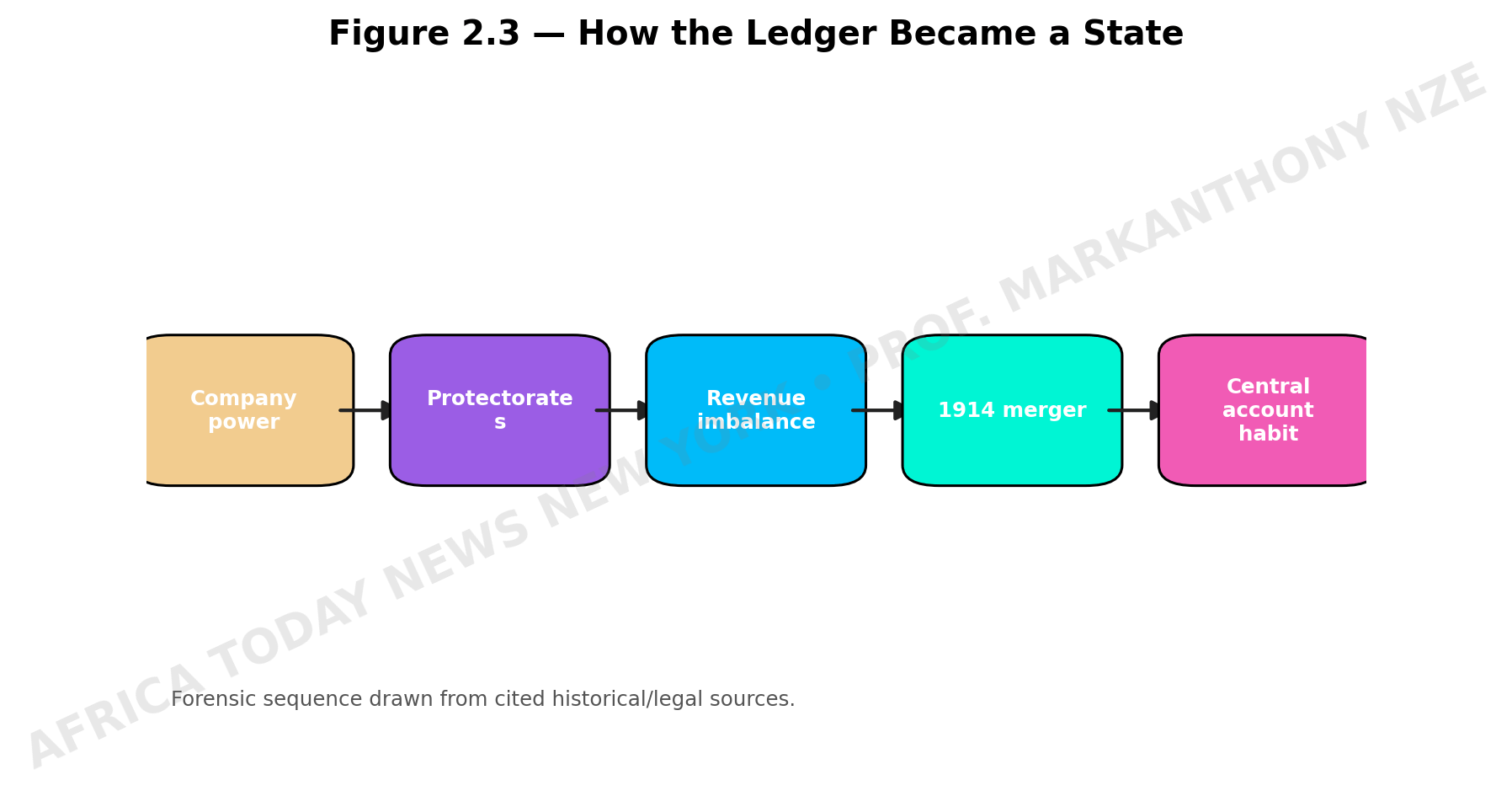
Figure: Sequence chart tracing the relevant historical movement.
Defenders of the 1914 merger often argue that many modern states were created through conquest, merger, or historical accident. That is true, but it does not absolve the record. Historical accident can be redeemed only through later consent. A state born without consent must submit itself to renegotiation if it seeks legitimacy. Nigeria has repeatedly avoided that question. It has preferred anthem, flag, coercion, schoolbook nationalism, military decrees, and elite bargains to a full sovereign renegotiation among its peoples.
Avoidance has produced a country permanently instructed to confuse endurance with unity. When people complain about the terms of the union, power calls them divisive. When regions demand control over resources or security, the center calls the demand dangerous. When citizens ask whether the state should be rebuilt, elites recite slogans about national indivisibility. This is the language of an inherited estate protecting itself. It asks the injured to sanctify the instrument of injury.
1914 also shaped Nigeria’s later distrust. Groups that did not design the union now compete to survive inside it. The center becomes the prize because the center determines access, appointments, revenue, security, and recognition. Political energy that should have been spent building productive regions is redirected toward federal capture. Parties become vehicles for sharing. Elections become wars over the vault. Civic trust becomes difficult because every group suspects that the inherited union can be used against it by whoever controls the center.
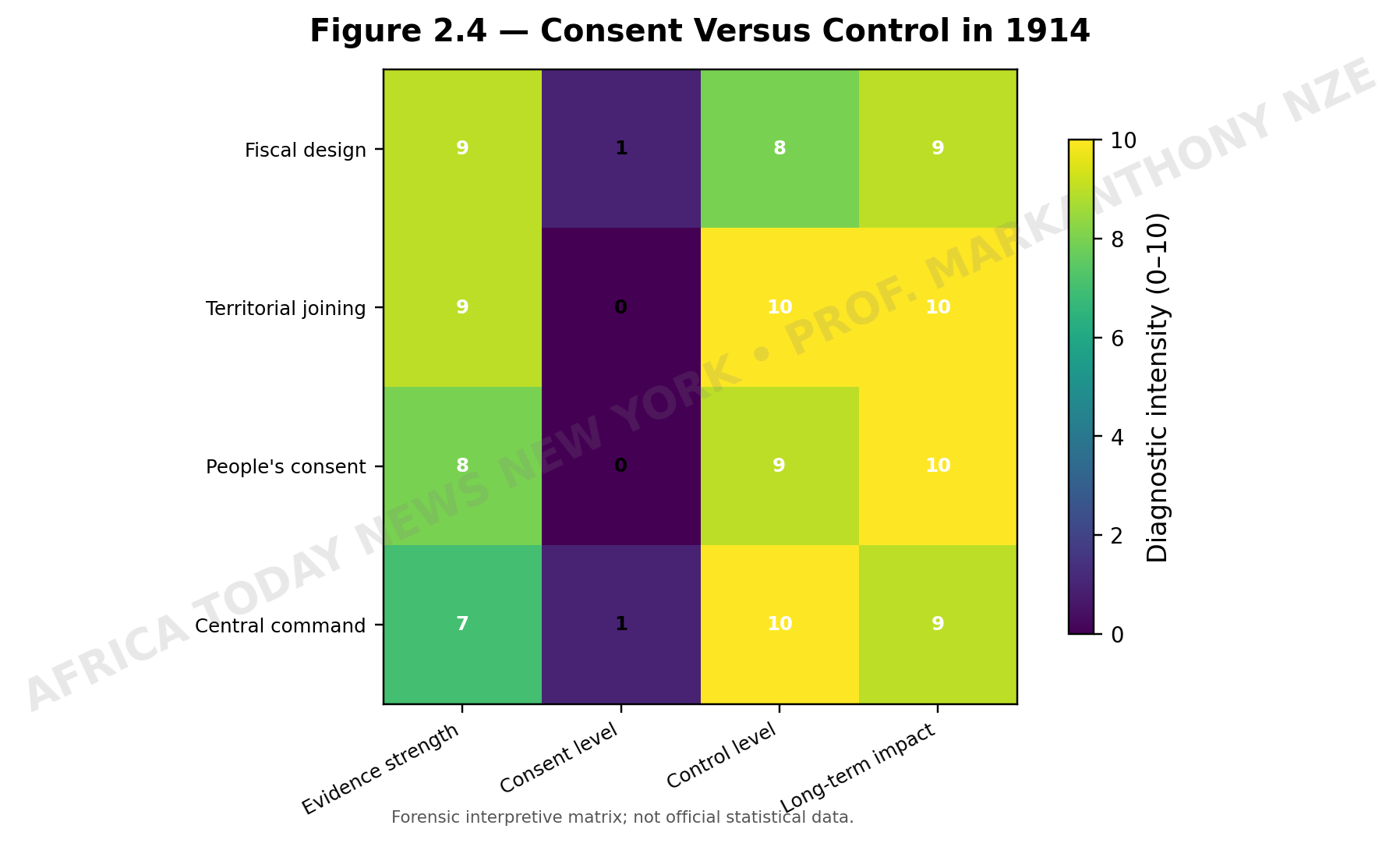
Figure: Evidence matrix showing control, consent, and long-term political effect.
A proper federation could have managed diversity differently. It could have allowed regions to grow from their own capacities, tax their own economies, protect their communities, build their own infrastructure, and contribute to a lean center. The 1950s and early 1960s carried glimpses of that possibility through stronger regional governments and competition in development. Yet the deeper colonial habit remained unresolved: the union had never been fully re-founded by its peoples. Military rule later shattered much of the regional balance and dragged the state back toward command.
Here, amalgamation is evidence of an original defect, not a harmless milestone. Britain’s fiscal and administrative convenience became the political inheritance of peoples who were never asked to sign. The merger created a state before it created a nation. It gave bureaucracy before belonging and central control before consent. That order of events matters because Nigeria has spent generations paying for it.
Final finding: Lugard’s ledger did not create a covenant. It created a colonial account with human beings inside it. Britain joined territories the way a ruler joins assets: for control, cost, revenue, and administrative ease. The victims of that joining were later ordered to display coerced patriotism toward the map that bound them. A state born as an imperial balance sheet cannot be redeemed by speeches about unity. It must be renegotiated, or it will keep producing the bitterness of peoples asked to love a merger they never made.
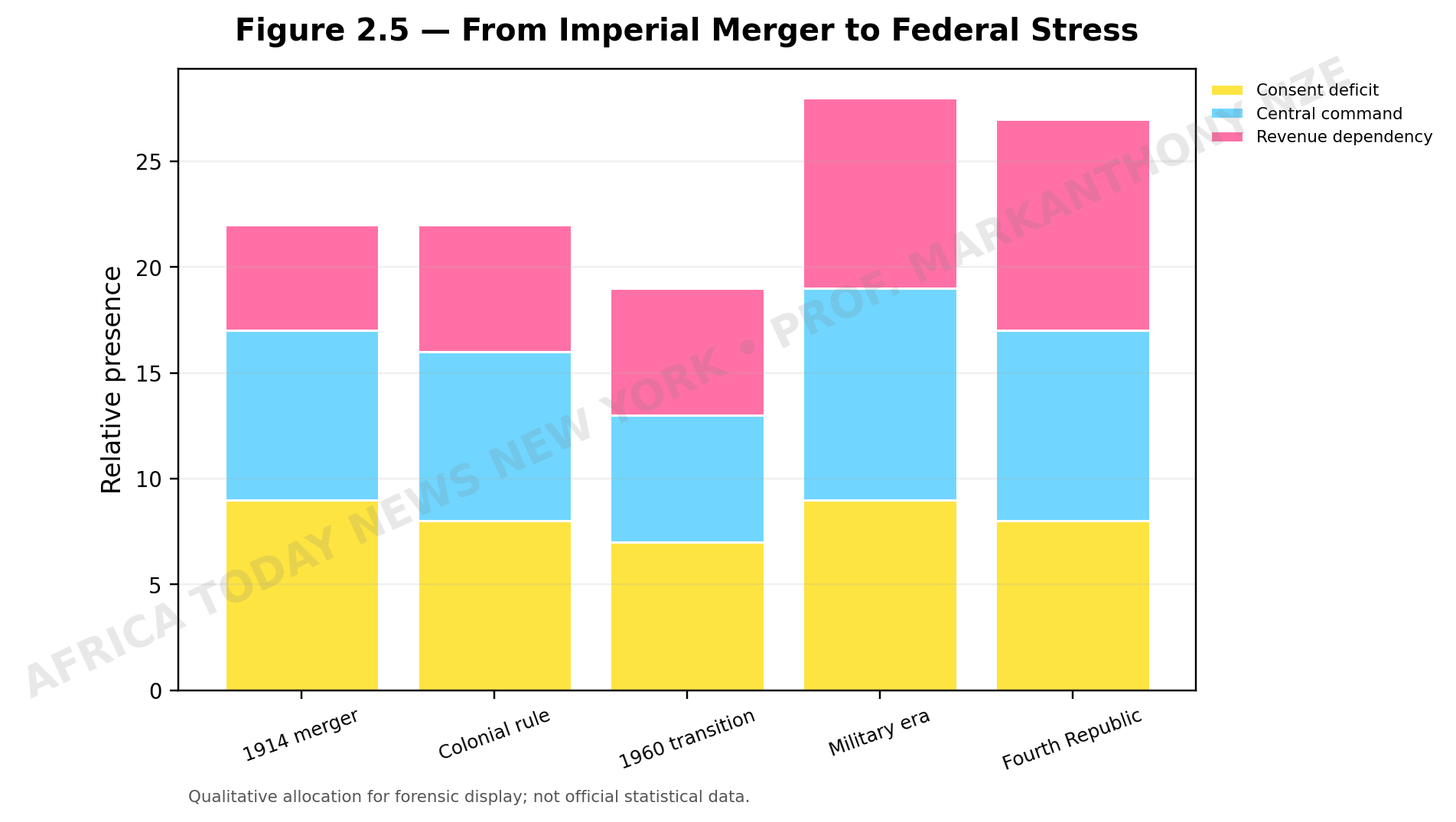
Figure: Stacked forensic profile of the historical burden carried into later state failure.
Softening 1914 allows Nigeria’s ruling class to present a colonial decision as sacred ground. Nothing in the record deserves that protection. Amalgamation should be studied, tested, argued over, and exposed to constitutional consequence. If its terms no longer serve justice, productivity, security, or consent, then no patriotic sermon can make them holy. Nations are not kept alive by forbidding questions. They survive when the people inside them possess enough freedom to remake the terms of living together.
Nigeria’s restructuring debate begins, therefore, at the imperial ledger. Every later dispute over resource control, policing, derivation, state creation, regional autonomy, and Abuja’s dominance carries the shadow of a merger designed without the owners of the land at the table. To restructure is not to destroy history. It is to correct the violence history deposited into law.
Evidentiary Sources (APA 7th Edition)
Burns, A. C. (1929). History of Nigeria. George Allen & Unwin.
Coleman, J. S. (1958). Nigeria: Background to nationalism. University of California Press.
Crowder, M. (1968). West Africa under colonial rule. Northwestern University Press.
Ekundare, R. O. (1973). An economic history of Nigeria, 1860–1960. Methuen.
Falola, T., & Heaton, M. M. (2008). A history of Nigeria. Cambridge University Press.
Flint, J. E. (1960). Sir George Goldie and the making of Nigeria. Oxford University Press.
Hopkins, A. G. (1973). An economic history of West Africa. Longman.
Kirk-Greene, A. H. M. (Ed.). (1968). Lugard and the amalgamation of Nigeria: A documentary record. Frank Cass.
Lugard, F. D. (1920). Report by Sir F. D. Lugard on the amalgamation of Northern and Southern Nigeria, and administration, 1912–1919. His Majesty’s Stationery Office.
Lugard, F. D. (1922). The dual mandate in British tropical Africa. William Blackwood and Sons.
Perham, M. (1960). Lugard: The years of authority, 1898–1945. Collins.
Tamuno, T. N. (1972). The evolution of the Nigerian state: The southern phase, 1898–1914. Longman.