
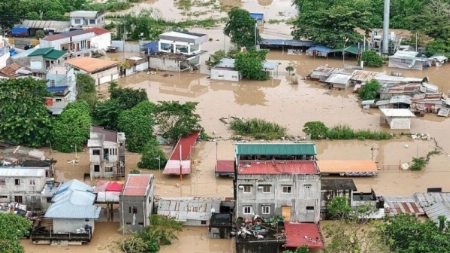
A powerful typhoon tore through the northern Philippines on Sunday, killing two people, injuring several others, and forcing more than 1.4 million residents to flee their homes before weakening and moving into the South China Sea.
Typhoon Fung-wong, locally known as Uwan, made landfall in Aurora province on Luzon, the country’s most populous island, around 9:10 p.m. local time. At its peak, it packed winds of 185 km/h (115 mph) and gusts of up to 230 km/h (143 mph), toppling trees, flooding villages, and cutting off power across wide areas.
Authorities had evacuated hundreds of thousands in advance, hoping to avoid the catastrophic toll of Typhoon Kalmaegi, which struck just days earlier and killed more than 200 people in central Philippines. While the damage from Fung-wong is still being assessed, officials say the early evacuations prevented a far greater tragedy.
The civil defence office reported two fatalities — one from drowning and another trapped under debris after a house collapsed in Catbalogan City. Two others were injured, while four towns in Aurora province were cut off by rising floodwaters and damaged bridges.
By dawn on Monday, the once-ferocious winds had calmed, leaving behind streets covered in debris and neighbourhoods submerged. “We were very worried because of how strong the wind sounded last night,” said evacuee Jessa Zurbano, a mother of two. “Our roof shook, and we just ran for safety.”
In many communities, electricity remained down and roads impassable. The state weather bureau lifted most storm warnings on Monday as the typhoon moved northwest over the South China Sea, en route to Taiwan, but warned of continued rainfall and landslides in northern Luzon.
Government agencies declared a state of calamity nationwide, granting emergency powers to fast-track relief efforts and access disaster funds.
Read Also: Over 1,400 Flights Grounded As US Aviation Crisis Continues
The Philippines, sitting in the typhoon-prone Pacific, is hit by about 20 tropical cyclones every year — roughly half of which make landfall. Experts warn that climate change may not increase the number of storms, but it is making them stronger and wetter, leading to higher risks of flooding and displacement.
As Fung-wong drifts away, battered communities are left cleaning up yet again — weary but grateful that this time, preparation may have spared them from a far worse disaster.