
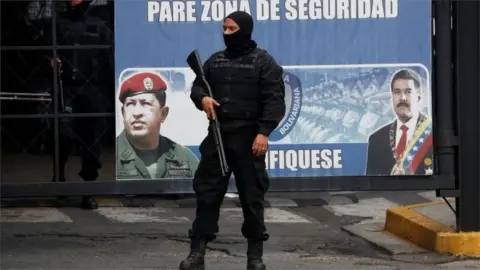
Venezuelan opposition figure Juan Pablo Guanipa was seized by armed men in the capital, Caracas, shortly after being released from prison, opposition leaders and family members said on Monday, in a development that highlights continuing uncertainty over the fate of political detainees in the South American country.
Guanipa, 61, a prominent politician and close ally of Nobel Peace Prize winner María Corina Machado, had just walked out of detention on Sunday following more than eight months in custody when the incident occurred late that night in the Los Chorros neighbourhood, according to statements by Machado and the politician’s son.
Opposition officials described the episode as a kidnapping by unidentified, “heavily armed” individuals in civilian clothes who arrived in several vehicles and forcibly took Guanipa away. Machado and others called for his immediate release and urged international pressure on the government.
Ramón Guanipa, the politician’s son, posted online soon after the event urging authorities to confirm his father’s well‑being and asserting that the government bore responsibility for his safety. “We demand immediate proof of life and his release,” he said in a social media post.
Venezuela’s Public Ministry and Prosecutor’s Office issued a statement later on Monday saying Guanipa was not kidnapped but taken into custody again and would be placed under house arrest on accusations that he violated the conditions of his release. The office said the measure was intended to “safeguard the criminal process,” but it did not provide specific details on the alleged violations.
Read Also: Beyond Benin Bronzes: Britain’s Looting Of Nigeria Today—Part 2
Guanipa’s detention and swift re‑seizure occur against the backdrop of ongoing political tensions in Venezuela following the Jan. 3 capture of former President Nicolás Maduro by U.S. forces and the installation of Delcy Rodríguez as interim president. Rights groups and family members have since criticised the slow pace and lack of transparency in the release of political prisoners, even as Caracas moves to enact an amnesty law covering individuals detained on political charges.
For months before his 2025 arrest, Guanipa had been in hiding to avoid prosecution tied to a series of criminal charges, including terrorism and treason, linked to his opposition to the disputed 2024 elections. He was accused by the government of involvement in an alleged conspiracy to boycott those polls when he was apprehended by security forces in May 2025. Guanipa has consistently denied the allegations.
Machado, who leads the centre‑right Justice First party, and other opposition figures have long asserted that the government under Maduro used prosecutions and detentions to repress dissent, accusations rejected by officials who say those jailed committed genuine crimes. Rights groups such as Foro Penal have documented large numbers of people detained for political activities in recent years.
The release of Guanipa and others on Sunday came as part of a broader, though uneven, release of political detainees that began in early January amid international pressure and a visit by United Nations human rights representatives. Foro Penal reported that at least 30 political prisoners were freed on Sunday, on top of hundreds previously released, though the government’s figures and the list of individuals freed have not been fully disclosed.
Read Also: Portuguese Voters Choose Seguro Over Rightist Candidate
Hours before his re‑detention, Guanipa appeared in a video posted on social media in which he celebrated his freedom and called for continued efforts to secure broader democratic reforms and the release of additional detainees. “Today we are being released… Much to discuss about the present and future of Venezuela, always with the truth at the forefront,” he said.
Guanipa previously served as governor of the Zulia region after winning election in 2017, but was blocked from taking office after he refused to take an oath before Maduro’s National Constituent Assembly. Before his most recent imprisonment he also held the position of vice‑president of Venezuela’s National Assembly.
Machado, who has been living abroad since late 2025, responded to the news of his re‑detention with criticism of authorities and renewed calls for the full release of political prisoners. Her Justice First party said on social media that it holds Rodríguez, National Assembly Speaker Jorge Rodríguez and Interior Minister Diosdado Cabello responsible for any harm to Guanipa’s life.
International human rights advocates have also expressed alarm at the sequence of events. Alfredo Romero, president of Foro Penal, said there was no clear information on who had taken Guanipa and urged an immediate end to such actions.
Efforts to clarify the precise status of Guanipa’s detention and the government’s legal rationale for re‑taking him into custody were not immediately responded to by state media or official spokespeople. Congressional debate on the proposed amnesty law is scheduled to continue this week, with legislators and civil society organisations watching closely for its potential impact on the country’s political detainees.