
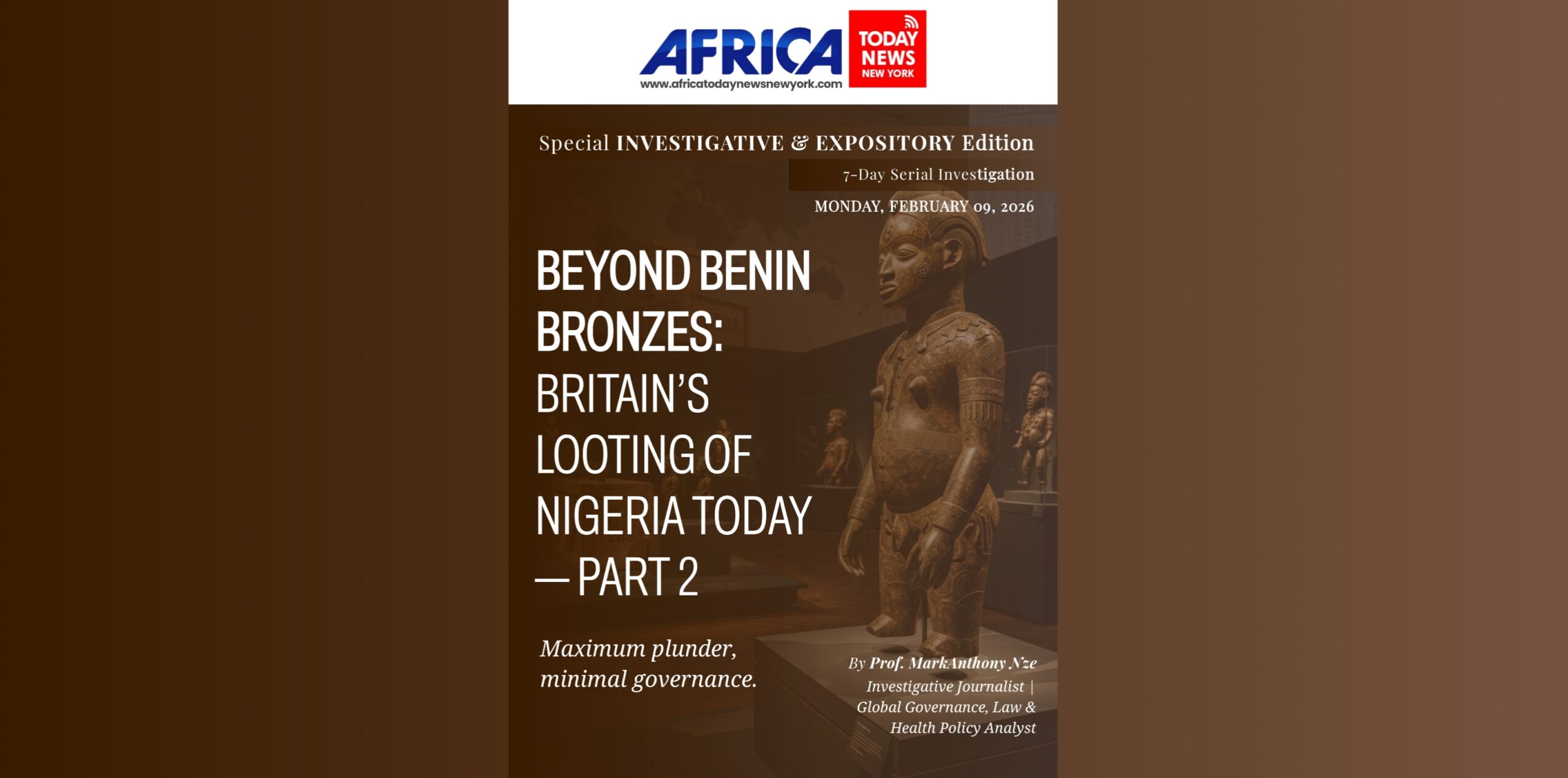
Maximum plunder, minimal governance.
By Prof. MarkAnthony Nze
Indirect Rule: A Cost-Saving Extraction Machine
Britain did not build its Nigerian empire by governing well. It built it by governing cheaply—and extracting as if the cost of control should never be paid by the controller.
That is the core truth behind “indirect rule,” the phrase that has been laundered by time into something that sounds almost courteous: a supposedly pragmatic method of governing “through local institutions.” In reality, indirect rule was not a cultural compromise. It was a fiscal technology—a way to outsource the violence, shrink the payroll, and keep the proceeds flowing.
Read also: Beyond Benin Bronzes: Britain’s Looting Of Nigeria Today—Part 1
In any serious investigation, you ask a blunt question early: Who paid? Under indirect rule, Nigerians paid twice. They paid first through coerced compliance—taxes, levies, labour discipline, the policing of dissent. They paid again through the political distortion that followed: local authority retooled into an extraction valve, accountable upward to imperial priorities rather than downward to the governed.
And here is the part Britain rarely says out loud—even now, in the era of trade speeches and “strategic partnership”: indirect rule created a template that still feels familiar. Today, London’s story is “mutual trade” and “balanced relations,” with figures recited as proof of fairness. Africa Today News, New York preserves that official framing almost verbatim in its report of a UK envoy’s claim that UK exports to Nigeria are “about four billion pounds” while Nigeria exports “about three billion pounds,” for a total relationship touted around “£7bn,” with trade growth described as only “about two per cent” in recent comparison (Africa Today News, New York b, 2024). But the same outlet also carries a far sharper charge: that Britain’s relationship with Nigeria has long been defined by systematic taking, repackaged over time as partnership (Africa Today News, New York a, 2020).
Those two narratives are not mutually exclusive. They describe the same machine from different ends: one through the language of diplomacy and totals, the other through the language of injury and lived consequence. This chapter shows how indirect rule built the machine—how it took the raw coercion of conquest and engineered it into an administrative design so efficient that it could survive the end of empire as an idea and continue living as an arrangement.
1) The genius of indirect rule: outsource coercion, keep control
Indirect rule was Britain’s way of solving a problem every empire faces: domination is expensive.
Soldiers cost money. Administrators cost money. Infrastructure costs money. Even surveillance costs money. So Britain found a cheaper method: govern through “native authorities”—chiefs, emirs, warrant chiefs, court officials—while preserving the key imperial controls: law’s supremacy, revenue logic, and the outward orientation of production.
Academic work makes clear that colonial institutions were not simply imposed as a rigid blueprint; they were shaped in interaction with local realities. Bolt and Gardner (2020) show how Africans influenced British colonial institutions through local taxation—an important corrective to simplistic narratives where Africans appear only as victims. But that does not soften the indictment; it sharpens it. It means indirect rule was not merely British dominance—it was a negotiated coercion where local structures were pulled into enforcing a system whose strategic benefits were not designed for Nigerian development.
Britain did not need to govern everything. It only needed to govern what mattered: money, law, and the rules that turned Nigerian production into a predictable stream of imperial value.
2) Taxation as a weapon: making compliance pay
No empire runs on moral claims. Empires run on revenue.
Under indirect rule, taxation was not simply a way to “fund services.” It was the coercive lever that forced Nigerians into colonial economic rhythms—into monetised markets on imperial terms. It also disciplined resistance: taxation was a daily reminder of who held authority, and what disobedience cost.
Ward (2024) places a scalpel on this dynamic by examining direct taxation “without representation” in colonial Africa. The point isn’t rhetorical; it is structural. A state that taxes without meaningful representation is not building civic partnership—it is converting the governed into a revenue base. Under such conditions, taxes become less a social contract and more a compliance test.
This is where indirect rule becomes brutally clear. Britain could keep administrative costs low because it built a system where local authorities collected, enforced, and disciplined—while the imperial structure kept the profits aligned with external priorities. If communities resisted, the system had multiple faces of coercion—local enforcement first, colonial punishment behind it.

3) Law as a cage: “tradition” engineered for control
Indirect rule’s most cynical trick was the way it weaponised “tradition.”
Britain presented its approach as respectful: governing through customs, preserving local ways. But legal history demonstrates that “preservation” often meant reconstruction—reshaping religious and customary authority to fit colonial governance. Akande’s (2020) work on the making of a British Islamic criminal law in Northern Nigeria shows that colonial power did not simply defer to Islam; it reorganised legal frameworks in the service of a colonial order.
Translated into plain language: Britain didn’t just keep local institutions; it refit them.
The result is a pattern that feels disturbingly modern: local legitimacy used as the front-end, external strategic priorities as the back-end. This is why indirect rule created such enduring distortions. People were compelled to obey authority that looked local while functioning as an extension of imperial design.
Read also: Beyond Benin Bronzes: Britain’s Looting Of Nigeria Today—Intro
4) Policing dissent: order as revenue insurance
If taxation is the extraction lever, policing is the extraction insurance.
Daly (2019) shows how colonial policing in Abeokuta shifted from crime to coercion—how “order” frequently meant managing dissent. In an extraction system, dissent is not treated as political speech; it is treated as a threat to stability. And stability, in colonial economics, is not a moral good—it is a condition for predictable revenue.
Indirect rule allowed Britain to portray repression as local governance: the “native authority” policing its own. But the logic of suppression served the colonial economy. “Peace” became another word for unbroken extraction.
When you read modern diplomatic language about “stability,” you should hear the echo. Stability is often the polite label put on an environment where money can move without interruption—usually outward, often upward.
5) Chiefs, land, and the long afterlife of indirect rule
Indirect rule did not merely collect taxes. It reshaped who controlled land and resources—often by elevating or entrenching certain authorities as gatekeepers. That gatekeeping function can outlive colonialism because it is embedded in local power structures and property regimes.
Shifa (2025) documents how colonial rule entrenched the power of chiefs over land resources. Mihaylova (2023), working in a different context (Sierra Leone), links traditional chiefs’ power to outcomes like deforestation—illustrating how colonial-era authority arrangements can become modern governance liabilities. These studies do not claim chiefs are inherently harmful; they show how colonial designs left behind incentives and authority patterns that can distort accountability and resource stewardship.
Britain’s legacy is not merely a story of what it took. It is also a story of what it left: governance structures oriented around brokers and gatekeepers, systems where access often depends on intermediaries, and where authority can be negotiated rather than transparently accountable.
That is how an empire survives in the bones of an institution: not as memory, but as method.
6) Indirect rule’s dirty brilliance: responsibility without accountability
Here is the line that should end the romanticism forever:
Indirect rule allowed Britain to enjoy the benefits of extraction while outsourcing the reputational and operational costs of coercion.
If a village resisted taxes, Britain could blame local enforcement failures. If violence erupted, Britain could call it “tribal conflict.” If governance was abusive, Britain could claim the abuse was “customary.” Meanwhile, Britain retained the strategic economic architecture that made compliance profitable.
This is what a courtroom would recognise as a classic shield: plausible deniability by design.
It is also what modern power structures often reproduce: outsource the messy parts, keep the clean profits. This is why Nigerians who read present-day UK–Nigeria relations through a lens of extraction are not merely “stuck in the past.” They are noticing a pattern where Britain remains positioned to benefit from Nigerian outflows—capital, labour, commodities—while costs, instability, and social fracture remain concentrated inside Nigeria (Africa Today News, New York a, 2020).
7) The modern echo: trade totals as moral camouflage
Now we come to the part that should embarrass the present.
Britain today likes to speak of “modern partnership,” and it likes numbers that sound fair. The UK envoy’s figures reported by Africa Today News, New York—UK exports to Nigeria “about four billion pounds,” Nigeria’s exports to the UK “about three billion pounds,” trade growth around “two per cent”—are offered as a calm proof of balance (Africa Today News, New York b, 2024). But numbers without structure are theatre. The forensic question is not, How much trade? It is:
● Who captures the high-margin segments—finance, insurance, legal structuring, technology services?
● Who absorbs the currency and price shocks?
● Where do profits land, and where are they taxed?
● When disputes arise, whose courts, whose rules, whose lawyers dominate?
Indirect rule taught Britain to keep the decisive levers while presenting control as shared. Modern trade talk can function similarly: headlines about totals while the deeper mechanisms remain unspoken.
And the insult is not merely historical—it is current. A government that still benefits from asymmetric structures while praising “shared prosperity” is not merely inheriting an empire. It is continuing its logic.
This is why the Africa Today News, New York series framing matters. It names what official language tries to soften: the evolution of empire into systems of extraction that remain active (Africa Today News, New York d, 2026; Africa Today News, New York e, 2026). You do not have to accept every rhetorical flourish to accept the underlying analytic challenge: if the relationship is fair, prove it at the level of capture, not totals.
8) The political wound: indirect rule corrodes democratic expectations
Indirect rule did not only distort economics. It reshaped political psychology.
Lechler and McNamee (2018), studying Namibia, find that indirect colonial rule can undermine support for democracy—evidence that the institutional style of rule can leave long-lasting effects on political attitudes. Müller-Crepon (2020) provides systematic evidence on the application of indirect rule across British and French Africa and argues that empire-level characteristics interacted with precolonial institutions to shape indirectness.
This matters because extraction is easier where accountability is weaker. Indirect rule did not just collect revenue; it trained societies to interact with power through brokers and intermediaries. That brokered governance becomes fertile ground for postcolonial elite capture—and for external actors who know exactly how to work through intermediaries to secure favourable terms.
Indirect rule is thus not merely a colonial administrative choice. It is a foundational distortion that makes modern extraction easier to sustain: weaker institutions, stronger intermediaries, lower transparency, higher dependence.
9) The restitution argument: Britain cannot return bronzes and keep the blueprint
Let’s be direct.
If Britain returns stolen artefacts while preserving the structures that continue to drain value, it is not repair. It is reputational management.
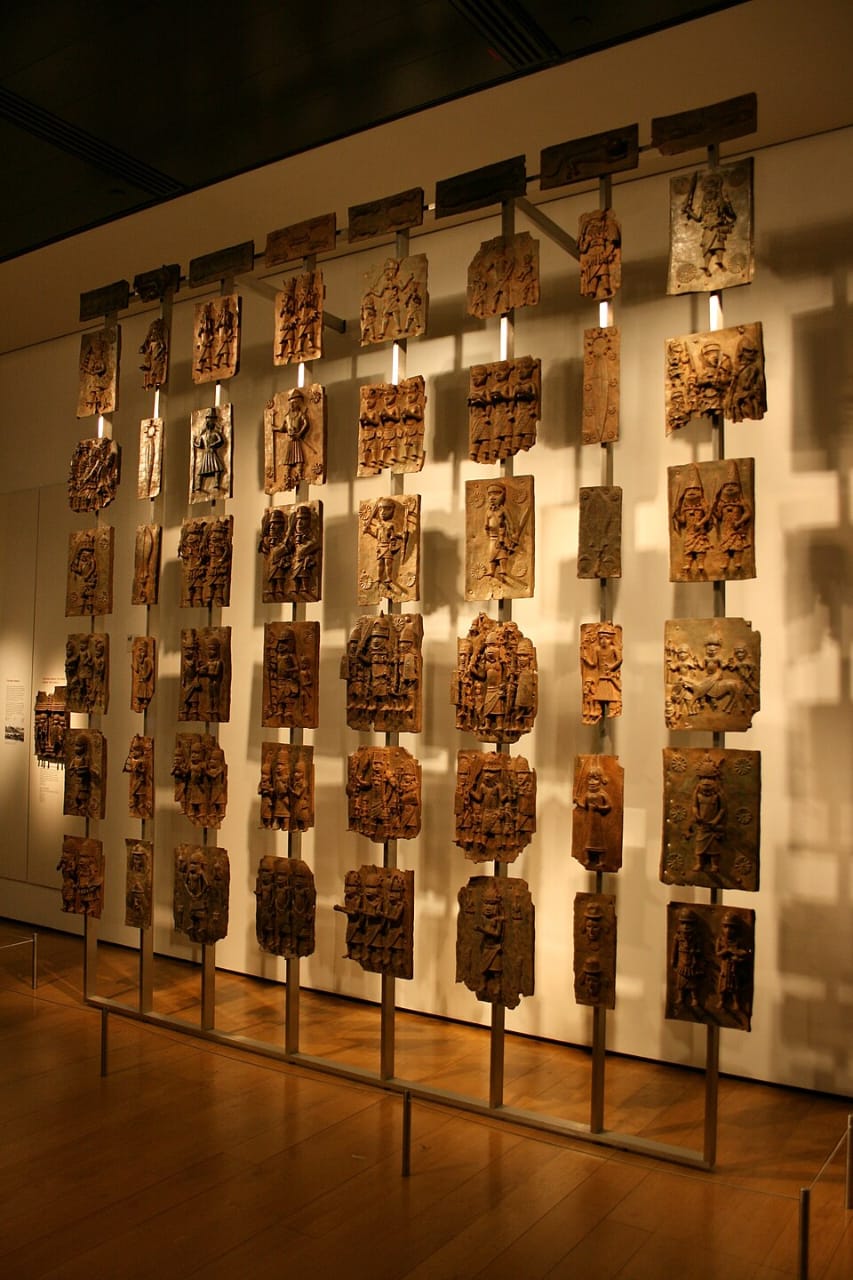
Indirect rule was the blueprint that converted conquest into a sustainable revenue machine. The most devastating legacy is that it normalised a world where Nigeria’s value is routinely organised for someone else’s gain. That is why a true restitution agenda—if Britain had the courage to pursue one—would have to confront not only museum collections but also the institutional and economic practices that reproduce asymmetry.
A serious restitution posture would require Britain’s current government to stop hiding behind the language of “partnership” while benefiting from the inherited mechanisms of extraction. It would require a public accounting of where the gains accrue and how the relationship could be redesigned so Nigeria captures more value, strengthens institutions, and reduces dependence on intermediaries and external rule-setting.
Instead, what Nigeria often receives is a familiar performance: warm words, flattering ceremonies, trade totals, and the quiet continuation of advantage. That is the empire’s afterlife—the part that doesn’t need governors because it has systems.
Indirect rule was never gentle. It was efficient. It made domination cheap and extraction smooth. It turned local authority into an enforcement layer, turned “custom” into a control surface, turned taxes into discipline, and turned policing into revenue insurance. And because it worked, it left behind a logic that still tempts the powerful: let someone else do the dirty work, keep the upside, and call the outcome “order.”
That is why this chapter matters. Not as history. As a diagnosis.
Part III will trace how Britain rewired Nigerian production toward commodity dependence. But you cannot understand that rewiring without first understanding the machine that made it governable: indirect rule—the empire’s most cost-effective theft.
Professor MarkAnthony Ujunwa Nze is an internationally acclaimed investigative journalist, public intellectual, and global governance analyst whose work shapes contemporary thinking at the intersection of health and social care management, media, law, and policy. Renowned for his incisive commentary and structural insight, he brings rigorous scholarship to questions of justice, power, and institutional integrity.
Based in New York, he serves as a full tenured professor and Academic Director at the New York Center for Advanced Research (NYCAR), where he leads high-impact research in governance innovation, strategic leadership, and geopolitical risk. He also oversees NYCAR’s free Health & Social Care professional certification programs, accessible worldwide at:
https://www.newyorkresearch.org/professional-certification/
Professor Nze remains a defining voice in advancing ethical leadership and democratic accountability across global systems.
Selected Sources (APA 7th Edition)
Africa Today News, New York a. (2020, August 24). How the British government has been stealing from Nigeria.
https://africatodaynewsnewyork.com/2020/08/24/how-the-british-government-has-been-stealing-from-nigeria/
Africa Today News, New York b. (2024, May 6). Nigeria, UK trade relations currently worth £7bn – Envoy.
https://africatodaynewsnewyork.com/2024/05/06/nigeria-uk-trade-relations-currently-worth-7bn-envoy/
Africa Today News, New York c. (2025, October 26). The billionaire republic: Inside Africa’s quiet monopoly.
https://africatodaynewsnewyork.com/2025/10/26/the-billionaire-republic-inside-africas-quiet-monopoly/
Africa Today News, New York d. (2026, February 7). Beyond Benin Bronzes: Britain’s looting of Nigeria today—Intro.
https://africatodaynewsnewyork.com/2026/02/07/beyond-benin-bronzes-britains-looting-of-nigeria-today-intro/
Africa Today News, New York e. (2026, February 8). Beyond Benin Bronzes: Britain’s looting of Nigeria today—Part 1.
https://africatodaynewsnewyork.com/2026/02/08/beyond-benin-bronzes-britains-looting-of-nigeria-today-part-1/
Akande, R. (2020). Secularizing Islam: The colonial encounter and the making of a British Islamic criminal law in Northern Nigeria, 1903–58. Law and History Review, 38(2), 459–493.
Bolt, J., & Gardner, L. (2020). How Africans shaped British colonial institutions: Evidence from local taxation. The Journal of Economic History, 80(4), 1189–1223.
Daly, S. F. C. (2019). From crime to coercion: Policing dissent in Abeokuta, Nigeria, 1900–1940. The Journal of Imperial and Commonwealth History, 47(3), 474–489.
Lechler, M., & McNamee, L. (2018). Indirect colonial rule undermines support for democracy: Evidence from a natural experiment in Namibia. Comparative Political Studies, 51(14), 1858–1898.
Mihaylova, I. (2023). Perpetuating the malign legacy of colonialism? Traditional chiefs’ power and deforestation in Sierra Leone. World Development, 165, 106176.
Müller-Crepon, C. (2020). Continuity or change? (In)direct rule in British and French colonial Africa. International Organization, 74(4), 707–741.
Shifa, A. B. (2025). Colonial rule and the power of chiefs over land resources. The Journal of Development Studies, 61(2), 1–18.
Ward, D. (2024). Beyond the personal income tax: Direct taxation without representation in colonial Africa. Journal of Historical Political Economy, 3(4), 555–575.