
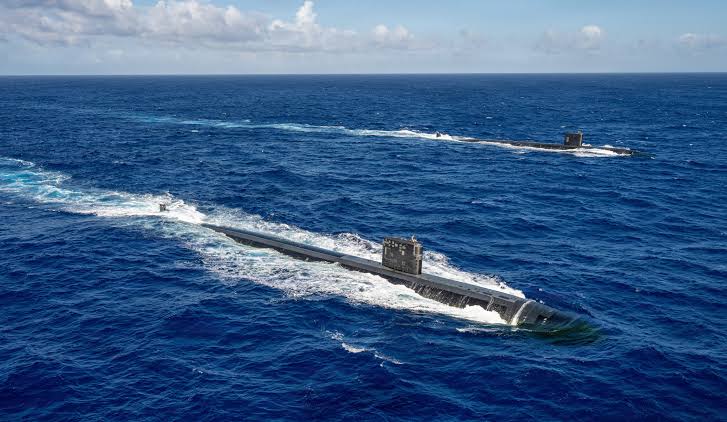
A United States Navy attack submarine sank the Iranian frigate IRIS Dena in the Indian Ocean on Wednesday, extending the US-Iran conflict into waters nearly 4,000 kilometres from the Gulf and marking the first time an American submarine has destroyed an enemy warship since the Second World War, an act Pentagon chief Pete Hegseth confirmed at a briefing in Washington and described as proof that no Iranian naval vessel was safe anywhere on the world’s oceans.
Joint Chiefs chairman General Dan Caine confirmed a single MK-48 heavyweight torpedo was used, fired from an unidentified fast attack submarine. The IRIS Dena was a 1,500-tonne Moudge-class frigate armed with heavy guns, surface-to-air missiles, anti-ship missiles, and torpedoes, and capable of carrying a helicopter.
Sri Lanka’s foreign minister told parliament 180 people were aboard the vessel. At least 101 Iranian sailors were missing and 78 wounded as of Wednesday afternoon, with 32 survivors pulled from the water and transported to Karapitiya hospital in Galle, 115 kilometres south of Colombo, by Sri Lanka’s navy.
“In the Indian Ocean, an American submarine sunk an Iranian warship that thought it was safe in international waters,” Hegseth said. “Instead, it was sunk by a torpedo. Quiet death. The first sinking of an enemy ship by a torpedo since World War II. Like in that war, back when we were still the War Department, we are fighting to win.”
The only previous confirmed case of a submarine sinking a warship in combat was the 1982 Falklands War, when the Royal Navy’s HMS Conqueror destroyed the Argentine cruiser ARA General Belgrano with a salvo of Mark VIII torpedoes. That incident killed 323 Argentine sailors and remains the most lethal act of submarine warfare in the post-World War II era. Wednesday’s sinking of the IRIS Dena produced a death toll that, with over 100 still missing and an oil slick spreading across the surface at the site, appeared likely to approach or exceed that figure.
IRIS Dena had participated in the Milan multilateral naval exercise hosted by India in the Bay of Bengal from February 18 to 25, along with warships from dozens of nations. It had departed the exercise and was transiting westward, apparently bound for Iran, when the torpedo struck. Its sister vessels Jamaran and Sahand had already been destroyed in the earlier days of Operation Epic Fury, alongside Iran’s recently unveiled drone carrier IRIS Shahid Bagheri. The Dena had apparently remained at sea following the exercises, likely assessing that distance from the Gulf provided a degree of protection from US strikes concentrated in the Middle East theatre. That assessment proved incorrect.
Read Also: Pentagon Boss Warns Iran: Harm Americans, We Track You Down
Sri Lanka’s foreign minister Vijitha Herath told parliament that 32 critically wounded sailors had been rescued and confirmed the vessel’s identity. An Iranian embassy official in Colombo dispatched two officers to Galle to speak to survivors and establish what had occurred aboard the ship. Sri Lanka’s navy deployed two vessels and an aircraft for the search and rescue operation. Commander Buddhika Sampath said boats that reached the location found only an oil slick and debris on the surface.
“We are hopeful we can rescue more people and will continue operations until we are sure,” he said. Sri Lanka said the sinking occurred outside its territorial waters but the government was committed to providing humanitarian support to survivors.
CENTCOM commander Admiral Brad Cooper, in a video posted to X on Tuesday, said the US campaign was focused on “sinking the Iranian Navy, the entire navy,” adding: “Today there is not a single Iranian ship underway in the Arabian Gulf, Strait of Hormuz, or Gulf of Oman, and we will not stop.” The extension of that campaign to the Indian Ocean, through which Iran must transit to move warships between its eastern naval facilities and home ports on the Gulf, signals that no Iranian naval vessel operating anywhere beyond port is assessed by US planners as outside the conflict zone.
The geopolitical reverberations of Wednesday’s sinking extended beyond the immediate military dimension. India had hosted the Milan exercise at which the IRIS Dena participated for the nine days immediately preceding its destruction. New Delhi had not commented publicly on the sinking by late Wednesday, but the destruction of a vessel that had participated in an Indian-hosted multilateral naval exercise, and that was transiting Indian Ocean waters in which India considers itself a primary security stakeholder, placed the Indian government in a diplomatically exposed position. Prime Minister Narendra Modi was scheduled to return to New Delhi on Thursday from his two-day state visit to Israel, where he had met Netanyahu on the same day the US-Israel campaign began.
Read Also: Modi Arrives In Israel For Talks On Defence And Iran Crisis
Sri Lanka’s government confirmed it had not been notified in advance. Foreign Minister Herath said Colombo’s priority was the humanitarian response and that the question of what had sunk the vessel and under what legal authority would be addressed through appropriate channels. Sri Lanka has traditionally maintained strict non-alignment and has no treaty relationship with the United States that would have required or authorised prior notification of military operations in its maritime approaches.
No Iranian government response had been issued as of Wednesday afternoon, as the country continued to operate under its interim three-person leadership council while the Assembly of Experts concluded the selection of a new supreme leader in Tehran.