
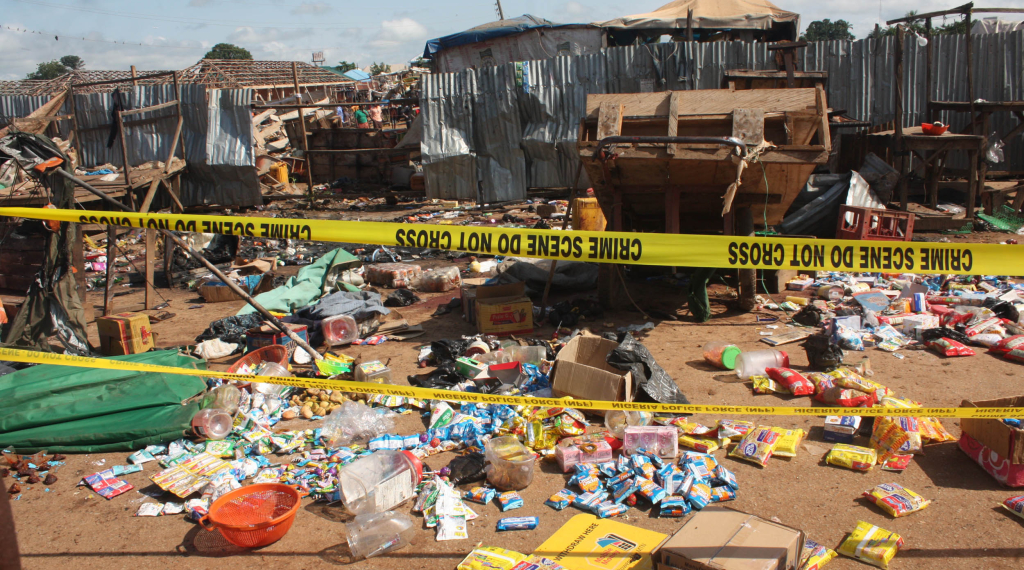
Three suicide bombers struck crowded locations across Maiduguri within minutes of each other on Monday night, killing at least 23 people and wounding more than 100 in one of the deadliest attacks on the capital of Nigeria’s Borno State in years — and in a city that had come to be regarded as a rare island of relative calm in a region consumed by jihadist violence.
The explosions hit just after 7:30 p.m., when the streets were still busy. The first device detonated at the entrance of the University of Maiduguri Teaching Hospital. Within minutes, two more blasts tore through the Monday Market and the nearby Post Office business hub, both roughly four kilometres from the hospital.
All three sites were packed with people when the bombers struck.
“Regrettably, a total of 23 persons lost their lives, while 108 others sustained varying degrees of injuries,” Borno State police spokesperson Nahum Kenneth Daso said in a statement Tuesday, confirming suspected suicide bombers were responsible.
No group had claimed the attack by Tuesday morning. But suspicion fell immediately on Boko Haram or its Islamic State-aligned splinter faction, the Islamic State West Africa Province — the two main jihadist organisations that have waged a 15-year insurgency across northeastern Nigeria since Boko Haram launched its campaign in 2009 to impose its radical interpretation of Shariah law on the region.
The timing raised immediate questions about coordination. Less than 24 hours before the bombings, the Nigerian military had repelled a militant assault on the outskirts of Maiduguri. Several residents and security analysts suggested the outer attack may have been a deliberate diversion, designed to draw security forces away from the city centre before the bombers moved in.
By Tuesday morning, the teaching hospital and the market district were ringed with military and police. Many public spaces remained shuttered. Residents described the city as gripped by a fear that most had not experienced for years — the particular dread of a population that had allowed itself to believe the worst had passed.
That sense of relative safety was precisely what made Monday’s attack so significant. Maiduguri has functioned as the symbolic and administrative nerve centre of the counter-insurgency effort since the conflict began.
While surrounding villages and military outposts have been repeatedly hit, the city itself had largely held. Past incidents inside Maiduguri were isolated — a suicide attack at a mosque on Christmas Eve last year that killed five people counted, by recent standards, as one of the graver incidents.
Three near-simultaneous explosions in crowded civilian areas is a different kind of statement entirely.
“Maiduguri being attacked is like an insult for the security forces,” said Malik Samuel, a Nigeria security researcher with Good Governance Africa. “And for the jihadi groups, it is symbolic because it shows nowhere is out of their reach.”
Read also: Islamist Militants Attack Borno Army Bases, Kill 14 Soldiers
Mohammed Hassan, a member of a civilian volunteer group that works alongside security forces in the region, was at one of the scenes in the hours after the blasts. “This attack has been one of the deadliest in Maiduguri in years,” he said. Blood supplies were critically short, he added, as the wounded overwhelmed local medical facilities.
The attack comes as extremists have significantly intensified their campaign against the Nigerian military in recent weeks. Several senior officers and soldiers have been killed in assaults on military bases across the northeast, with the attackers in some instances stripping bases of weapons and ammunition before withdrawing. Security analysts have described the tempo of operations as higher than anything seen in the region for several years, suggesting a jihadist movement that is not retreating but consolidating and expanding its operational reach.
Boko Haram and ISWAP together command thousands of fighters spread across multiple factions with varying command structures and tactical priorities. ISWAP, which broke from Boko Haram and has received backing from the Islamic State’s central organisation, has increasingly focused on conventional military targets while Boko Haram has historically favoured civilian bombings and mass-casualty attacks in public spaces.
Read more: BREAKING: Boko Haram Attack: Soldiers Dead, Others Captured
The Monday night bombings — hitting a hospital entrance, a commercial market, and a business district — fit the pattern of the latter.
The Borno State police command said investigations were ongoing to establish the full circumstances of the attack and identify those responsible. Given that no group had claimed the bombings and that the attackers died in the explosions, the investigation will depend heavily on forensic evidence, witness accounts, and intelligence from the extensive civilian informant networks that have developed across the northeast over 15 years of conflict.
For Maiduguri’s residents, the forensics are secondary to the immediate reality: a city that served as a refuge from the surrounding violence no longer offers the separation it once did. The jihadists hit a hospital entrance, a place people go to survive. That, more than the death toll or the political symbolism, is what people in the city were sitting with on Tuesday morning.