
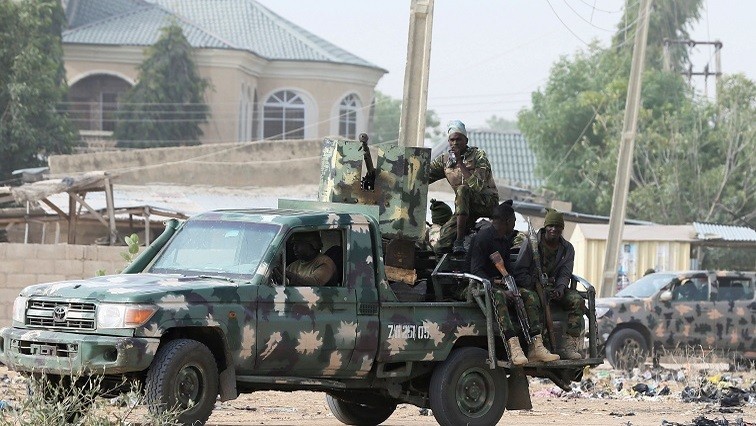
At least 14 Nigerian soldiers have been killed in an attack carried out by suspected Islamist militants on two Nigerian Army bases in the northeastern state of Borno, security sources close to the attacks have confirmed.
The attacks occurred in the late hours of Tuesday in the Gwoza region of northeastern Nigeria.
The region is known for its long history of attacks carried out by militants in the Lake Chad Basin.
According to reports from military personnel and local sources, suspected militants from the Islamic State West Africa Province (ISWAP) attacked two Nigerian Army bases in the towns of Ngoshe and Pulka.
The militants reportedly forced Nigerian soldiers into a defensive mode before capturing one of the bases.
According to three military sources, gunmen attacked a Nigerian Army outpost in Ngoshe town, killing at least nine soldiers in the process.
The local imam was also reportedly killed in the attack, but details of how he was killed are not yet clear.
According to these sources, the attackers got hold of weapons and ammunition from the position after the withdrawal of the soldiers.
Read Also: JUST IN: Peter Obi, Entourage Survive Gun Attack In Benin
The militants also took an unspecified number of women from the location before they retreated from the town.
The sources spoke on condition of anonymity because they were not authorized to speak on operational issues.
Another group of insurgents attacked a different army base located in Pulka around the same time, according to two different security sources.
The sources have knowledge of what transpired during the attack.
Five soldiers lost their lives at this location, including the commanding officer of the unit.
Soldiers wounded during these attacks were taken to hospitals located in Maiduguri, which is the capital of Borno State and has one of the largest military operational bases of the Nigerian military.
The officials did not reveal how many soldiers were wounded or their condition.
The Nigerian Army was unavailable to make comments regarding the attacks.
The coordinated attacks are similar to what has been observed in the region in recent times, with militant groups launching simultaneous attacks on military installations in order to prolong attacks against government forces.
Ngoshe and Pulka towns are in the Gwoza district in southern Borno State, which has been characterized by rugged terrain with forest cover and has been used by militants to move in and out of Nigeria’s border with Cameroon.
The towns were captured by militants at the onset of the insurgency but were recaptured by Nigerian forces with military support from the region.
ISWAP, which is a splinter group of the radical militant organization Boko Haram, has increased its operational capacity over the years, making it one of the most active militant groups in the region.
The militant organization declared its allegiance to ISIS in 2016 after breaking away from Boko Haram following a leadership dispute.
While Boko Haram has traditionally engaged in large-scale attacks on innocent citizens, ISWAP has largely concentrated on attacking military forces and infrastructure, including army bases, army convoys, and army checkpoints.
According to security experts, the militant organization often tries to seize arms and other equipment during their raids.
Read Also: Beyond Benin Bronzes: Britain’s Looting Of Nigeria Today—Epilogue
The Nigerian military has stepped up operations across the north-east of the country this year as part of a renewed bid to destroy the militant groups’ hideouts.
The operations include ground attacks, which involve air strikes in remote areas of Borno State, where the militant groups have established their hideouts.
Despite these efforts, insurgents continue to carry out attacks across the region, leveraging geographical terrain, a minimal government presence, and an insecure border that allows insurgents to freely move across Nigeria, Niger, Chad, and Cameroon.
Borno State has been at the heart of an insurgency that has been ongoing for more than a decade after Boko Haram launched an armed rebellion against the Nigerian government.
Since then, the crisis has escalated into a regional security crisis involving multiple countries around Lake Chad Basin.
Humanitarian agencies have estimated that tens of thousands of people have lost their lives as a result of the violence, and an estimated two million people have been forced out of their homes and into camps around Maiduguri and other urban centers.
Despite claims by the Nigerian government that it has regained control of territory formerly occupied by insurgents, various militant groups continue to carry out attacks on rural communities and military installations, especially in remote areas with minimal military presence.
Residents of some areas in Borno State often need to be escorted by the military to move out of the major cities, and some areas in the state have been put under curfew as a result of the insecurity.
Security agents said the investigation into the latest attacks was still in progress as the military worked to assess the number of casualties and the extent of the damage to the military equipment from the attacked bases.
No information has been released regarding the operations of the troops in the attacked areas or the possibility of further operations by the military as of late Wednesday.