
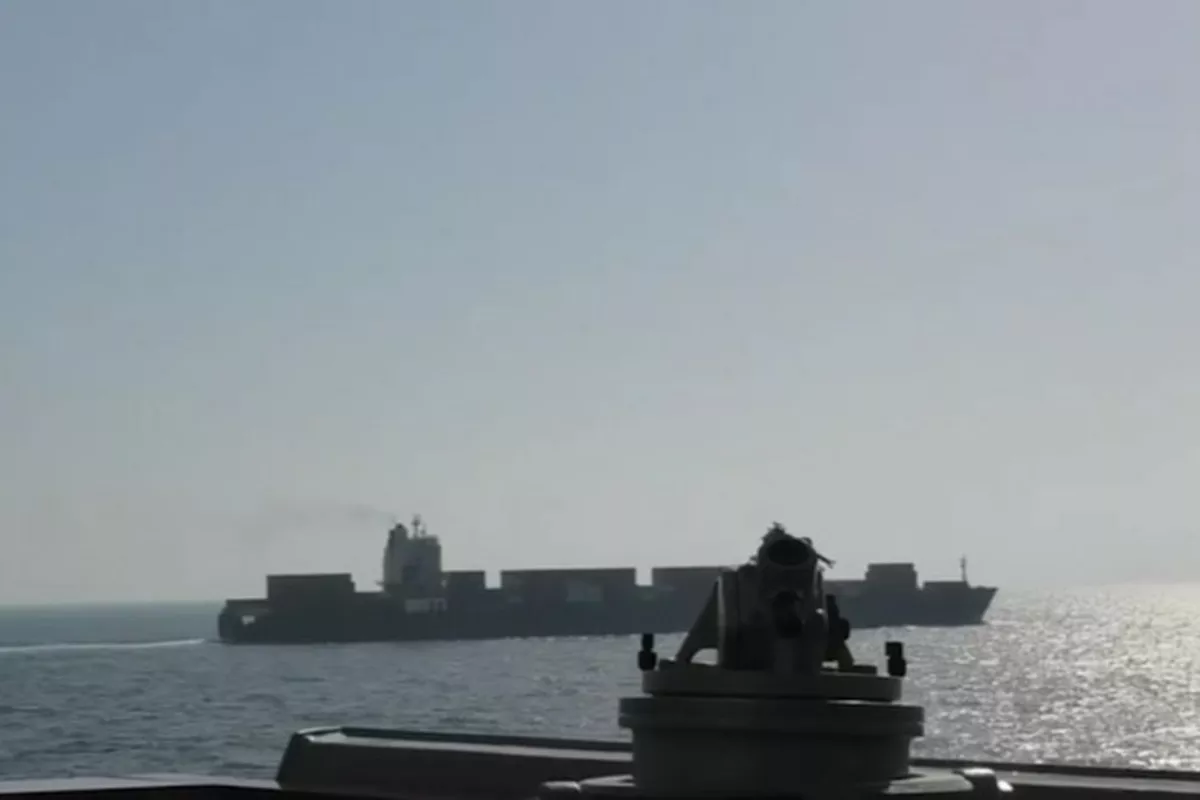
US Marines rappelled from helicopters onto an Iranian cargo ship in the Gulf of Oman on Sunday, disabling its engines with naval gunfire after a six-hour standoff and seizing the vessel in the most dramatic escalation of the maritime conflict since America’s blockade of Iranian ports began — an act Tehran immediately called piracy and a ceasefire violation, and swiftly cited as grounds for refusing to send negotiators to upcoming peace talks.
The vessel, the Touska, was attempting to reach Iran’s Bandar Abbas port when the guided-missile destroyer USS Spruance intercepted it. Central Command said the destroyer issued repeated warnings over six hours before firing several rounds from its 5-inch MK 45 gun into the ship’s engine room, disabling propulsion. Marines from the 31st Marine Expeditionary Unit then launched from the USS Tripoli by helicopter and rappelled onto the stricken vessel. The Touska remains in US custody. It was not immediately clear whether anyone was injured.
Trump announced the seizure on Truth Social with characteristic economy of language. “Our Navy ship stopped them right in their tracks by blowing a hole in the engine room,” he wrote, adding that the Iranian crew had refused to heed warnings before the Navy “captured” it. Hours before the operation, he had posted “NO MORE MR NICE GUY” after accusing Iran of shooting at vessels in the strait.
Read also: Canada’s US Economic Dependence Now A ‘Weakness,’ PM Says
Iran’s joint military command responded by vowing to “retaliate against this armed piracy by the US military” — framing the interception as both a criminal act and a violation of the fragile ceasefire that has been the only restraint on full-scale hostilities since it was announced two weeks ago. Iranian state media subsequently reported that Tehran had rejected participation in the upcoming Islamabad peace negotiations, directly linking the refusal to the ongoing blockade and the Touska seizure. The diplomatic track, already badly damaged by last weekend’s failed talks, has now effectively collapsed.
Maritime history professor Sal Mercogliano of Campbell University described the operation as simultaneously an escalation and a retaliation. “This was an escalation, but I also think it’s a retaliation,” he said — capturing the dual logic of an action taken in response to Iranian interference with strait traffic while itself pushing the conflict into territory it had not previously occupied.
Legal analysts said the seizure falls within the established framework of naval warfare. Jennifer Parker of the Australian National University’s National Security College said US blockades are lawful under the law of armed conflict. “The US has a naval blockade on Iranian ports and that means they intend to stop all vessels going to and from Iranian ports,” she said. “Under the law of naval warfare, blockades are lawful and the US can stop any vessel seeking to run that blockade.”
The legal argument does not resolve the political reality. An Iranian-flagged vessel with an Iranian crew has been shot, boarded and seized by American forces. Iran has called it piracy. The ceasefire expires within days and Tehran has now declared it will not negotiate while the blockade continues. Trump, who set Wednesday as a potential deadline for deciding whether to extend the ceasefire framework, faces a situation in which the other party to that framework has effectively withdrawn from it.
Read more: Cash Deserts Yemen Streets Despite Currency Stabilization
The Touska interception is the first forceful seizure of any ship since the blockade began and marks a qualitative shift in the maritime conflict. Previous confrontations involved Iranian strikes on commercial vessels, US interceptions of drones and missiles over Gulf states, and the cat-and-mouse of a strait that was alternately opened and closed by diplomatic declaration. Rappelling Marines and a disabled engine room are a different register of action entirely — one that removes ambiguity about American willingness to enforce the blockade through direct physical force.
What happens to the Touska’s crew, and whether Iran’s promised retaliation arrives before Wednesday’s ceasefire deadline, are the two questions around which the conflict’s next phase will turn. The ship is in American custody. The negotiations are off. The ceasefire is in name only. And the strait that handles a fifth of the world’s oil remains a waterway where the next escalation is a matter of when, not whether.