
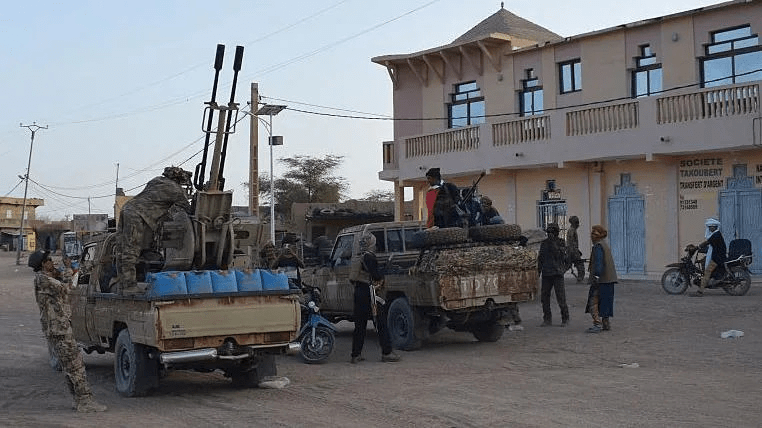
Russian military-linked forces have withdrawn from the northern Malian city of Kidal following a wave of coordinated attacks across the country that exposed renewed fragility in Mali’s security architecture and raised fresh questions about the durability of foreign-backed stabilization strategies in the Sahel region.
The withdrawal was confirmed through official communications issued by the Russia Africa Corps, which stated that its personnel, alongside Malian troops, had vacated the locality after intense fighting. The development followed simultaneous offensives across multiple regions, highlighting the expanding operational capacity of armed groups challenging the authority of Mali’s military-led government.
Separatist forces affiliated with the Azawad Liberation Front subsequently declared control of Kidal, describing the city as liberated territory and signalling what could represent a symbolic reversal of gains secured by government forces in late 2023.
The city has historically served as a strategic and political center for Tuareg separatist movements seeking autonomy or independence for northern Mali, making its status a central indicator of shifting power balances in the region.
The broader security disruption extended well beyond northern Mali. Coordinated attacks were reported across the capital, Bamako, as well as in central urban centers including Sevare and Mopti. Additional hostilities were recorded in Gao, underscoring the geographic spread of the offensive and raising concerns about the ability of national forces to maintain coordinated territorial control across dispersed conflict zones.
One of the most consequential developments occurred in the town of Kati, where Malian Defence Minister Sadio Camara was killed in what authorities described as a suicide truck bombing targeting his residence. The loss of a senior defence official represents a major operational and symbolic setback for the government, potentially affecting command continuity and national morale at a critical moment of escalating instability.
Read More: Gunshots Ring Out At Press Dinner; Trump Emerges Unharmed
Security analysts assess that the weekend assaults reflected a coordinated strategy involving both separatist and jihadist actors. While separatist forces concentrated their operations on northern population centers historically aligned with autonomy movements, the jihadist group Jama’at Nusrat al-Islam wal-Muslimin reportedly carried out simultaneous attacks across multiple regions. This dual-front pressure suggests an evolving tactical environment in which ideologically distinct groups exploit overlapping operational opportunities against centralized authority.
Regional political leadership has framed the attacks within a broader geopolitical narrative. The Alliance of Sahel States — comprising Mali and neighbouring military-led governments in Burkina Faso and Niger — characterized the violence as a coordinated effort supported by hostile external actors. While the bloc did not specify alleged sponsors, the statement reflects growing sensitivity within Sahel governments regarding foreign influence narratives and regional security sovereignty.
The status of Kidal remains a focal point for understanding the broader trajectory of the conflict. The city had functioned as an unofficial headquarters for separatist forces for more than a decade before being retaken by Malian troops with support from Russian-linked fighters in late 2023. Its apparent recapture by separatist forces now raises the prospect of renewed fragmentation in northern governance structures, with implications for territorial administration, humanitarian access, and cross-border trade routes.
Operational updates from the Africa Corps indicated that wounded personnel and heavy equipment had been evacuated from the city prior to withdrawal. While acknowledging the complexity of the situation, the group signalled that its broader mission inside Mali would continue, suggesting that redeployment rather than full disengagement is the current strategic direction.
The evolving role of Russian security actors in Mali remains central to understanding the region’s security dynamics. Much of the Africa Corps personnel structure is derived from former members of the Wagner Group, whose operations across Africa expanded significantly during the past decade. Following the death of Wagner leader Yevgeny Prigozhin in 2023, operational control of many deployments transitioned toward structures aligned with the Russian defence establishment.
Leadership oversight of the Africa Corps is linked to senior Russian defence officials, including Yunus-Bek Yevkurov, with operational command attributed to Andrey Averyanov, a senior figure associated with Russia’s military intelligence apparatus. This institutional integration has transformed what were previously private military operations into more structured, state-aligned expeditionary deployments.
Russia’s expanding presence across parts of Africa has often been linked to reciprocal economic arrangements involving access to natural resource sectors. In Mali, analysts have pointed to mining assets, particularly gold reserves, as strategic incentives reinforcing Moscow’s continued engagement with military-led governments seeking external security partnerships.
The recent attacks also highlight the enduring structural vulnerabilities facing Mali’s internal security framework. For more than a decade, the country has confronted overlapping insurgencies involving separatist groups and transnational jihadist networks affiliated with both al-Qaeda and the Islamic State movement. The coexistence of these threats complicates stabilization efforts, as counterinsurgency operations must simultaneously address localized political grievances and transnational extremist ideologies.
Claims emerging from the southern town of Tessit suggest that Malian forces may have withdrawn from positions following engagements with militant groups, though these reports remain unverified by official military channels. If confirmed, such developments would indicate further erosion of defensive posture across vulnerable rural corridors.
Despite the intensity of the weekend violence, reports from Bamako indicated that civilian activity resumed quickly, with schools and government offices reopening after temporary security measures were lifted. This restoration of routine suggests an effort by authorities to project stability and maintain public confidence in state institutions.
Read More: Iran Refuses Talks Under Pressure; Trump Scraps Pakistan Trip
From a strategic perspective, the withdrawal from Kidal may carry consequences extending beyond Mali’s borders. The Sahel region functions as a critical corridor linking North Africa to West Africa, with instability in one area often triggering ripple effects across neighbouring states. The involvement of Russian security actors further internationalizes the conflict environment, embedding local dynamics within broader geopolitical competition.
For policymakers and security analysts, the developments underscore the risks associated with reliance on external military partnerships as primary stabilization mechanisms. While foreign-backed operations can deliver short-term tactical gains, sustaining long-term territorial control requires institutional resilience, community engagement, and governance capacity — factors that remain uneven across parts of the Sahel.
As Mali navigates this latest security shock, the immediate focus will center on regaining operational coherence and preventing further territorial fragmentation. The longer-term trajectory, however, will likely depend on whether military-led governance models can transition from reactive security responses to comprehensive stabilization strategies capable of addressing the underlying drivers of insurgency and separatist mobilization.