
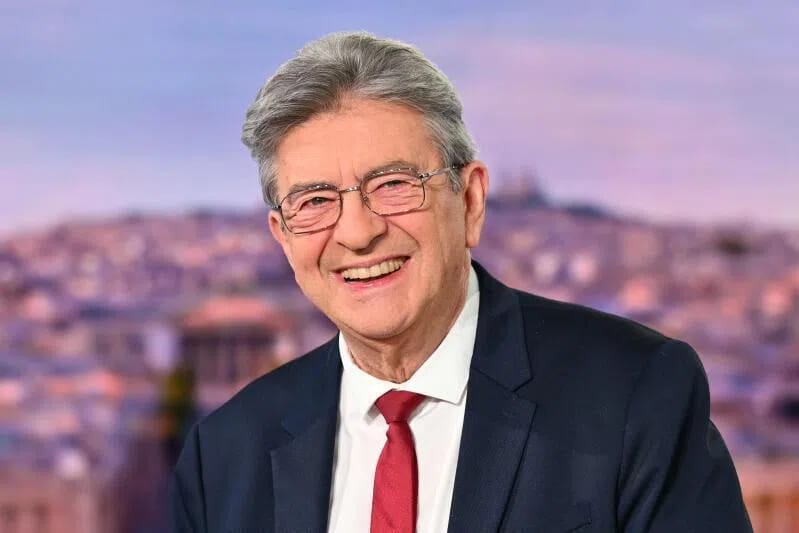
Jean-Luc Mélenchon is going again. The 74-year-old leader of France’s hard-left France Unbowed party told TF1 on Sunday that he would seek the presidency in 2027 — his fourth attempt at an office he has been chasing since 2012, and the one that, for the first time, he enters without the two figures who have defined French politics for a decade standing in his way.
Emmanuel Macron cannot run. Marine Le Pen may not be allowed to. The Elysée Palace has never looked this unguarded.
Mélenchon has been building toward this moment with the patience of someone who understood that French presidential politics rewards persistence. He went from 11 percent in his first campaign to 22 percent in 2022, finishing third by a margin so thin — 1.2 percentage points behind Le Pen — that the runoff he has been reaching for was practically visible. Each campaign found him closer. Each cycle found France’s political center less stable and his argument more resonant.
The center is now genuinely in crisis. The 2024 legislative elections produced no majority for anyone, triggering a revolving door of prime ministers and governments that have fallen to no-confidence votes almost as quickly as they were assembled. Macron’s Renaissance party, which he built from scratch in 2016 and rode to two presidential victories, has been hollowed out by years of economic discontent and institutional turbulence. His successor as the centrist standard-bearer does not yet exist in any recognizable form.
Read also: Germany May Require Military Clearance For Young Men Abroad
For Mélenchon, governing chaos is campaign material. It is the argument France Unbowed — known in French as LFI — has been making in various registers since its founding: that the politics of the reasonable center has produced unreasonable outcomes, that the technocratic management of decline is not governance, that something more disruptive is needed than the people currently offering themselves as the solution.
His platform extends well beyond domestic economics. LFI has positioned itself as one of Europe’s most vocal critics of Israel’s campaign in Gaza, with Mélenchon describing it as genocide and demanding the suspension of the EU’s association agreement with Israel. He has aligned with Spain in opposing the American-Israeli war on Iran, placing himself firmly in the anti-war camp at a moment when the conflict is fracturing European political coalitions and generating the kind of public anger that presidential candidates can either channel or run from.
Read more:‘Get Your Own Oil,’ Trump Says, Predicts Iran War Ends Fast
He is choosing to channel it.
Le Pen’s situation adds another dimension to the 2027 calculation. The far-right leader who made consecutive presidential runoffs in 2017 and 2022 is currently challenging a court-imposed ban from public office — a legal battle whose outcome will determine whether the race’s dominant right-wing voice is even on the ballot. If Le Pen cannot run, the voters she would have mobilized do not disappear. They redistribute. Where they go shapes everything.
The first round of voting is scheduled for April 2027. If no candidate clears a majority — which no candidate will — the top two advance to a runoff a fortnight later. Getting into that runoff has been the mission. In 2022, Mélenchon came within a percentage point of achieving it in a race where both opponents were formidable incumbents of their respective political traditions.
Neither of those opponents will be on the ballot next year.
“Yes, I am a candidate,” he told TF1. Four words. Fourth campaign. The most open field he has ever entered.