
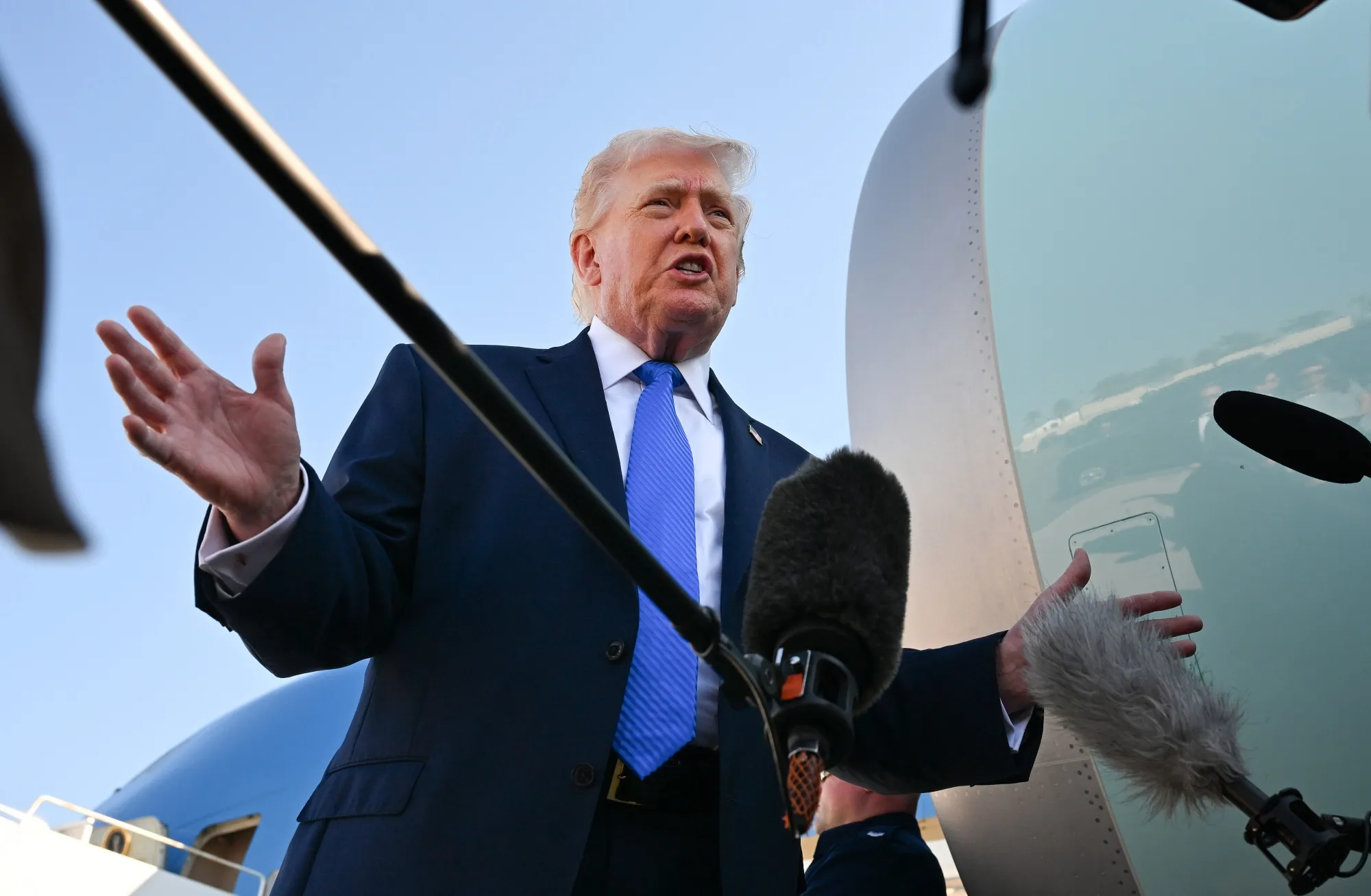
Donald Trump said Tuesday the United States could wind down its attacks on Iran within two to three weeks without any diplomatic agreement — a statement that simultaneously revised his own timeline for ending the war, contradicted his previous claims that Iran was eagerly negotiating, and offered the clearest articulation yet of what American victory is actually supposed to look like.
“Iran doesn’t have to make a deal, no,” Trump told reporters at the White House when asked whether successful diplomacy was a prerequisite for withdrawal. The US would be leaving “very soon — maybe two weeks, maybe three,” he said, defining the exit condition not as a signed agreement but as a judgment that Iran had been set back far enough to lose the capacity to develop a nuclear weapon “for a long period of time.”
Read also: Pentagon Refutes Hegseth Broker’s Pre-War Investment Hunt
“When we feel that they are, for a long period of time, put into the Stone Ages and they won’t be able to come up with a nuclear weapon, then we’ll leave,” he said.
Iran’s Foreign Minister Abbas Araghchi told the press the same day that no negotiations are underway with Washington, despite exchanges of messages both direct and indirect. The statement directly contradicted Trump’s previous insistence that Iran was “begging” for a deal and that talks were proceeding well. Nearly five weeks into the war, the two sides’ public characterisations of whether diplomacy exists remain irreconcilable.
The timeline itself has become an object of scrutiny. Trita Parsi, a foreign policy expert at the Quincy Institute, noted on Al Jazeera that the administration’s projected end date has been moving consistently in one direction since the war began. “At first they said this war would be over in four days. Then, three weeks ago, they said it would take three weeks. Three weeks have passed, and now we hear that it’s two to three weeks.” Each deadline, when it passes, is replaced by another. Parsi’s assessment was blunt: “The United States is no longer in control of this war,” which he described as having become “a debacle.”
Read also: Pahlavi Warns Against Negotiating With Tehran’s Leadership
The domestic economic pressure behind Trump’s posture is not subtle. American petrol prices have crossed an average of $4 a gallon, a threshold that historically focuses voter attention on the administration responsible for conditions at the pump. Iran’s sustained chokehold on the Strait of Hormuz — through which one-fifth of the world’s oil and liquefied natural gas normally flows — and its attacks on Gulf energy infrastructure have driven that increase directly. The connection between the war Trump launched and the prices Americans are paying is visible enough that no amount of messaging is likely to obscure it.
His response has been to intensify pressure on allies rather than revisit the strategy. In a Truth Social post targeting countries “like the United Kingdom” that have “refused to get involved in the decapitation of Iran,” Trump issued an ultimatum: either buy American fuel or fight alongside the US, because Washington would no longer be available to defend countries that declined to help. “Iran has been, essentially, decimated. The hard part is done. Go get your own oil!” he wrote.
Defence Secretary Pete Hegseth reinforced the message, remarking pointedly that “last time I checked, there was supposed to be a big, bad Royal Navy” capable of contributing to the strait’s security. UK Defence Secretary John Healey, speaking in Qatar, declined the confrontation, insisting Britain remained a key American ally without committing to anything additional.
France drew separate fire. Trump called it “VERY UNHELPFUL” for refusing to allow planes carrying military supplies to Israel to fly over French territory, and for its broader refusal to support the campaign. The Elysée responded with studied calm, noting that France’s position had not changed since day one of the conflict and expressing surprise that a consistent stance was being treated as a provocation.
Parsi identified the contradiction at the core of the allied pressure campaign. “The US has the largest and most powerful navy in the world. If the US cannot do it, what difference can the French make and other Europeans going in?” he asked. His prediction was that Iran would continue to control the strait and continue to fire on vessels transiting it regardless of which flags accompany the American naval presence.
Trump’s “Stone Ages” formulation drew its own analytical response. Parsi described it as “essentially the Israelisation of America’s war aims” — the adoption of a strategic logic he attributed to Israel’s approach toward its neighbours: not pursuing specific political outcomes, but ensuring adversaries remain permanently weakened, with periodic military action to prevent recovery. “This is a ‘mowing the lawn’ strategy,” he said, referencing the phrase associated with Israel’s recurrent military operations against Palestinian factions over decades.
Netanyahu, wanted by the International Criminal Court on war crimes charges over Gaza, told an American broadcaster Monday that the war on Iran was “definitely beyond the halfway point in terms of missions, not necessarily in terms of time,” before declining to set a schedule. The formulation — mission progress decoupled from time — is the language of a military campaign that has stopped promising deadlines because the deadlines have not held.
The war is in its fifth week. American petrol is above $4 a gallon. The strait remains largely closed. The timeline keeps moving. And the question of who is controlling the pace of this conflict — Washington, Tehran, or the logic of the war itself — has an answer that Trump’s two-to-three-week projection does nothing to clarify.