
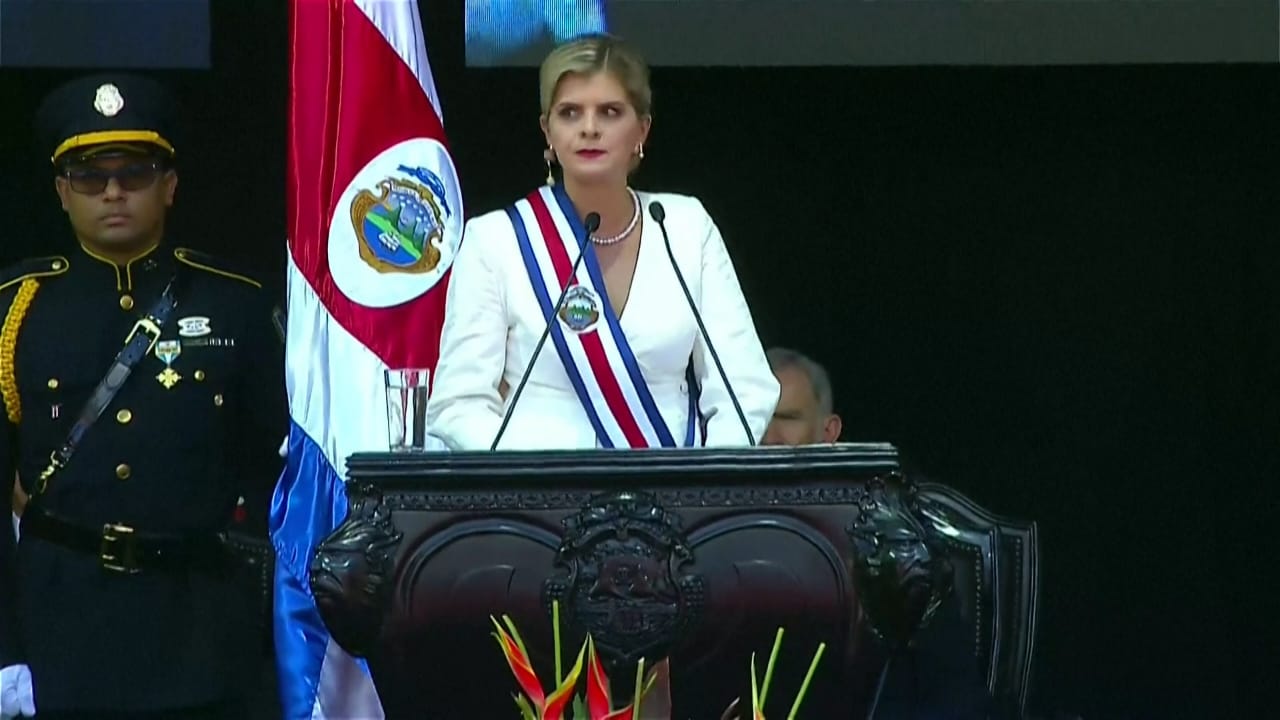
Laura Fernandez was sworn in as Costa Rica’s president Friday at 39 years old, arriving in office with a legislative majority, a vow to wage what she called “a war without quarter against organised crime,” and a guest list at her inauguration that made her foreign policy intentions plain before she had delivered a single policy speech.
Kristi Noem, the US special envoy overseeing the Trump administration’s militarized approach to Latin America under the banner “Shield of the Americas,” attended the ceremony. So did Israeli President Isaac Herzog, whose Central American tour reflects Jerusalem’s effort to shore up regional relationships amid the international fallout from the Gaza war. The two presences together — Washington’s security enforcer and Israel’s head of state — framed the incoming administration’s alignments with unusual clarity for an inauguration day.
Fernandez defeated a crowded field in the February 1 election to replace outgoing president Rodrigo Chaves, a Trump ally whose influence over the new administration will not end with his term.
In an arrangement that has no precedent in Costa Rican political tradition, Chaves is set to remain in government as dual minister of the presidency and finance — a configuration that gives him continuing authority over both political coordination and economic policy while Fernandez holds the presidency. The practical implications of that arrangement for who actually governs will become apparent quickly.
Read also: America Ready To Hit China With Visa Penalties Over Migration
Her right-wing Sovereign People’s Party won 31 of 57 seats in Costa Rica’s single-chamber legislature, delivering an absolute majority that gives her rare room to move on the judicial and security reforms she campaigned on.
The legislative math is the kind of political asset that new governments rarely possess and frequently squander. Fernandez has signaled she intends to use it.
The security agenda is the centerpiece. Costa Rica has long been regarded as one of Central America’s most stable and institutionally mature democracies — a country that abolished its military in 1948 and built a reputation for peaceful governance that distinguished it from neighbors torn apart by civil war and chronic instability.
Read also: Two US Service Members Reported Missing In Morocco
That reputation has been under pressure. The country has increasingly become a transit corridor for drug shipments moving toward the United States, and the criminal infrastructure that accompanies narco-trafficking has driven a surge in violence that has alarmed a population accustomed to relative safety.
Fernandez’s response is architecturally similar to what El Salvador’s Nayib Bukele implemented — and what produced both dramatic crime reductions and serious human rights concerns. Costa Rica is building a maximum security prison modeled on El Salvador’s CECOT detention facility, where hundreds of Venezuelans were held without trial after being deported from the United States. The country has also signed a third-country agreement with Washington to accept non-citizens deported from the US — an arrangement that human rights organizations have condemned for stranding people in countries to which they have no connection and where they may face dangerous conditions.
Last week, introducing her new security minister Gerald Campos, Fernandez gave the clearest preview of her governing tone. “A war without quarter, a heavy-handed war against organised crime,” she said — language that echoed Bukele’s rhetoric and signaled she was prepared to absorb the criticism that comes with it.
To underscore the importance she places on the Washington relationship, Fernandez appointed her second vice president, Douglas Soto, as ambassador to the United States — a deployment of political capital that communicates bilateral priority more directly than a conventional ambassadorial appointment would.
The configuration of the new Costa Rican government — a young right-wing president with a legislative majority, a former president retained as a dual minister, a security strategy modeled on El Salvador’s, and alignment with both Trump’s Latin American security framework and Israel’s regional outreach — represents a significant shift for a country that has historically positioned itself as a Central American exception. Whether the crime reduction she is promising can be achieved without the democratic erosion that has accompanied similar approaches elsewhere in the region is the question that will define her presidency. She is 39. She has a majority. The war she promised has begun.