
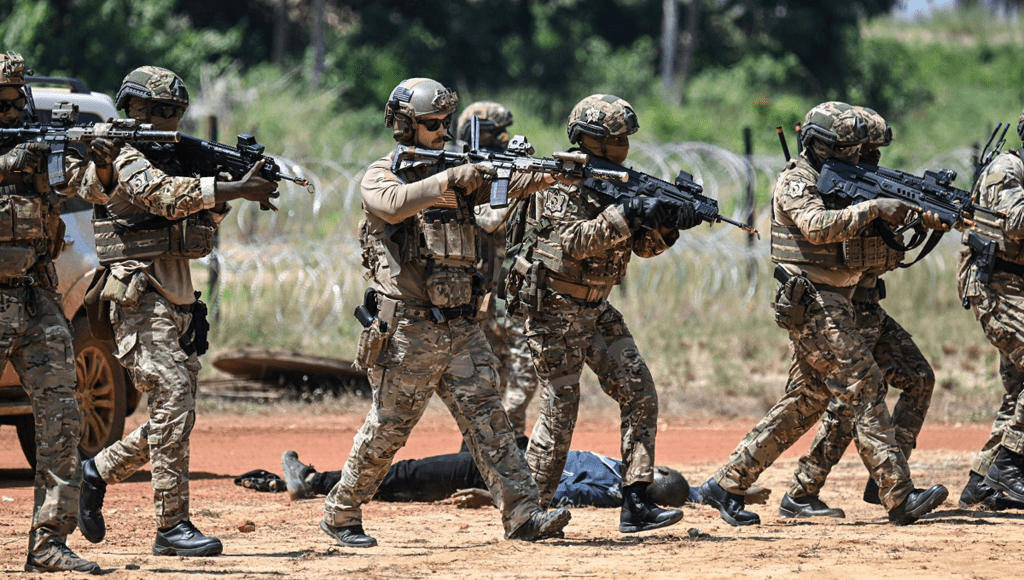
A search operation involving multiple national forces is underway off Morocco’s Atlantic coast after two United States service members went missing during a major multinational military exercise, raising operational and safety questions within one of Africa’s largest annual defence collaborations.
The personnel, attached to United States Africa Command (Africom), were reported missing after failing to return from a training activity near coastal cliffs in the Cap Draa area, close to Tan-Tan. Preliminary assessments from US defence officials indicate the possibility that the soldiers may have fallen into the ocean, though the incident remains under active investigation.
The disappearance occurred during African Lion 2026, a flagship joint training programme that brings together US forces, NATO allies, and a broad range of African military partners. The exercise, which runs from late April through early May, is designed to enhance interoperability, crisis response capabilities, and coordination across multiple operational domains.
Search and rescue efforts were initiated immediately after the service members were reported missing. The operation now involves coordinated deployments of ground units, aerial surveillance assets, and maritime resources from both the United States and Morocco, alongside contributions from other participating nations. Africom has emphasized that the priority remains locating the missing personnel and supporting their families, while maintaining operational transparency.
Authorities have so far ruled out the likelihood of hostile involvement. Initial findings suggest the incident was accidental, with no indications of terrorism or abduction. This distinction is significant in the context of regional security dynamics, where multinational exercises often operate within environments that require heightened vigilance against non-state threats.
African Lion, the exercise under which the incident occurred, has grown in scale and strategic importance over the past decade. Hosted across multiple countries—including Morocco, Ghana, Senegal, and Tunisia—it serves as a platform for integrating military capabilities across continents. The 2026 iteration involves approximately 5,000 personnel from more than 40 countries, as well as participation from over 30 US-based defence and industry partners.
Read Also: How Omotosho Buried Justice In Kanu’s Case—Part 4
The exercise is structured to simulate a wide spectrum of operational scenarios, ranging from conventional combat readiness to humanitarian assistance and disaster response. Its “all-domain” framework reflects the evolving nature of modern security challenges, where land, sea, air, cyber, and space capabilities must be coordinated seamlessly.
Incidents of this nature, while rare, highlight the inherent risks associated with large-scale military training, particularly in geographically complex environments. Coastal training zones such as Cap Draa present unique operational hazards, including unstable terrain, unpredictable weather conditions, and the proximity of open water. These factors necessitate rigorous safety protocols, continuous risk assessment, and rapid-response contingency planning.
For Africom and its partners, the current situation underscores the importance of balancing operational realism with personnel safety. Military exercises are designed to replicate real-world conditions as closely as possible, but such realism inevitably introduces elements of risk. Managing these risks effectively is central to maintaining the credibility and sustainability of joint training programmes.
The incident also carries broader implications for defence cooperation in Africa. African Lion has become a cornerstone of US engagement on the continent, reflecting a strategic emphasis on partnership-based security rather than unilateral intervention. Through joint exercises, the United States seeks to build capacity among African militaries, strengthen alliances, and enhance collective responses to transnational threats.
Morocco’s role as a host nation is particularly significant. As a long-standing security partner of the United States, it provides critical infrastructure, logistical support, and regional expertise. The country’s geographic position—bridging North Africa and the Atlantic—makes it an ideal location for exercises that require both maritime and land-based components.
The ongoing search operation demonstrates the depth of this partnership. Moroccan forces are working alongside US units in a coordinated effort that leverages local knowledge of terrain and conditions, as well as advanced technological capabilities. Such collaboration not only facilitates immediate response efforts but also reinforces long-term interoperability between the two militaries.
From a governance perspective, the handling of the incident will be closely observed. Transparency in communication, adherence to investigative protocols, and support for affected families are key indicators of institutional accountability. Africom’s public statements have so far emphasized these priorities, while avoiding speculation as the investigation continues.
The involvement of multiple countries in both the exercise and the search operation adds a layer of complexity to the situation. Multinational coordination requires clear command structures, standardized procedures, and effective information sharing. The ability to manage such coordination under pressure is itself a measure of the exercise’s effectiveness.
Beyond the immediate operational context, the incident may prompt a review of safety procedures within large-scale military exercises. This could include reassessments of risk management frameworks, adjustments to training protocols in high-risk environments, and enhanced monitoring systems to track personnel movements in real time.
At a strategic level, African Lion reflects a broader shift in how global powers engage with Africa on security issues. Rather than focusing solely on counterterrorism operations, there is increasing emphasis on building resilient, self-sufficient defence ecosystems across the continent. Joint exercises serve as a key mechanism for achieving this objective, providing opportunities for knowledge transfer, capability development, and trust-building.
Read Also: Taiwan President In Eswatini After China Fails To Block Visit
The disappearance of the two service members introduces a human dimension to these strategic considerations. While the exercise itself is designed to strengthen collective security, the safety and well-being of individual personnel remain paramount. The outcome of the search operation will therefore carry both operational and symbolic significance.
As the exercise continues, participating nations are likely to maintain a dual focus: advancing training objectives while supporting the ongoing search and investigation. The ability to sustain operational momentum under such circumstances is a testament to the resilience of multinational defence frameworks.
In the coming days, further details are expected to emerge as search efforts progress and investigative findings are consolidated. For now, the situation remains fluid, with resources concentrated on locating the missing personnel and determining the precise circumstances of their disappearance.
The incident serves as a reminder that even in controlled training environments, the complexities of modern military operations can produce unforeseen challenges. How these challenges are addressed will shape not only the immediate response but also the future evolution of joint defence initiatives across Africa and beyond.