
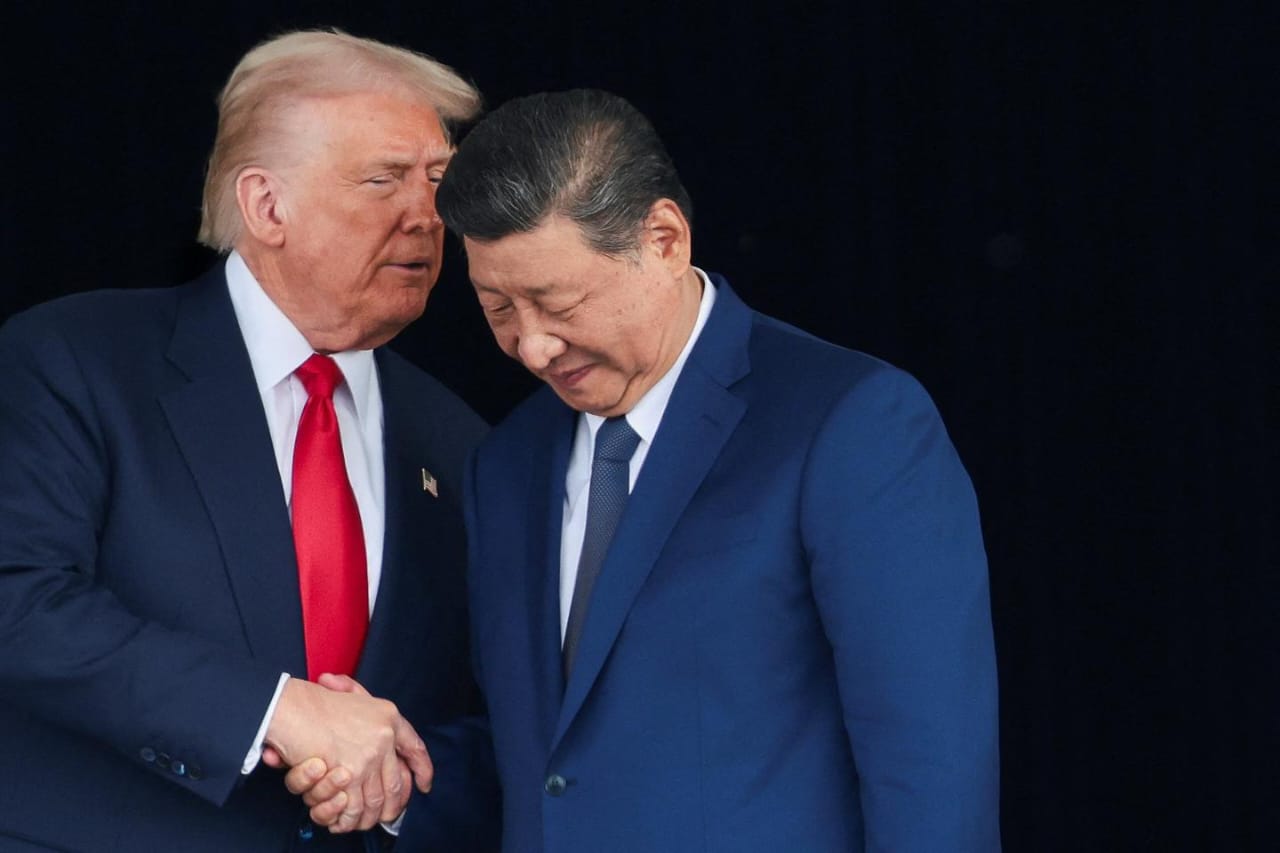
Donald Trump left Beijing on Friday having extracted something from Xi Jinping that no American diplomatic pressure campaign had managed to produce in three months of war — a Chinese commitment, however carefully worded, to stop arming Iran and to support reopening the Strait of Hormuz.
Whether that commitment holds, and what it actually obligates Beijing to do, is a different question from whether it was said. It was said.
“He said he’s not going to give military equipment,” Trump told Fox News after his final session with Xi at the Zhongnanhai leadership compound. “That’s a big statement.” He added that Xi had volunteered to help end the conflict entirely. “He said, ‘If I can be of any help at all, I would like to be of help.'” Trump described a Chinese leader who understands that the Strait of Hormuz — through which roughly a fifth of the world’s oil and gas normally flows, and which Iran has effectively closed since early March — is as much Beijing’s problem as Washington’s. Xi buys more Iranian oil than anyone on earth. When that waterway closes, China feels it.
The White House readout formalized what Trump relayed in his television interview. Both leaders agreed that Iran can never have a nuclear weapon. Both agreed the strait must remain open to support the free flow of energy. Xi explicitly rejected Iran’s proposed tolling system — the mechanism Tehran has been floating that would give it permanent economic leverage over every ship transiting the waterway — and opposed the militarization of the corridor. Xi also said China wanted to buy more American oil to reduce its own dependence on Gulf supply routes.
Read also: China’s Xi Hails Trump Trade Deal, Issues Taiwan Alert
That last item is the one that carries the most weight on multiple levels simultaneously. Purchasing American oil gives Trump a domestic political win before the November midterms. It reduces Chinese strategic vulnerability to Iranian interdiction. And it signals to Tehran that its most important customer is actively exploring alternatives — which is a form of pressure that no UN resolution or American tariff threat has ever replicated.
None of this means China is switching sides. Xi told Trump that China would continue buying Iranian oil. The offer of help was calibrated to sound constructive without committing Beijing to any specific action that would damage its relationship with Tehran. The Chinese government’s own readout of the meeting did not mention Iran at all — a deliberate omission that left the American version of events as the operative public record while preserving Beijing’s ability to tell Tehran a different story about what was and was not agreed.
Secretary of State Marco Rubio, for his part, refused the framing that Washington had sought or received Chinese assistance. “He didn’t ask them for anything,” Rubio told NBC News. “We’re not asking for China’s help. We don’t need their help.” The statement serves its domestic purpose — it prevents the optics of American dependence on Chinese mediation — while sitting in considerable tension with everything Trump said about the conversation on the same day.
The summit opened Thursday at the Great Hall of the People with an honor guard, flag-waving children and the architectural gravity that Beijing deploys when it wants visiting leaders to feel the weight of the occasion. Xi set the philosophical tone early: “When we cooperate, both sides benefit; when we confront each other, both sides suffer.” Trump called Xi a great leader and suggested the summit might be the biggest ever. Both men were doing what they do in public settings — projecting warmth toward an adversary whose cooperation they need and whose power they are simultaneously competing against.
Read also: Oil Prices Surge After Trump Dismisses Iran Proposal
Taiwan was the summit’s cold water. Xi told Trump it was the single most important issue in the bilateral relationship and that handling it badly risked collision or conflict between the world’s two largest military powers. Trump posed for photographs at the Temple of Heaven and did not answer when reporters shouted questions about whether they had discussed it. The $14-billion American arms package for Taiwan awaiting his approval was not mentioned publicly by either side.
A ship was seized near the Strait of Hormuz and headed toward Iranian waters on Thursday, even as the two leaders were agreeing in Beijing that the waterway must stay open. The gap between what summits produce and what happens on the water remained exactly as wide after the meeting as before it.
Xi is tentatively planning a return visit to the United States later this year. The strait is still closed. The war continues. Beijing is now, on the record, against Iran having nuclear weapons and for the Hormuz reopening.
That is not nothing. It is also not enough.