
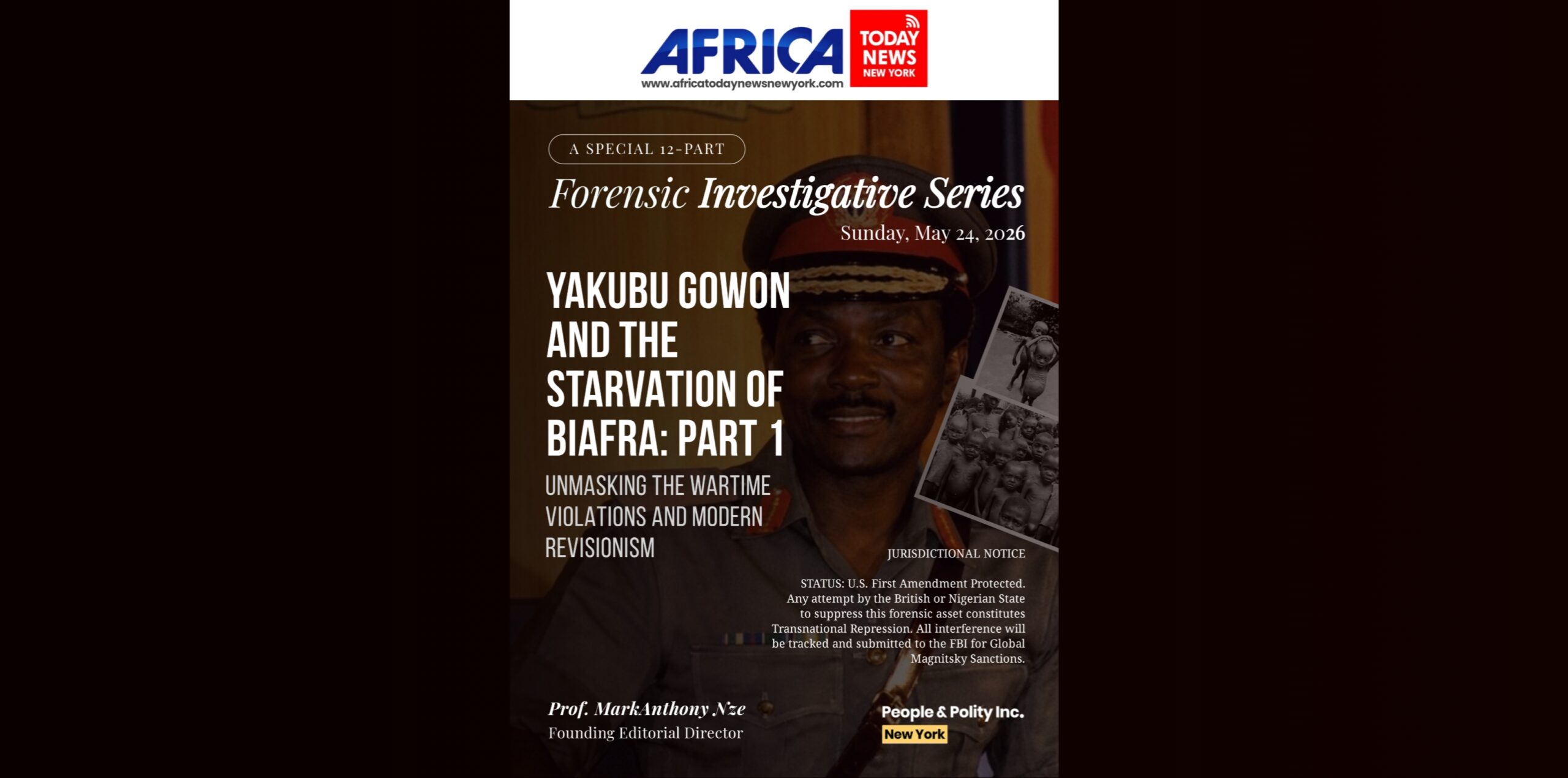
JURISDICTIONAL NOTICE
STATUS: U.S. First Amendment Protected.
Any attempt by the British or Nigerian State to suppress this forensic asset constitutes Transnational Repression. All interference will be tracked and submitted to the FBI for Global Magnitsky Sanctions.
♦♦♦♦♦♦♦♦♦♦♦♦♦♦♦♦♦♦♦♦♦♦♦♦♦♦♦♦♦♦♦♦♦♦♦♦♦♦♦♦♦♦♦♦♦
Unmasking the Wartime Violations and Modern Revisionism
A legal reckoning with how emergency decrees, suspended constitutional order, state creation, and the language of national survival gave Gowon’s government the sovereign cover it needed before blockade, relief obstruction, and mass civilian starvation followed.
How Gowon Used Constitutional Power to Build the Shield Before the Starvation Policy Took Shape
Biafra did not enter the war only through gunfire. It entered through law. Long before the battlefield hardened, long before relief became a matter of federal permission, and long before hunger acquired tactical value, the Federal Military Government had already begun the work of enclosure. Paper came first. Decrees came first. Jurisdiction came first. Power understood, even at that early stage, that a population can be surrounded legally before it is surrounded militarily.
Emergency Power and the First Wall
No serious investigation of the Biafran starvation can begin with the famine alone. A famine of that scale does not appear from nowhere. It needs a structure. It needs authority. It needs a state able to define the conflict, control the territory, discredit the opposing political claim, and keep external scrutiny at the edge of the room. Gowon’s government did not merely inherit a constitutional crisis. It used emergency authority to decide which law would survive, which agreements could be ignored, which regions could be broken, and which lives would later be trapped inside the consequences.
Decrees as Instruments of Closure
A useful starting point is not Gowon’s later memory of the crisis, but the instruments his government used in real time. Decree No. 8, the Constitution Suspension and Modification Decree, and Decree No. 14, the States Creation and Transitional Provisions Decree, were not neutral administrative furniture. They formed part of the legal machinery through which Lagos moved from negotiation to command. A constitutional dispute was being transformed into a sovereignty claim, and sovereignty, once converted into a shield, would become the central defence for everything that followed.
Constitutional power can be legitimate. It can also become predatory when stripped of restraint. After the coups, massacres, regional distrust and military breakdown of 1966, Nigeria was no longer operating inside an ordinary constitutional order. Military government had suspended the civilian framework and claimed the necessity of emergency rule. Yet necessity is not a blank cheque. A state facing crisis still leaves a record of choices. It chooses whether to decentralize or centralize. Whether to honor negotiated commitments or retreat from them. Whether to preserve bargaining space or close it. Whether to treat a wounded region as a political partner or as a territory to be managed, divided and reduced.
Aburi and the Road Not Taken
Aburi exposed the choice. In January 1967, the military leaders met in Ghana under conditions that acknowledged one essential fact: Nigeria could not be held together by mere declaration. Trust had collapsed. Authority had fractured. Eastern security fears were not imaginary. A meaningful settlement required a restructuring of power, not another speech about unity. Aburi pointed toward decentralisation because central command had become suspect. It recognised, even if briefly, that the federation could not survive by pretending the centre still possessed uncontested moral authority.
Lagos returned from Aburi and moved in the opposite direction. Instead of giving effect to the spirit of decentralised settlement, Gowon’s government reasserted central control and recast the dispute through federal supremacy. Later explanations framed this retreat as prudence, clarification or necessity. The harder reading is less forgiving. A negotiated constitutional pathway was available. It was not implemented. Once that path was abandoned, the field shifted. Law no longer functioned as a bridge between disputing authorities. It became a weapon held by one side.
Strategically, the failure of Aburi cannot be dismissed as diplomatic misfortune. Aburi was not simply a meeting. It was the last serious constitutional window before war became inevitable. Its collapse gave the Federal Military Government room to describe subsequent measures as emergency responses rather than deliberate escalations. Yet the sequence matters. When a state refuses a decentralising settlement, then unilaterally restructures the territory of the dissenting region, it cannot later pretend that war arrived as a natural weather event. It helped build the road.
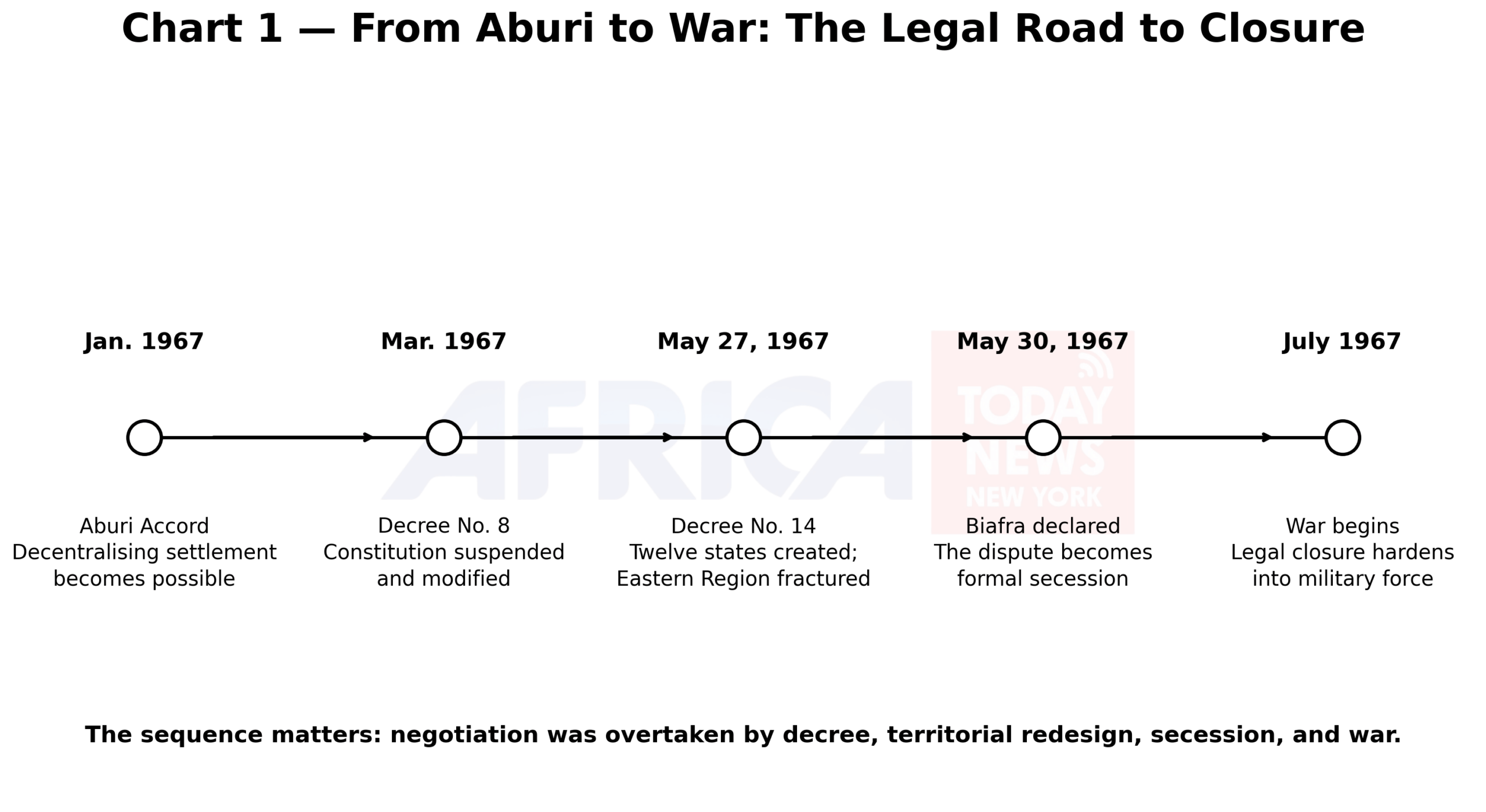
Chart note: Chart 1 explains the legal and political sequence from Aburi to war. It does not treat the outbreak of conflict as an isolated military event. It shows how negotiation, decree, territorial redesign, secession and war formed a compressed chain. The visual matters because Part 1’s central claim depends on sequence: once the Aburi settlement path collapsed and unilateral state creation followed, the legal field shifted from negotiated federation to imposed command.
When Federal Reform Became Strategic Surgery
State creation on May 27, 1967, remains one of the most consequential acts of the crisis. Gowon presented the creation of twelve states as a federal solution, a way to answer minority fears and prevent domination within the old regions. Minority grievances were real and deserved constitutional attention. But timing, method and effect decide legal meaning. Carving up the Eastern Region days before secession was not a neutral act of federal imagination. It altered the territorial, economic and strategic balance at the very point of breakdown. It separated the Igbo heartland from oil-bearing coastal minority areas and changed the material stakes of the coming war.
A court would ask not only what the government said it intended, but what its act predictably did. Decree No. 14 weakened the Eastern Region’s territorial claim, attacked its economic base, complicated its political legitimacy, and signalled that Lagos would no longer treat the region as a negotiating unit. In the language of federal reform, the decree appeared administrative. In the logic of conflict, it was strategic. It fractured the opposing side before the first formal declaration could settle into international consciousness.
No government defending unity is excused from examining how it defines unity. Gowon’s version of unity rested on federal command. It required the centre to retain the power to reorder the federation unilaterally, even against the region most directly affected. That is not covenantal unity. It is custodial unity. It says the state may rewrite the political body in the name of preserving it. Once that principle is accepted, consent becomes secondary and coercion begins to acquire constitutional costume.
Military regimes are especially skilled at turning constitutional language into administrative obedience. They issue decrees rather than arguments. They announce frameworks rather than submit terms to popular consent. They claim emergency necessity while restricting the political space in which necessity could be challenged. Gowon’s government did precisely what military governments do when legality becomes inconvenient: it made new law from command, then asked the public to treat command as order.
Read also: Yakubu Gowon And The Starvation Of Biafra: Overview
Sovereignty as the Outer Wall
Sovereignty then became the outer wall of the operation. Once Lagos framed the conflict as rebellion against a lawful federal authority, the international system became predisposed toward restraint. Recognised states enjoy advantages that secessionist entities do not. They possess embassies, diplomatic language, inherited borders, treaty personality, access to foreign suppliers, and the presumptive sympathy of other governments afraid of their own internal fractures. Gowon’s government understood this terrain. It placed Nigeria’s territorial integrity at the centre of the narrative and forced Biafra to argue from the weaker position of exception.
International law was not blind to civilians, but in the late 1960s it was not strong enough to overcome the sovereign shield. Common Article 3 had created minimum standards for non-international conflict, but the broader legal order still allowed governments wide room to classify internal wars as domestic security matters. Lagos occupied that room aggressively. By defining the conflict as an internal rebellion, the Federal Military Government narrowed the space for external intervention and made humanitarian inspection easier to manage, delay or contest.
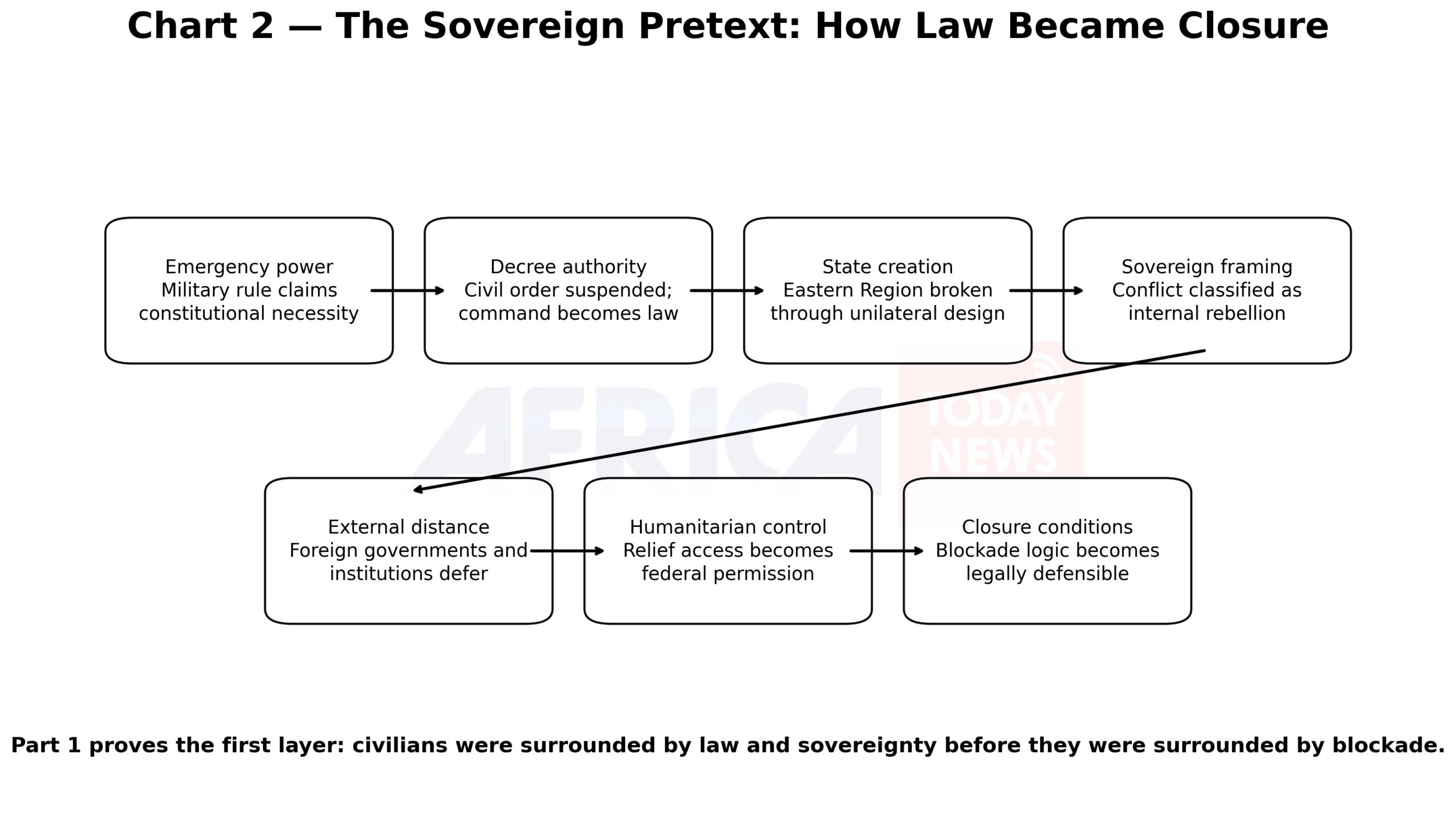
Chart note: Chart 2 traces how emergency power moved from constitutional necessity into legal closure. It shows that the sovereign pretext was not one doctrine standing alone; it required a sequence of institutional moves. Military rule claimed emergency power, decrees converted command into law, state creation fractured the Eastern Region, and internal-conflict framing created external distance. The final result was a permission regime in which humanitarian access could later be controlled by the same authority applying pressure.
Classification as a Weapon of Jurisdiction
A state can commit grave injury not only by what it does openly, but by how it classifies the arena in which the injury occurs. Classification decides who may speak, who may enter, who may investigate, who may deliver aid, and who may call suffering by its proper name. Once Biafra was placed inside the category of domestic rebellion, hunger could later be described as a consequence of military necessity rather than as an instrument of policy. Relief could be treated as a security problem. Foreign criticism could be dismissed as interference. Civilian death could be absorbed into the rhetoric of restoring order.
Viewed in that light, sovereignty was not merely a legal principle. It was an operating environment. It protected the government’s narrative before it protected civilians. It gave Britain, the Organization of African Unity and the United Nations a convenient doctrinal vocabulary for restraint. It allowed outside actors to say the crisis was tragic while declining to confront the federal method directly. Sovereignty became the polite word for distance.
Gowon’s defenders often argue that every state has the right to preserve itself. That is true, but it is not enough. Rights have limits. A state’s right to territorial integrity does not contain a hidden right to starve civilians into submission. National survival does not erase civilian immunity. Federal authority does not dissolve humanitarian obligation. Even in war, law asks what means were used, what was known, what alternatives existed, and whether civilian suffering was incidental, reckless, tolerated or deliberately instrumentalised.
Why Part 1 Matters
Part 1 matters because it establishes the first layer of responsibility. Later parts will examine blockade, famine, relief obstruction, medical damage, foreign complicity and revisionism. But the legal groundwork began earlier. Before children became the evidence of starvation, the state had already created the terms under which their suffering would be defended. Before relief planes became contested, the government had already claimed sovereign control over the space they would try to enter. Before international institutions failed, the conflict had already been packaged for them as an internal matter.
The Boundary Before the Blockade
Every closed system begins with a boundary. Gowon’s boundary was not only military. It was constitutional and diplomatic. It told the Eastern Region that the center would decide the terms. It told minorities that Lagos would redefine their political future. It told foreign governments that the issue was Nigerian sovereignty. It told humanitarian actors that access would be controlled through federal permission. It told the world that unity was the governing value. Hidden inside that language was the emerging right of the state to decide how much suffering unity could require.
No forensic reading should mistake sequence for coincidence. Aburi promised decentralisation. Lagos reasserted central authority. Decree No. 14 dismembered the Eastern Region. Biafra declared independence. War followed. Federal policy then moved toward encirclement. Relief access became contested. Starvation became visible. Later, reconciliation language attempted to close the record without a full accounting. Each step has its own facts, but the pattern is cumulative. Power first defined the legal field, then used that field to manage the consequences of its own decisions.
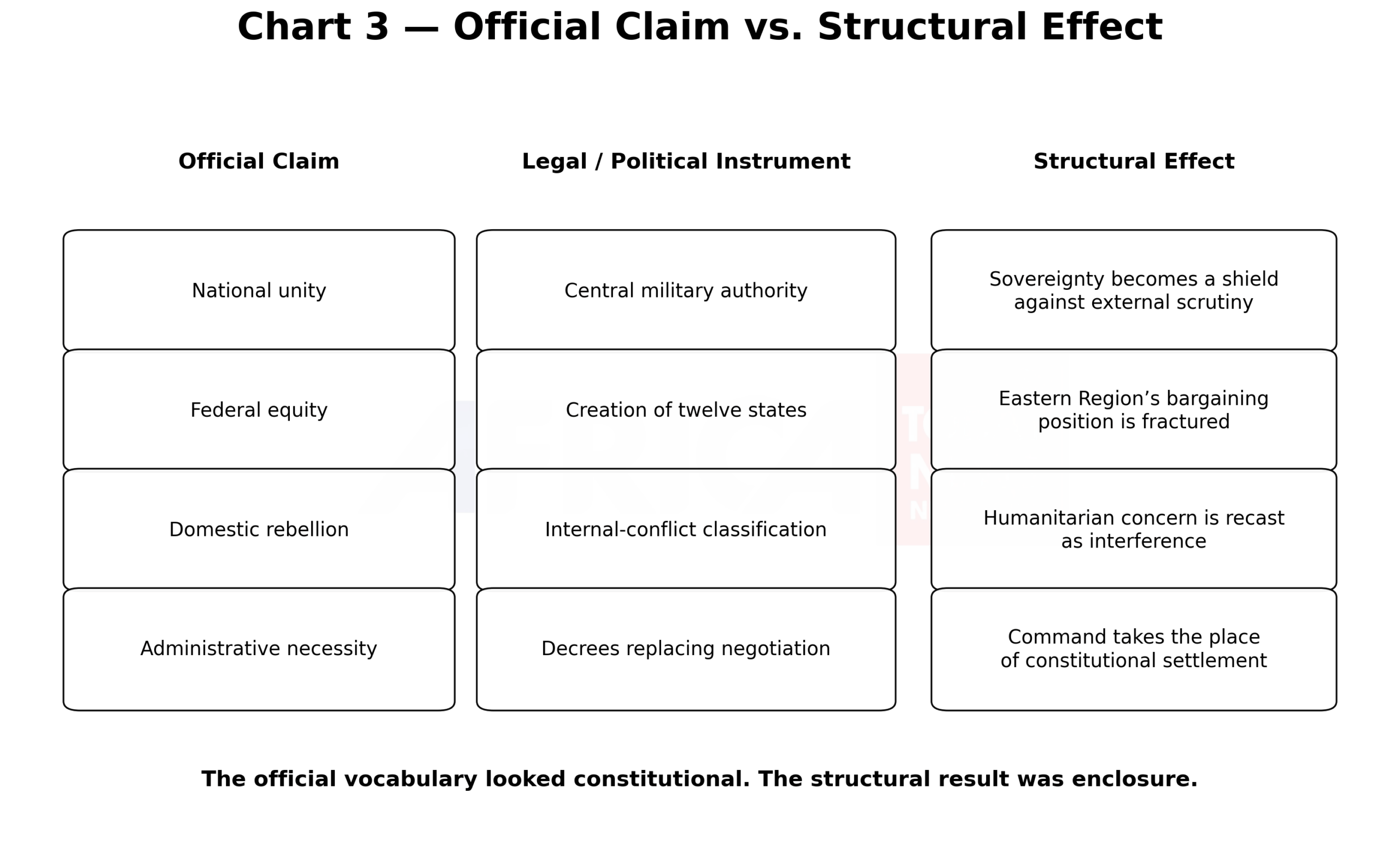
Chart note: Chart 3 contrasts official claims with structural effects. The purpose is to show how benign vocabulary can conceal coercive outcomes. “National unity” translated into central military authority; “federal equity” translated into the fracture of the Eastern Region’s bargaining position; “domestic rebellion” translated into humanitarian concern being recast as interference. This visual functions as a cross-examination of language: it asks what the words did, not how they sounded.
A constitution can be suspended in crisis, but accountability cannot. Decrees can replace statutes, but they do not replace moral and legal scrutiny. Military necessity can explain urgency, but it cannot erase causation. Gowon’s government used the language of national survival to justify measures that narrowed political settlement, weakened a region, insulated federal action, and prepared the ground for a war in which civilians would become trapped behind state policy.
The Charge
Here lies the essential charge of the sovereign pretext: Lagos claimed it was preserving the nation, but preservation became indistinguishable from domination once the state reserved to itself the power to define law, redraw territory, control access and dismiss external scrutiny. Unity became a claim of jurisdiction. Jurisdiction became a shield. Behind that shield, the machinery of closure began to move.
Later revisionism depends on separating the starvation from the legal acts that preceded it. That separation must be refused. The famine was not born only at the blockade line. It was incubated in the state’s prior decision to make sovereignty absolute, negotiation subordinate, and territorial restructuring unilateral. Once those choices were made, civilian vulnerability was no longer an accident waiting to happen. It was a foreseeable consequence of a political crisis being converted into a military enclosure.
Gowon’s memoir may present these years through the language of duty, allegiance, circumstance and national burden. The record requires a colder vocabulary. Emergency power. Constitutional suspension. Unilateral territorial reordering. Sovereign insulation. Diplomatic containment. Humanitarian vulnerability. These are not rhetorical flourishes. They are the legal bones beneath the later famine.
A state that asks history to remember its unity must also answer for the instruments it used to enforce it. Gowon’s government did not simply defend Nigeria. It defined Nigeria in a way that placed one population outside the protection of meaningful negotiation and inside the reach of military compulsion. That is where the story begins. Not with reconciliation. Not with memoir. Not with patriotic legend. With the paper that made closure possible.
Historical Sources, Legal Authorities, and Evidentiary Record — APA 7th Edition
Federal Military Government of Nigeria. (1967). The Constitution (Suspension and Modification) Decree (Decree No. 8). Lagos: Ministry of Information.
Federal Military Government of Nigeria. (1967). States (Creation and Transitional Provisions) Decree (Decree No. 14). Lagos: Ministry of Information.
Adesina, O. O. (2014). The international politics of the Nigerian civil war. Journal of the Historical Society of Nigeria, 23, 90–113.
Anghie, A. (2018). Imperialism, sovereignty and the making of international law. Cambridge University Press.
Orakwue, J. C. (2021). International law and the Biafran question: A critical appraisal of sovereignty and self-determination. Academic Press.
Ezeani, E. (2019). The Biafran War and postcolonial humanitarianism. Routledge.
Rajagopal, B. (2020). International law from below: Development, social movements and Third World resistance. Cambridge University Press.