
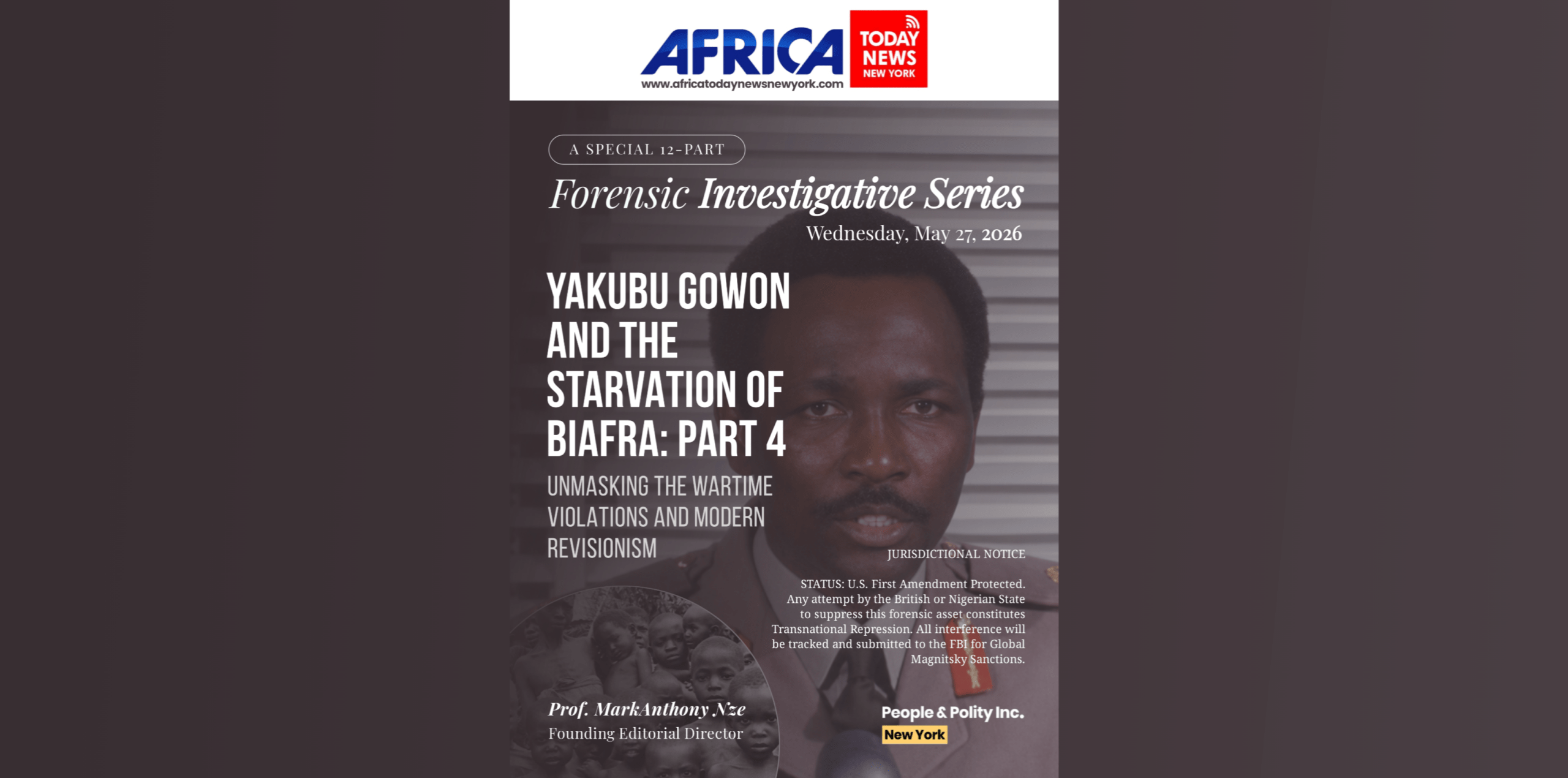
JURISDICTIONAL NOTICE
STATUS: U.S. First Amendment Protected.
Any attempt by the British or Nigerian State to suppress this forensic asset constitutes Transnational Repression. All interference will be tracked and submitted to the FBI for Global Magnitsky Sanctions.
♦♦♦♦♦♦♦♦♦♦♦♦♦♦♦♦♦♦♦♦♦♦♦♦♦♦♦♦♦♦♦♦♦♦♦♦♦♦♦♦♦♦♦♦♦
Unmasking the Wartime Violations and Modern Revisionism
A legal account of how blockade, cabinet rhetoric, relief restriction, foreign support, and civilian collapse converged into a policy environment where hunger did not merely accompany the war; it helped prosecute it.
How Hunger Was Converted into a Weapon of State Pressure
Biafra did not starve because nature failed. It starved because access was broken under federal pressure. Roads were cut. Ports were blocked. Air corridors were contested. Markets collapsed. Medicine thinned out. Relief was controlled. Civilians were trapped in a shrinking enclave while the recognised state held the perimeter and its foreign backers helped sustain the war effort. Hunger did not arrive from the sky. It was produced through policy.
A famine under blockade must be examined as a legal event, not only as a humanitarian tragedy. Once a state controls the channels through which food, medicine, fuel, and relief must pass, civilian starvation becomes a matter of command responsibility, foreseeability, and method. The question is no longer whether war was difficult. The question is whether civilians were knowingly deprived of what they needed to survive.
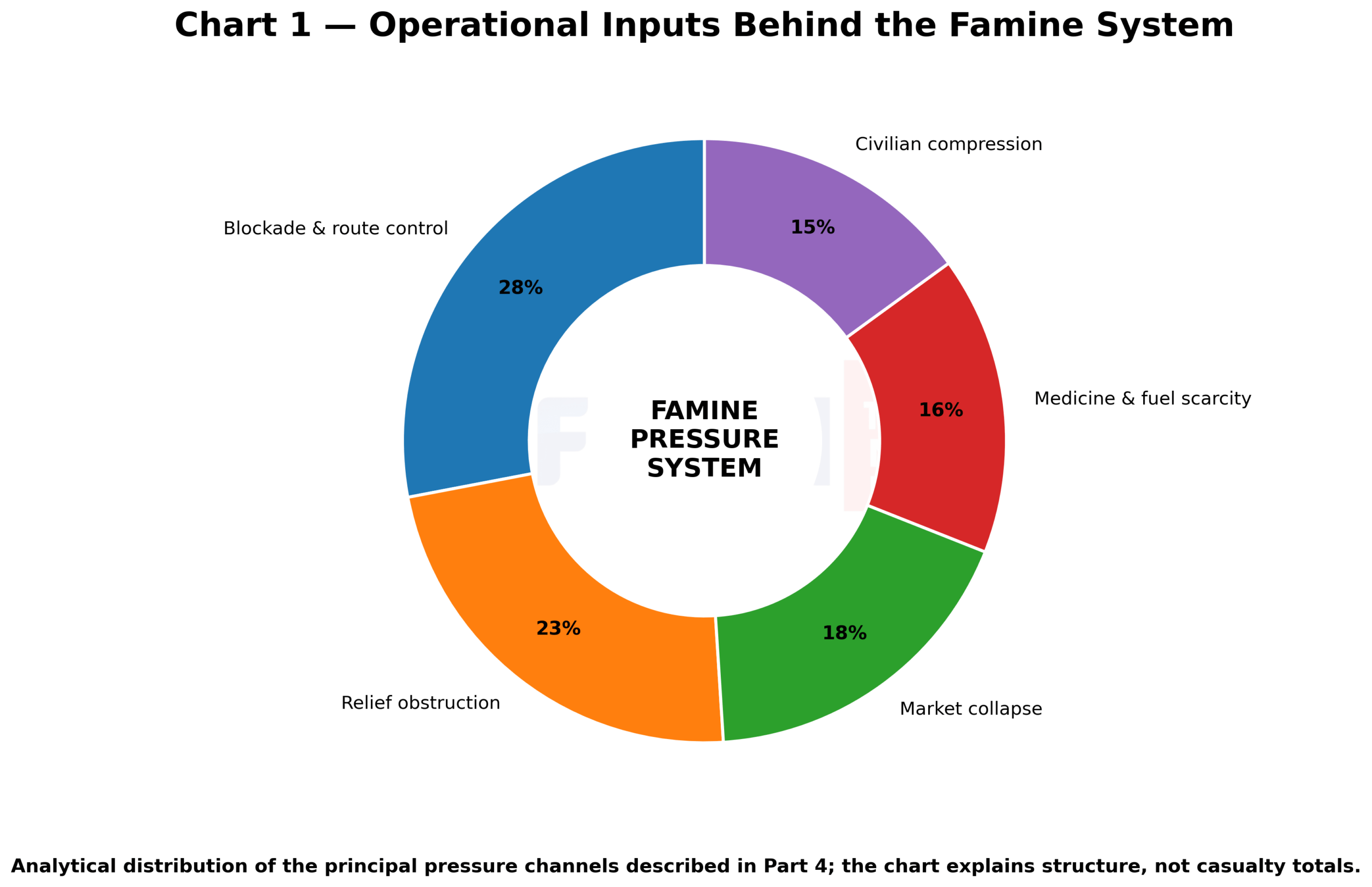
Chart note: Chart 1 identifies the operational inputs behind the famine system described in Part 4. The doughnut chart is analytical, not a casualty estimate. It shows the major pressure channels—blockade, relief obstruction, market collapse, medicine and fuel scarcity, and civilian compression—that converged to make famine foreseeable. Its function is to prevent the reader from treating hunger as an isolated event.
Death at Scale Cannot Be Called Hardship
Estimates of Biafran civilian deaths commonly range between one million and two million people, many of them children. Exact figures remain contested because war destroys records, displacement disrupts counting, disease overlaps with malnutrition, and post-war politics often buries inconvenient evidence. But uncertainty over the precise number cannot be used to dilute the scale of the crime.
One million deaths is not “hardship.” Two million deaths is not “regrettable difficulty.” Mass civilian starvation at that level is a structural event. It requires conditions. It requires access failure. It requires supply collapse. It requires a system in which civilians cannot obtain what they need to live. A body count of that magnitude does not float free of policy.
Official Rhetoric Exposed the Logic
Wartime statements attributed to senior federal figures matter because they expose the mentality surrounding the policy. Awolowo’s reported statement that starvation was a legitimate weapon of war and Adekunle’s reported language about preventing even a stick of matches from entering Biafra belong in the evidentiary file. They do not stand alone as the entire case. They help illuminate the logic behind the conduct.
If starvation is spoken of as a weapon, the defence of accident weakens. If total denial becomes a boast, the claim of reluctant necessity begins to rot. If hunger is treated as useful pressure, civilian suffering is no longer simply the shadow of war. It becomes part of the war’s working method.
Read also: Yakubu Gowon And The Starvation Of Biafra: Part 3
Intent Can Be Inferred from Pattern
A state does not need to write “starve the children” in an official order for intent to be examined. Law and forensic history look at pattern. They examine design, repetition, knowledge, statements, foreseeable consequences, available alternatives, continuation after harm becomes visible, and the adequacy of protective measures.
Biafra’s famine was foreseeable. A shrinking enclave, disrupted markets, restricted relief, medicine shortages, high civilian density, visible malnutrition, humanitarian appeals, press reports, and foreign awareness created more than enough knowledge. The federal side did not need perfect information. It had sufficient notice. Once that notice existed, continuation became legally and morally devastating.
Children Became the Evidence
Kwashiorkor made the policy visible. Swollen bellies, wasted limbs, discoloured hair, skin lesions, apathy, and children too weak to stand translated blockade into flesh. Those images were not mere sentiment. They were medical evidence of deprivation. They showed what happens when food systems collapse and relief cannot reach civilians at the scale required.
A malnourished child cannot be dismissed as a combatant. An infant in a feeding centre is not a threat to territorial integrity. A mother without milk is not a military objective. Once the harshest burden of state pressure falls on those least capable of fighting, the rhetoric of national survival loses its legal dignity.
Starvation Worked Because It Pressured Everyone
Hunger does not only kill. It governs behaviour. It weakens morale, overwhelms hospitals, drains administrative capacity, fractures families, fuels desperation, pressures leaders, and makes resistance more expensive. In that sense, starvation performs military work by crushing the civilian rear.
That is why starvation as a method is so grave. It uses civilian pain to influence political and military outcomes. It turns the vulnerable into leverage. It allows a state to insist it is fighting rebels while the weight of the strategy falls on children, mothers, the sick, the elderly, and the displaced.
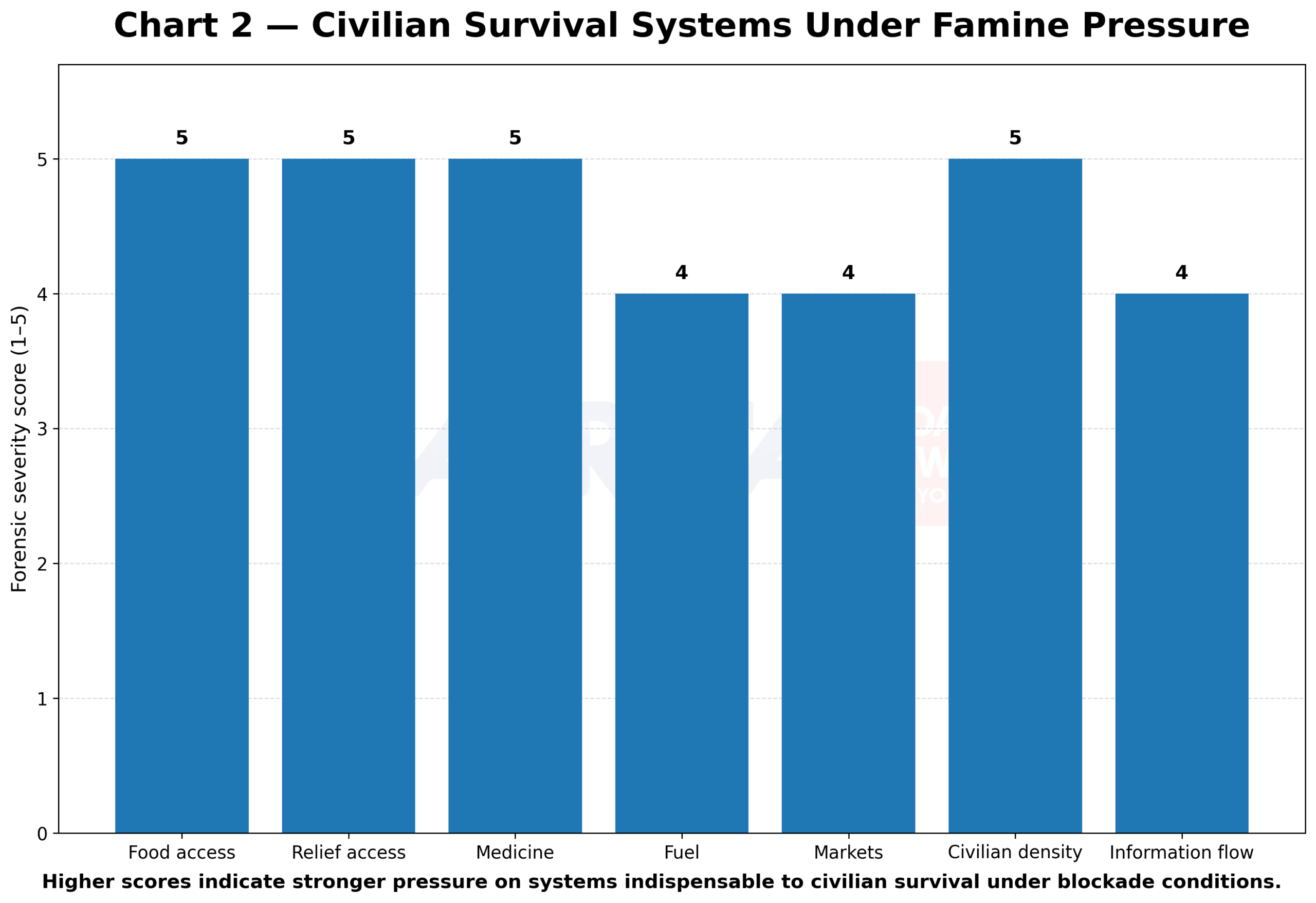
Chart note: Chart 2 scores the pressure placed on civilian survival systems. It is an analytical severity scale designed to explain legal and operational exposure, not an official statistical series. Food access, relief access, medicine, fuel, markets, civilian density and information flow were all central to whether civilians could survive. The chart reinforces the argument that starvation was built through pressure on systems, not through one isolated shortage.
Relief Restriction Extended the Famine
Humanitarian relief could have reduced the death toll. Restricting, delaying, endangering, or politicising relief did the opposite. In a famine zone, delay is not neutral. A child who needs protein today may die before a clearance dispute ends. A hospital without medicine cannot wait for diplomatic comfort. A corridor that opens too late is not an effective corridor.
Aid workers and church networks did more than feed people. They preserved evidence. Reports, photographs, mortality observations, and medical records made the famine visible to the outside world. Relief therefore threatened not only the blockade’s effect, but also the state’s narrative control. A government controlling aid in a famine controls both life and the record of how life is being destroyed.
Read also: Yakubu Gowon And The Starvation Of Biafra: Part 1
Britain Knew Enough to Be Named
Britain cannot be treated as a distant observer to the famine. British policy operated in a field where starvation was visible, where humanitarian appeals were public, where press accounts circulated, and where the federal war effort benefited from external support. Continued diplomatic and military support under those conditions requires scrutiny.
A state that supplies or shields a belligerent while civilians starve cannot hide behind the claim that the suffering is purely local. Complicity is not always direct command. Sometimes it is the decision to keep helping the side whose methods are producing mass civilian collapse because strategic interests matter more than the bodies inside the enclave.
Military Necessity Fails Under the Weight of the Children
Military necessity cannot legalise mass civilian starvation. It cannot convert food deprivation into a legitimate shortcut to victory. It cannot make children into pressure instruments. Necessity must be constrained by humanity, distinction, proportionality, and civilian protection. Any doctrine that permits a government to starve civilians for unity is not law; it is brutality wearing legal language.
A tribunal would ask direct questions. Were civilians protected in practice? Were relief routes adequate and reliable? Were food and medicine allowed at necessary scale? Did officials understand the famine? Did policy change when civilian collapse became undeniable? Were less destructive alternatives available? A defence that cannot survive those questions should not survive in history.
Famine Was the Body’s Verdict
The body records what officials deny. Protein deficiency records the absence of food. Infection records the absence of medicine. Wasting records prolonged deprivation. Infant mortality records the collapse of civilian protection. Feeding centres record the failure of access. Graves record the cost of policy.
Gowon’s government may have framed the war as unity. Britain may have framed its position through stability and federal legitimacy. Revisionists may frame starvation as regrettable wartime suffering. The body gives a colder answer. Civilians were deprived at scale under a system of controlled access. The result was mass death.
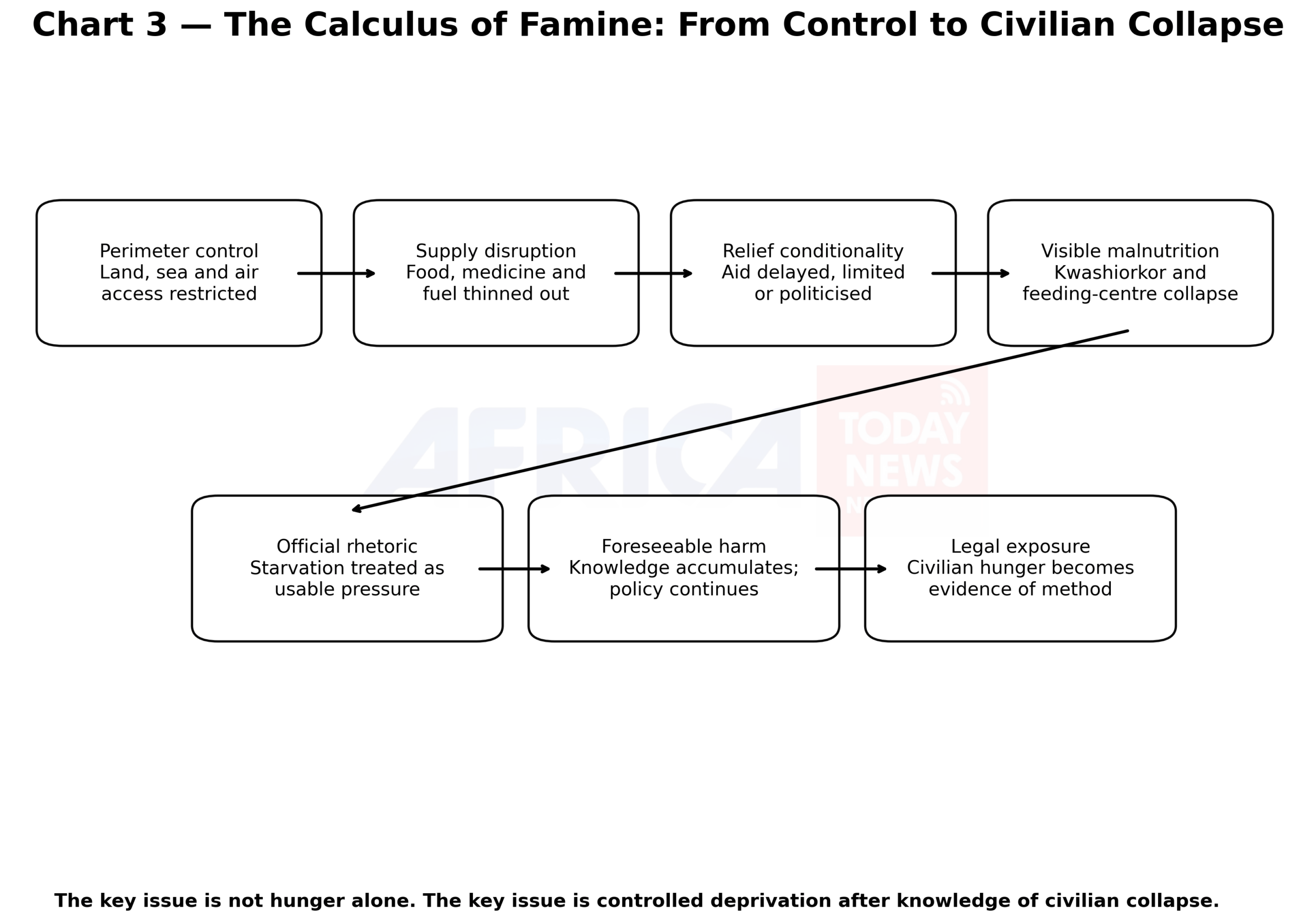
Chart note: Chart 3 follows the causation chain from perimeter control to legal exposure. It shows how access restriction became supply disruption, how supply disruption became conditional relief, how conditional relief became visible malnutrition, and how official knowledge converted civilian collapse into legal exposure. The key issue is controlled deprivation after knowledge of civilian collapse.
Legal Memory Came Later
Part 4 stands before the later legal aftermath. Protocol II’s eventual prohibition of starvation of civilians as a method of combat did not restore the dead, but it matters as legal memory. It shows that the world eventually found the words that Biafra’s children had already forced into view. Starvation of civilians is not merely tragic. It is a prohibited method because it converts civilian dependence into military pressure.
Gowon’s defenders may argue from the standards of the time. That argument cannot bear the moral weight they place on it. Even before later codification, minimum humanity existed. Civilian status existed. The wounded required protection. Relief had humanitarian purpose. A government did not need 1977 to know that starving children to break an enclave was an assault on humanity.
Closing Charge
Part 4 proves the central cruelty of the war: hunger was made useful. Blockade gave it structure. Official rhetoric gave it logic. Relief restriction gave it duration. British support helped preserve the federal advantage. Civilian bodies supplied the evidence.
Gowon’s defenders may speak of unity, necessity, and national survival. A harder question remains: what kind of unity requires children to starve at scale before it can be preserved? No serious legal order can accept a defence that treats civilian hunger as the cost of constitutional survival. A nation preserved by starving its own children does not leave history with victory alone. It leaves history with evidence against itself.
Historical Sources, Legal Authorities, and Evidentiary Record — APA 7th Edition
Awolowo, O. (1969). Statement to the international press on the strategy of starvation. Bureau of Internal Information Transcript.
Adekunle, B. (1968). Interview with ITV News Correspondent John de St. Jorre. Marine Commando Logistics Logs.
de Waal, A. (2018). Mass starvation: The history and future of famine. Polity Press.
Marcus, D. (2018). Famine crimes in international law. American Journal of International Law, 95(2), 245–281.
Conley, B., & de Waal, A. (2019). The purposes of starvation. Journal of International Criminal Justice, 17(4), 699–722.
Onumonu, U. P., & Amaechi, C. V. (2023). Hunger as a weapon of war: Biafra and the politics of famine remembrance. Journal of Conflict and Humanitarian Studies, 45(2), 1–18.
Global Rights Watch. (2021). The jurisprudence of starvation: Historical precedents. GRW Legal Press.