
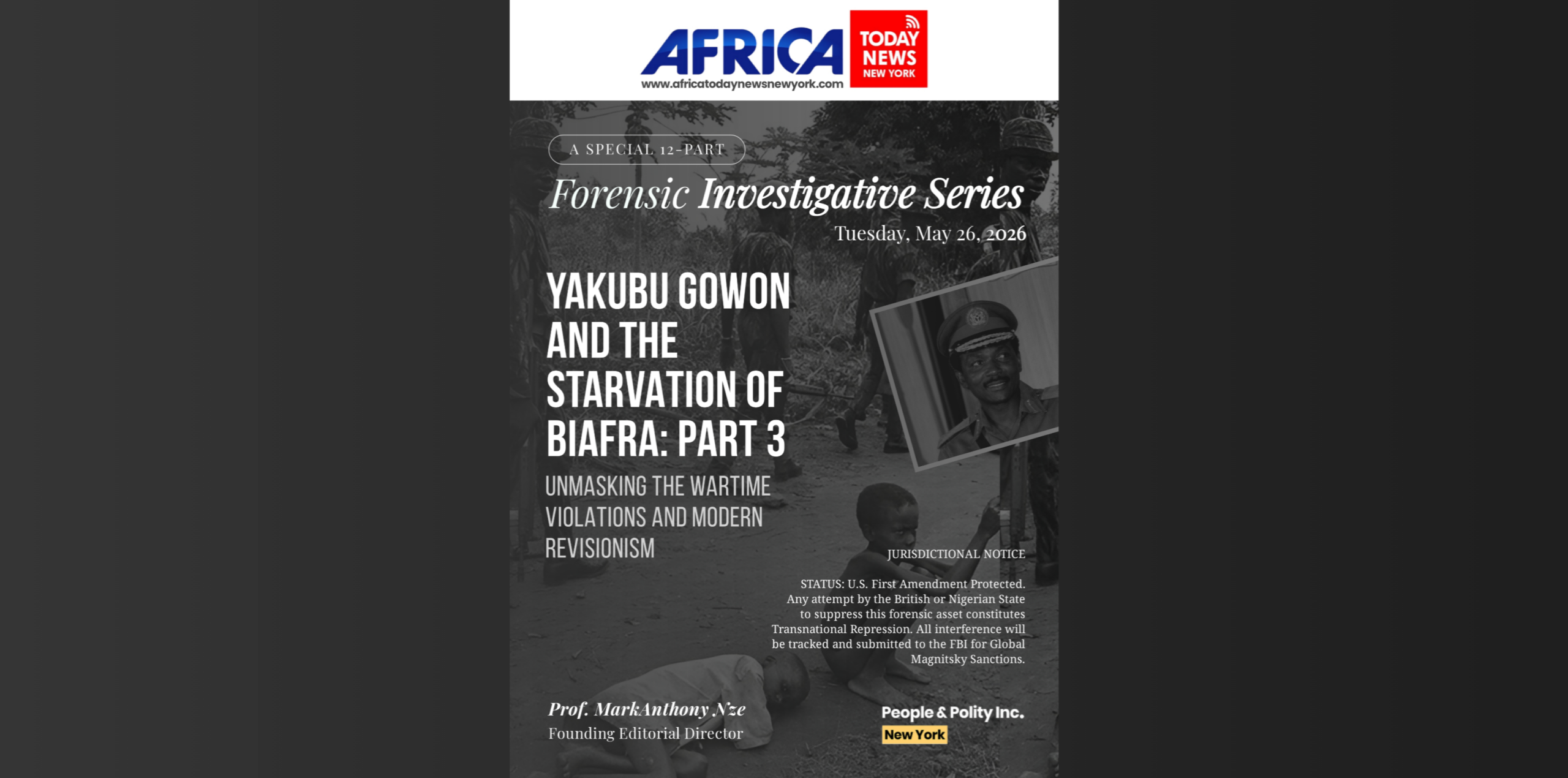
JURISDICTIONAL NOTICE
STATUS: U.S. First Amendment Protected.
Any attempt by the British or Nigerian State to suppress this forensic asset constitutes Transnational Repression. All interference will be tracked and submitted to the FBI for Global Magnitsky Sanctions.
♦♦♦♦♦♦♦♦♦♦♦♦♦♦♦♦♦♦♦♦♦♦♦♦♦♦♦♦♦♦♦♦♦♦♦♦♦♦♦♦♦♦♦♦♦
Unmasking the Wartime Violations and Modern Revisionism
A legal-operational record of how Gowon’s government converted closure into policy, making civilian survival dependent on the permission of the authority enforcing the siege.
How the Federal Military Government Turned Food, Medicine, Roads, Ports, Airspace and Relief Access into Instruments of War
Biafra was not merely surrounded. It was processed through closure. Land routes, sea access, air corridors, markets, banking channels, fuel supplies, medicine, and humanitarian relief were drawn into one coercive system. The blockade did not function as a line on a map. It functioned as a method of pressure that reached the civilian body through every system that sustains life.
A blockade in a shrinking enclave is not ordinary military pressure. It compresses civilians into a smaller space while reducing the means available to keep them alive. Food becomes scarce. Medicine becomes irregular. Fuel becomes strategic. Markets collapse. Relief becomes contested. Every road, port, aircraft, warehouse, clinic, farm, and payment channel becomes part of the war’s operating field. That is not incidental hardship. It is controlled survival.
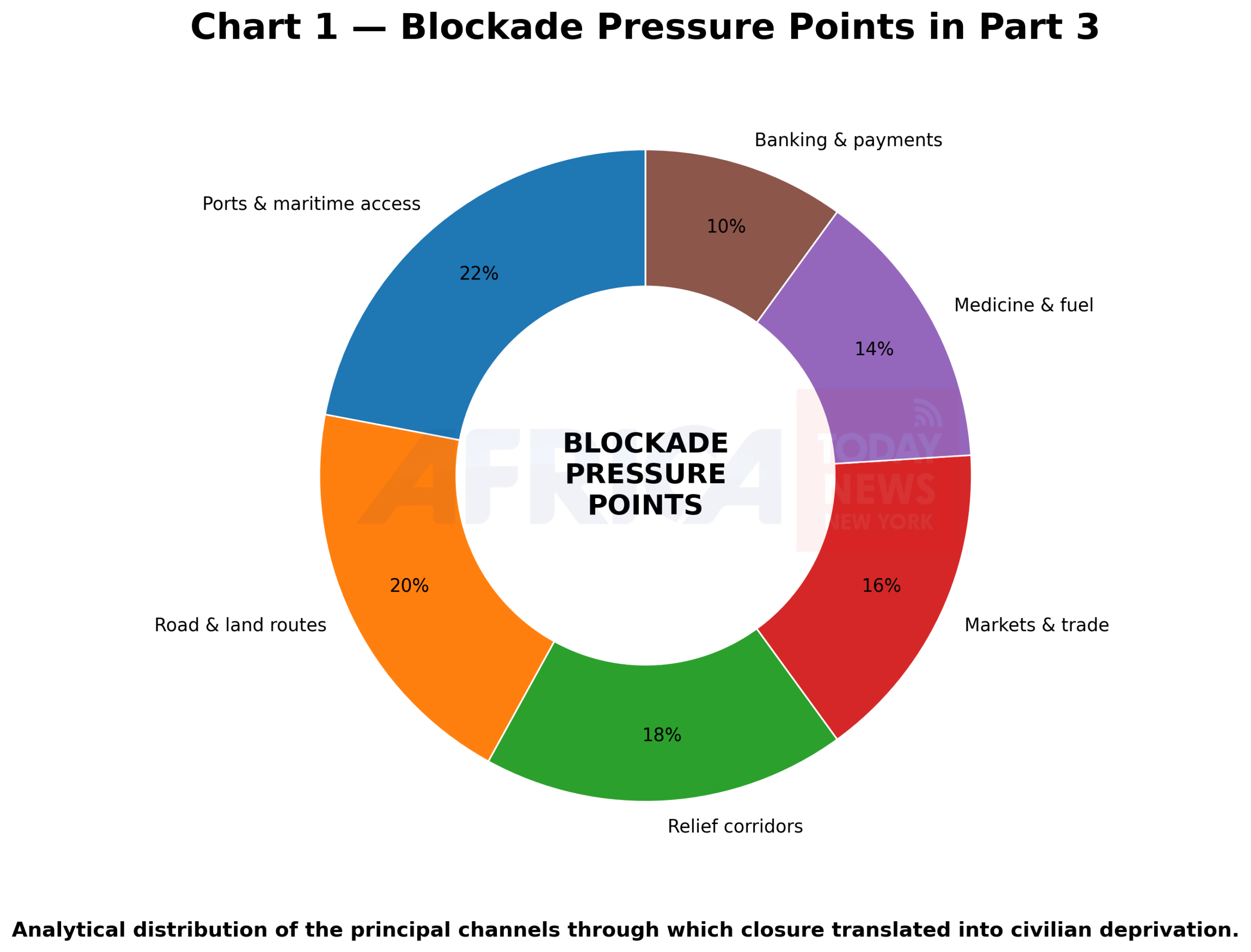
Chart note: Chart 1 presents the blockade as a system of pressure points, not a single military line. The doughnut chart is analytical rather than statistical: it allocates attention across the major channels discussed in Part 3, including ports, roads, relief corridors, markets, medicine, fuel, banking and payments. Its purpose is to show how several civilian survival systems were drawn into one coercive environment.
Operational Control Followed Legal Control
Part 1 showed how Gowon’s government built the sovereign shield. Part 2 showed why that shield could not excuse Geneva breaches. Part 3 follows the shield into operation. Once Lagos claimed the conflict as domestic rebellion and placed federal sovereignty over the entire theatre, blockade policy became easier to present as security administration. The state controlled the legal language first. It then used that language to control access.
Every siege needs more than soldiers. It needs customs orders, port control, route restrictions, clearance procedures, airspace enforcement, banking disruption, intelligence screening, and diplomatic explanation. A modern blockade is paperwork attached to force. It may be enforced by guns, but it survives through administration. In Biafra, administration became the quiet machinery of deprivation.
Read also: Yakubu Gowon And The Starvation Of Biafra: Part 2
Food Was Pulled into the War
Food is civilian life. Once food access is restricted in a trapped population, war crosses into the stomach. The Federal Military Government could describe the blockade as security, but the practical effect was predictable: fewer supplies, higher prices, thinner diets, weaker children, and collapsing households. A population already displaced by war cannot withstand the deliberate narrowing of supply without mass injury.
The legal issue is not whether a state may interrupt enemy military logistics. The legal issue is whether the interruption was structured or maintained in ways that foreseeably deprived civilians of objects indispensable to survival. Biafra’s food crisis did not require speculation. If markets are cut, ports sealed, relief contested, and territory compressed, famine becomes a foreseeable outcome.
Medicine and Fuel Became Pressure Points
Civilian survival depends on systems, not food alone. Fuel runs transport, clinics, water pumping, generators, cooking, and hospital operations. Medicine determines whether malnutrition, infection, childbirth complications, trauma, and preventable disease become survivable. Once fuel and medicine become scarce inside a besieged enclave, mortality does not only rise from hunger. It rises from the collapse of the civilian environment.
The blockade therefore struck beyond the plate. It reached hospitals, mothers, infants, surgical wards, emergency transport, water systems, and disease control. A starving child is often not killed by hunger alone. Infection, dehydration, diarrhoeal disease, respiratory illness, and lack of treatment finish what deprivation begins. The blockade created conditions in which ordinary illnesses could become death sentences.
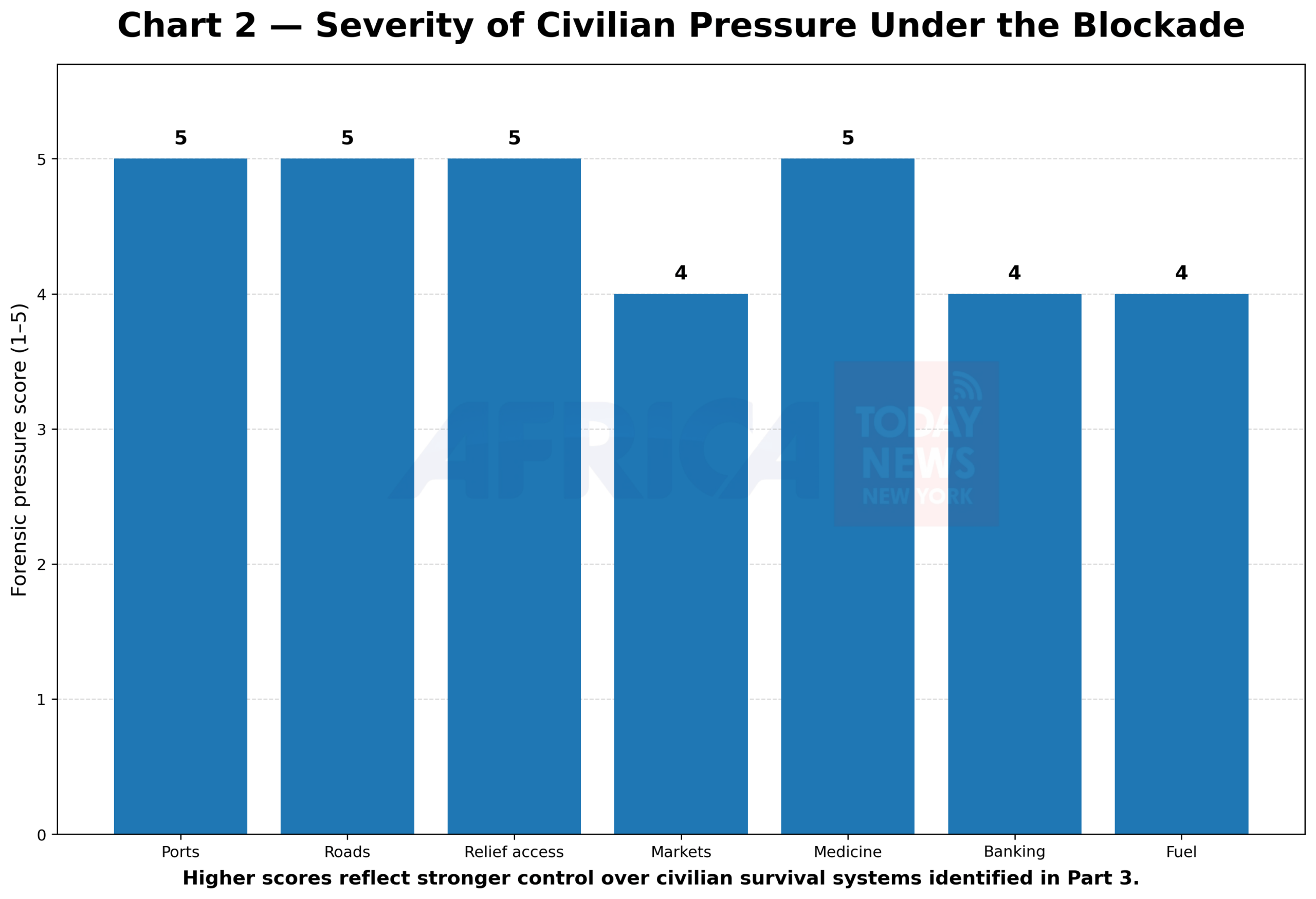
Chart note: Chart 2 scores the severity of pressure on civilian survival systems identified in Part 3. The score is a forensic severity scale, not an official numerical dataset. It shows why the blockade cannot be reduced to food alone. Ports, roads, relief access, medicine, banking and fuel all affected whether civilians could survive, move supplies, treat disease and maintain ordinary social life.
Relief Was Made Conditional
Humanitarian relief should have been treated as a protected channel for civilians. Instead, it became subject to federal control, suspicion, and negotiation. Aid routes were not merely logistical matters. They were legal and political battlegrounds. Whoever controlled relief controlled not only calories and medicine, but also witnesses, reports, photographs, and the international record.
A besieging authority that demands control over relief in a famine zone holds more than a security power. It holds leverage over civilian life. Every delayed clearance, contested route, restricted aircraft, or challenged aid organisation had consequences. In a famine, delay is not neutral. A week can become a grave. A denied corridor can become a ward of dying children. Procedure can kill without sounding violent.
Banking and Markets Were Part of the Siege
War is also fought through money. Banking restrictions, currency disruption, commercial isolation, and broken trade channels affect whether civilians can buy, store, transport, or distribute essentials. A population does not need food sitting somewhere in the world. It needs the capacity to obtain it, pay for it, move it, and distribute it. Destroy that capacity, and famine advances without needing a bullet.
Economic isolation intensified Biafra’s vulnerability. Markets weaken when routes collapse. Prices rise when goods cannot enter. Families lose purchasing power. Hospitals lose supplies. Traders cannot move inventory. Farmers cannot maintain distribution. Relief becomes the substitute for a strangled economy, but relief itself remains conditional. That is how siege economics works: first the market is broken, then the victim is blamed for dependency.
Airspace Became a Humanitarian Battleground
As land and sea access narrowed, air routes became crucial. An airstrip was no longer merely a military asset. It was a lifeline. Relief flights carried food, medicine, doctors, and the evidence of civilian collapse. They also exposed the state’s claim of ordinary military necessity to outside scrutiny.
Air access therefore became dangerous for both practical and political reasons. A relief aircraft does not simply land supplies. It lands witnesses. It carries records outward. It interrupts the state’s attempt to control the narrative. In that context, humanitarian aviation was not outside the war. It was placed inside the war by the very logic of federal control.
Read also: Yakubu Gowon And The Starvation Of Biafra: Part 1
Civilian Survival Became Permission-Based
The central fact is brutal: civilian survival became dependent on the permission of the authority enforcing the siege. When food routes require federal consent, medicine requires clearance, relief flights require tolerance, and markets operate under military pressure, civilian life is no longer protected as a matter of right. It is administered as a matter of discretion.
No humanitarian order can survive that arrangement. Rights cannot be reduced to permissions granted by the party applying pressure. A trapped civilian population cannot be made to ask the besieger for the objects indispensable to survival and then be told the resulting hunger is an accident of war. Permission-based survival is already a form of coercion.
Evidence of Design Does Not Require a Single Master Memo
States rarely write criminal policy in plain moral language. They write orders, restrictions, statements, permissions, denials, and justifications. They act through ministries, officers, cabinet positions, military commands, press briefings, and diplomatic channels. Design appears in sequence, repetition, coordination, and effect.
For Part 3, the record matters because it shows blockade as structure. Federal statements on relief, economic studies of the war, legal commentary on starvation, and historical work on logistical isolation point toward a policy environment in which civilian access was systematically constrained.
“Containment” Was the Public Word
Containment sounds controlled, defensive, almost sterile. It hides the human content of the policy. A contained population still needs food. A contained hospital still needs medicine. A contained mother still needs milk for a child. A contained infant still needs protein. A contained market still needs supply.
When a government uses containment language while controlling the routes of civilian survival, the word must be cross-examined. What did containment contain? Did it contain combatants only, or did it contain children, clinics, farms, markets, and feeding centres? Did it protect civilians, or did it make their survival contingent on federal war aims? Neutral vocabulary cannot cleanse coercive effect.
Blockade Was a Weapon Because It Produced Leverage
A blockade becomes a weapon against civilians when civilian suffering helps produce pressure. Hunger weakens morale. Clinics collapse. Families panic. Administrative capacity erodes. Military resistance becomes harder to sustain when the civilian rear is starving. External sympathy may rise, but internal exhaustion rises faster. That is why starvation has strategic value to a ruthless state.
Once officials understand those effects and maintain the system, blockade cannot be described as passive. It is doing work. It is weakening the enclave not only militarily, but socially. It attacks the will to continue by making ordinary survival unbearable. That is a method, not an accident.
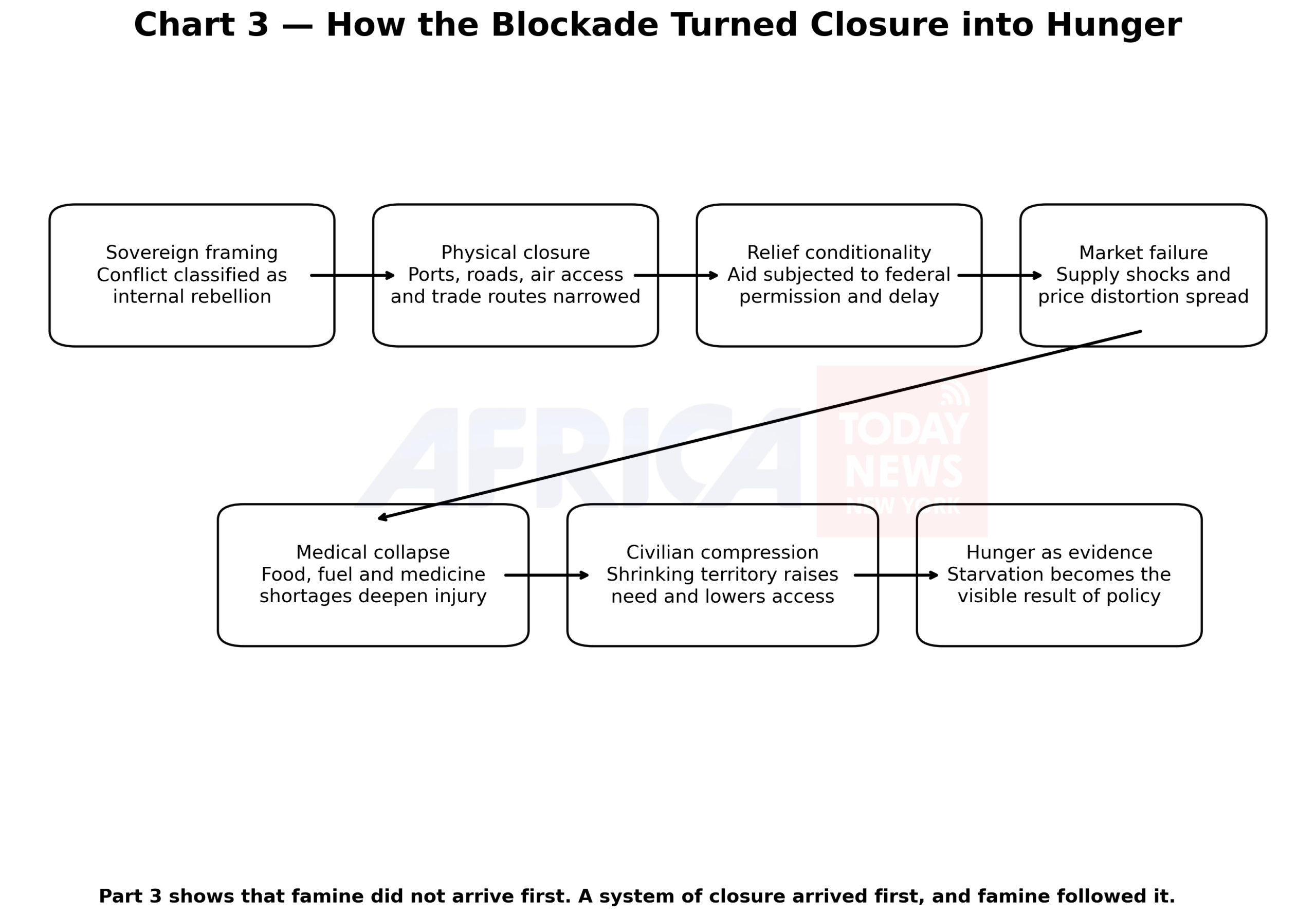
Chart note: Chart 3 follows the chain from sovereign framing to civilian hunger. It shows that famine did not appear first. Closure came first: physical restriction, conditional relief, market failure, medical collapse and civilian compression. The flowchart is meant to make causation visible. Hunger appears at the end of the chain because it is the outcome of controlled access, not an isolated tragedy.
Britain Cannot Be Removed from the Perimeter
British responsibility does not require British soldiers to stand at every roadblock. The question is what Britain supplied, defended, excused, or protected while the blockade operated. A war effort sustained by external arms, diplomatic cover, and political legitimacy does not become purely domestic because the suffering occurred inside Nigeria’s borders.
Britain’s role belongs in the operational story because the federal government fought with the advantages of international recognition and foreign support. When the humanitarian consequences became visible, continued external support helped preserve the conditions under which the blockade could endure. That is why Britain’s file cannot be separated from Gowon’s file. One supplied the shield from outside while the other tightened the perimeter inside.
Closing Charge
Part 3 proves that the blockade was not a background condition. It was an operational policy. Food, medicine, fuel, money, markets, roads, ports, airspace, and relief were drawn into a system of coercion that made civilian survival conditional.
Gowon’s government did not need to announce starvation in the crudest possible language for the blockade to function as a starvation system. The evidence lies in what was controlled, what was denied, what was delayed, what was known, and what continued. Once a state governs access to the means of life and civilians starve behind that access regime, hunger is no longer an accident. It is administered.
Historical Sources, Legal Authorities, and Evidentiary Record — APA 7th Edition
United Kingdom National Archives (TNA). (1968). Foreign and Commonwealth Office Files: FCO 38/247. Minutes of Nigerian Federal Executive Council meetings.
Enahoro, A. (1968). Official press statement on the conditions of relief operations. Lagos: Federal Ministry of Information.
Mudge, G. A. (1970). Starvation as a means of warfare: Advertisement or weapon? The International Lawyer, 4(2), 228–268.
Clarance, W. (2022). Relief operations in the Biafran enclave: A bureaucratic history. Academic Press.
Nafziger, E. W. (1983). The economics of political instability: The Nigerian-Biafran War. Westview Press.
Ogbudinkpa, R. N. (2019). The economics of the Nigerian Civil War and its logistics. Fourth Dimension.
Ventura, M. J. (2015). The crime of extermination in international law. International Criminal Law Review, 15(4), 623–660.