
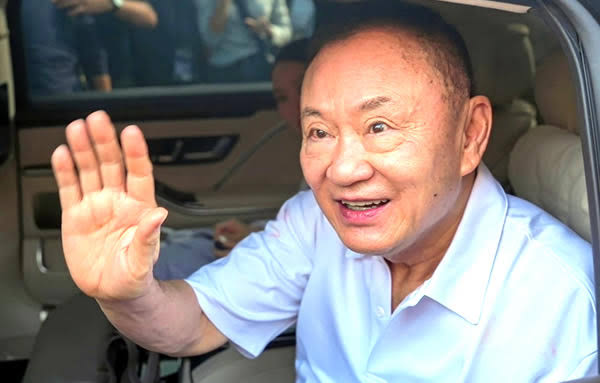
Thaksin Shinawatra will walk away from his sentence entirely on Wednesday, the beneficiary of a royal pardon that closes a legal chapter that his opponents spent years engineering and his allies spent just as long attempting to soften. The former Thai prime minister, 76, has now received two royal pardons in the span of roughly two years — the first cutting an eight-year corruption sentence down to one year, the second erasing what remained of even that reduced term.
The timing was the King’s prerogative. The pardon decree, signed by King Maha Vajiralongkorn and published Wednesday in the Royal Gazette, was issued to mark Queen Suthida’s birthday — the customary occasion on which Thailand’s monarchy extends clemency to eligible prisoners across the country. Thaksin’s name appeared on the list.
Under Section 8 of the decree, individuals with less than one year remaining on their sentences are released immediately. Justice Minister Pol Lt Gen Rutthapon Naowarat confirmed Wednesday that Thaksin meets that threshold and will be discharged from the remainder of his sentence forthwith.
The electronic monitoring ankle bracelet he has worn since his May parole can come off at once, the minister said, though he noted that provincial committees still need to complete a set of administrative procedures before the formal process is fully concluded.
Read also: Thailand Endorses Myanmar’s ASEAN Normalization Campaign
The journey to this point involved a sequence of reversals, legal controversies, and institutional maneuvers that would be difficult to construct as fiction. Thaksin returned to Thailand in August 2023 after fifteen years in self-imposed exile following the military coup that ended his second premiership. He was sentenced to eight years in prison for corruption and abuse of power — convictions that predated his exile and had accumulated during the years he governed from abroad. A royal pardon immediately reduced that to one year. He then spent his sentence not in a prison cell but in a private room at a Bangkok hospital, a transfer granted on health grounds that his critics viewed as preferential treatment reserved for the politically connected.
The Supreme Court agreed that something had gone wrong. It ruled last year that Thaksin had improperly served his reduced sentence in hospital accommodation rather than in a correctional facility, triggering his transfer to Klong Prem Central Prison — the institution where Thailand houses high-profile convicts and where, for a period, the former prime minister’s situation appeared to have finally reached a form of institutional accountability.
Read also: Myanmar’s Coup Leader Steps Down, Eyes Presidency
He served eight months there before being released on parole in May, again on grounds of age and health.
Wednesday’s pardon removes the remaining obligations entirely.
The arc of the case reflects dynamics that run deep in Thai political life. Thaksin was first elected prime minister in 2001 on a platform of economic populism that built him a durable support base among rural and working-class Thais, particularly in the north and northeast of the country. His Thai Rak Thai party won again in 2005. The coup that removed him in 2006 did not dissolve that support — it calcified it. The political forces that emerged from his movement continued winning elections in subsequent years, and the confrontation between his network and the Thai establishment, including the military and royalist institutions, defined the country’s politics for nearly two decades.
His daughter Paetongtarn Shinawatra now leads the government as prime minister.
Whether that proximity to power influenced the pace or nature of his legal relief is a question his opponents raise and his supporters dismiss, though the pattern of outcomes — reduced sentence, hospital accommodation, parole, and now full pardon — has unfolded with a consistency that critics find difficult to attribute to coincidence.
Royal pardons in Thailand are genuinely broad instruments. Thousands of prisoners typically benefit from each decree, and the mechanism carries constitutional legitimacy that places it beyond ordinary political contestation. Thaksin’s inclusion in Wednesday’s list is, on its face, an administrative decision about a 76-year-old man with less than one year remaining on a sentence already reduced from eight years by a prior pardon.
What it is in practice is the effective end of a legal process that consumed a decade and a half of Thai political energy, ultimately concluding with the man at its center living freely in Bangkok while his daughter runs the country. The bracelet comes off. The case is closed.