
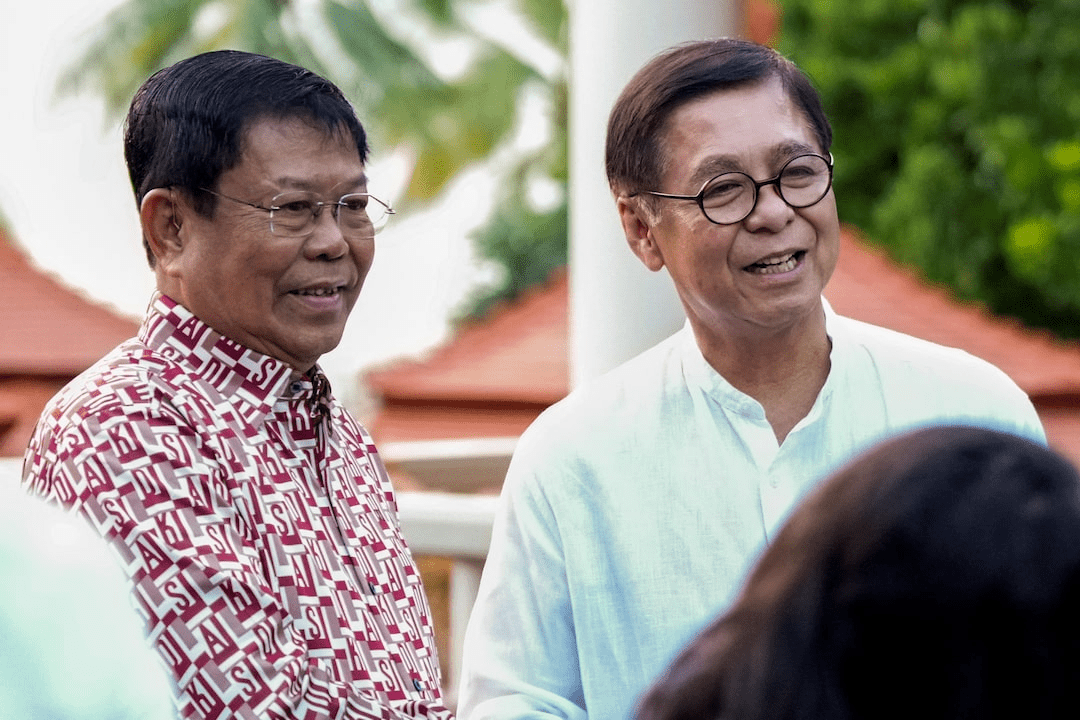
Thailand has positioned itself as Myanmar’s primary advocate for returning to ASEAN’s good graces, with its foreign minister meeting newly installed President Min Aung Hlaing on Wednesday to discuss the path back to a regional bloc that has kept the military leadership at arm’s length for four years.
Thai Foreign Minister Sihasak Phuangketkeow told reporters that Bangkok wanted to support Myanmar’s reintegration into the Association of Southeast Asian Nations — but was careful to attach conditions to that support. “For them to return to ASEAN, they must be able to proceed and respond to the concerns from ASEAN,” he said, threading the needle between Thailand’s longstanding policy of engagement with Naypyidaw and the bloc’s demands for genuine progress on peace.
Read also: Kenya Arraigns Local Ant Supplier Linked To Bangkok Seizure
The man Sihasak was meeting embodies the contradiction at the heart of that diplomacy. Min Aung Hlaing, 69, led the February 2021 coup that ended Myanmar’s decade of tentative democratic governance, ignited a civil war that has killed thousands and displaced millions, and prompted ASEAN to exclude the military leadership from its top-level summits. On April 3, he was chosen as president by a parliament dominated by an army-backed party following an election that Western governments and opposition groups dismissed as a choreographed exercise in legitimising military control under civilian packaging.
Few countries have formally recognised the new government. ASEAN as a bloc has not. Its leaders will gather next month in the Philippines, and the question of how to handle Myanmar’s status will hang over that summit as it has over every ASEAN gathering since 2021.
Read also: Myanmar’s Coup Leader Steps Down, Eyes Presidency
Thailand’s willingness to engage directly reflects both geography and calculation. The two countries share a long border, and the instability in Myanmar generates refugees, drug flows and armed group activity that spill into Thai territory regardless of Bangkok’s diplomatic posture. Engagement, in Bangkok’s view, is not endorsement — it is management of a problem that does not resolve itself through exclusion.
Sihasak welcomed Myanmar’s decision last week to grant amnesty to thousands of prisoners, a release that included ousted former President Win Myint and a modest sentence reduction for Nobel laureate Aung San Suu Kyi, who was the country’s de facto leader when the coup removed her from power. He framed the amnesty as a step in the right direction while making clear that steps were what he was looking for, not gestures. “We hope that these kinds of actions will take place more going forward, particularly the reduction of violence,” he said, adding that access for humanitarian organisations was the other immediate priority — how Myanmar could “open a space for ASEAN or international organisations to go in.”
In his inauguration address, Min Aung Hlaing said his priority was promoting peace and reconciliation and that he intended to normalise relations with ASEAN. This week he invited opposition armed groups to begin dialogue by the end of July. Two of the most significant rebel groups rejected the offer on Tuesday — a response that illustrated the distance between the new president’s stated intentions and the political reality of a civil war in which armed resistance to military rule has proven more durable and more capable than the generals anticipated when they seized power.
ASEAN’s Myanmar problem has no clean solution. The bloc operates on the principle of non-interference in members’ internal affairs, a doctrine that has made collective pressure on Naypyidaw both philosophically uncomfortable and practically limited. Some members have been openly critical of the military for treating ASEAN’s Five-Point Consensus peace plan as a public relations exercise rather than a genuine commitment. Others have prioritised maintaining communication channels. The result has been a bloc visibly frustrated but structurally constrained — able to exclude generals from photo opportunities at summits but unable to compel the behaviour changes that would justify readmitting them.
Thailand’s pitch is that it can serve as the bridge between those two positions — engaging enough to keep Myanmar talking, conditional enough to maintain ASEAN’s credibility on the peace process. Whether Min Aung Hlaing’s government, having just formalised its grip on power through an election most of the world declined to recognise, has any genuine incentive to make the concessions ASEAN is asking for is the question Bangkok’s diplomacy cannot answer on Myanmar’s behalf.